

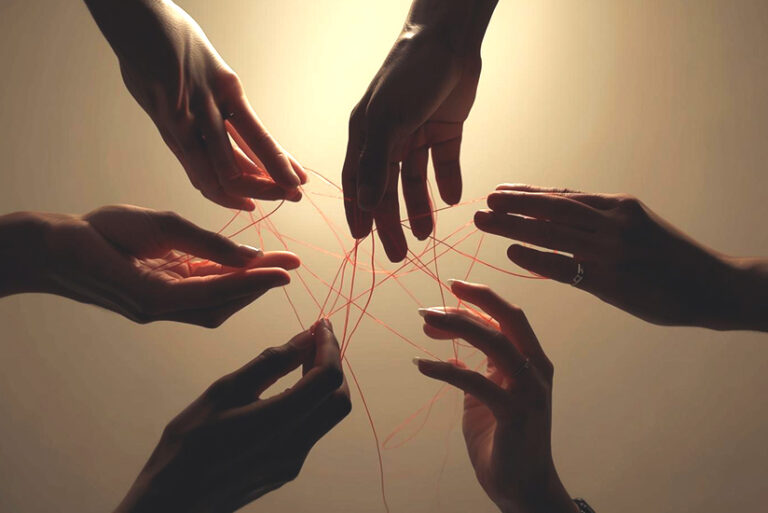
We grow up hearing tales of destiny—that an unseen red string ties us to the people meant to cross our path. Whether brief or lifelong, strangers and friends alike tug at the invisible threads that shape who we become.
By Felicity Santiago
The Red String Theory was an idea I often encountered as a teen—slipped into novels, whispered in poems, or dramatized in the movies I watched. The belief, originating in East Asia, is simple yet profound: an invisible red cord connects people who are destined to meet. The stories usually painted it as romance—a fated couple finding each other against all odds.
As a teenager, though, I used to scoff at it. It felt cheesy, another overused plot device. Maybe that’s why I grew sensitive to anything that smelled of control—whether an abstract force like fate or the rules imposed by people around me. Teachers dictated what not to do: don’t skip class, don’t break the rules, don’t group with your friends. At home, the same refrain: don’t waste time, don’t make mistakes. And though some rules were wise, others felt suffocating.
I wanted freedom. To make my own choices. To live by my own terms.
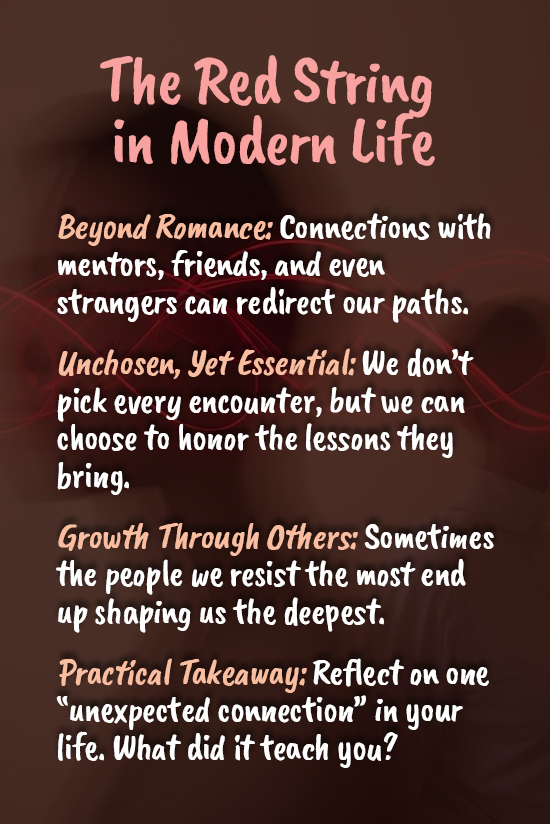
But when adulthood came, reality unfolded differently. Yes, I had freedom—but it wasn’t as simple as doing whatever I pleased. The paths I walked weren’t just mine to choose. People—friends, mentors, colleagues, even strangers—appeared along the way, each influencing me in ways I didn’t anticipate. Some shaped my outlook. Some challenged my values. Some left lessons I carry even now.
And that’s when I realized: maybe the Red String Theory isn’t about control. Maybe it’s about connection.
Fiction, I discovered, mirrors life more than we admit. In our personal story arcs, we encounter static characters, dynamic characters, and those whose brief presence changes our course forever. We don’t always choose them, but their impact lingers.
“Every connection, no matter how fleeting, is never without purpose.”
Looking back, I see how even fleeting encounters have molded me. A stranger’s kindness, a mentor’s hard truth, a friend’s betrayal—all became threads in my tapestry. Each connection, no matter how accidental, was never without purpose.
So maybe the Red String Theory is not a cheesy ideology after all. Maybe it’s a reminder that in a world where we crave control, some things are meant to unfold beyond our choosing. And in those unseen ties—whether fragile or unbreakable—we find not just fate, but meaning.