
By Dr. Tony Leachon
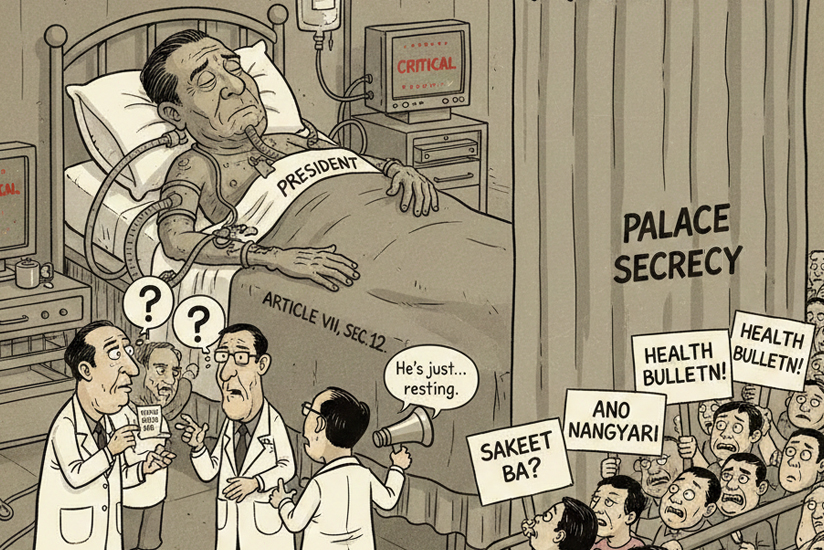
Illness is a deeply personal matter. For most of us, the Data Privacy Act protects our medical information, affirming the dignity of patient autonomy and confidentiality. Yet when the patient is the President, the Constitution itself reminds us that privacy must yield to public duty.
Article VII, Section 12 of the 1987 Philippine Constitution is clear: “In case of serious illness of the President, the public shall be informed of the state of his health.”
This mandate overrides the usual protections of privacy, not to diminish compassion for the leader, but to safeguard the nation. It is a recognition that the health of the head of state is inseparable from the health of the Republic.
This is not a call for intrusion, nor for sensationalism. It is a call for balance—for transparency that honors both the leader’s humanity and the people’s right to stability. To disclose illness is not to shame, but to serve. It is to say: I am human, but the nation must endure beyond me.
History offers lessons. Franklin Roosevelt concealed his paralysis and heart disease, believing strength was best shown in silence. François Mitterrand hid his cancer, leaving France to discover the truth only after his passing. Winston Churchill suffered a stroke in 1953, initially concealed from the public, raising questions about his fitness to govern. In contrast, Dwight Eisenhower disclosed his heart attack, choosing openness over secrecy, and in doing so, preserved trust in the office he held.
Closer to home, President Ferdinand Marcos Sr. suffered from lupus nephritis, a serious autoimmune disease that led to kidney failure and the need for dialysis. His condition was largely concealed during his presidency, even as it affected his capacity to govern.
The lack of transparency fueled speculation, weakened public trust, and contributed to political instability. It became a stark reminder that non‑disclosure can magnify uncertainty, erode confidence, and destabilize institutions.
The effects of these choices are profound. Transparency builds trust, ensures continuity, and prevents speculation. It allows institutions to prepare, the public to understand, and the leader to be seen with empathy rather than suspicion.
Non‑disclosure, on the other hand, breeds uncertainty, fuels rumors, and risks destabilizing governance. It can erode confidence not only in the leader but in the very institutions meant to protect the nation.
These stories remind us that disclosure is not weakness. It is courage. It is empathy—for the people who must prepare, for the institutions that must endure, and for the leader himself, who deserves compassion rather than speculation.
In our own journey as Filipinos, we must see illness not as scandal but as signal—a call to strengthen institutions, to prepare for continuity, and to remind ourselves that no leader is immortal, but the values of accountability and integrity must be.
True wealth is not measured in secrecy or power. It is found in honesty, in the discipline of disclosure, and in the humility to place the nation above oneself.
In illness, truth becomes service. And in service, even frailty can inspire strength. For a leader, the highest act of courage is not to hide weakness, but to face it with control, wisdom, and justice—transforming personal adversity into a beacon of moral clarity for the nation.
📚 References
• 1987 Philippine Constitution, Article VII, Section 12 – Mandates disclosure of the President’s serious illness.
• Franklin D. Roosevelt – Concealed paralysis and heart disease; secrecy criticized after his death.
• Dwight D. Eisenhower – Disclosed heart attack in 1955; transparency preserved public trust.
• Winston Churchill – Stroke in 1953 initially concealed; secrecy raised doubts about governance.
• François Mitterrand – Prostate cancer concealed for 14 years; disclosure only after death sparked scandal.
• Ferdinand Marcos Sr. – Suffered lupus nephritis leading to dialysis and kidney transplants; secrecy fueled speculation and instability.
#RelentlessForChange
#HealthWithHonor