
Why Every Student Should Learn CPR Before Graduation 

By the FAME Leaders Academy and H&L Advisory Board 

Imagine a teenager who witnesses a classmate collapse during sports practice. Imagine that same teenager confidently calling emergency services and starting chest compressions immediately. 

That scenario should not be exceptional. It should be normal. 

Teaching CPR in schools accomplishes three powerful goals: 

It Saves Lives 

Many cardiac arrests happen at home. A trained student may one day save a parent or grandparent. 

It Builds Confidence 

Learning CPR empowers young people with practical competence in crisis situations. 

It Creates Lifelong Habits 

Students trained early are more likely to refresh skills as adults. 

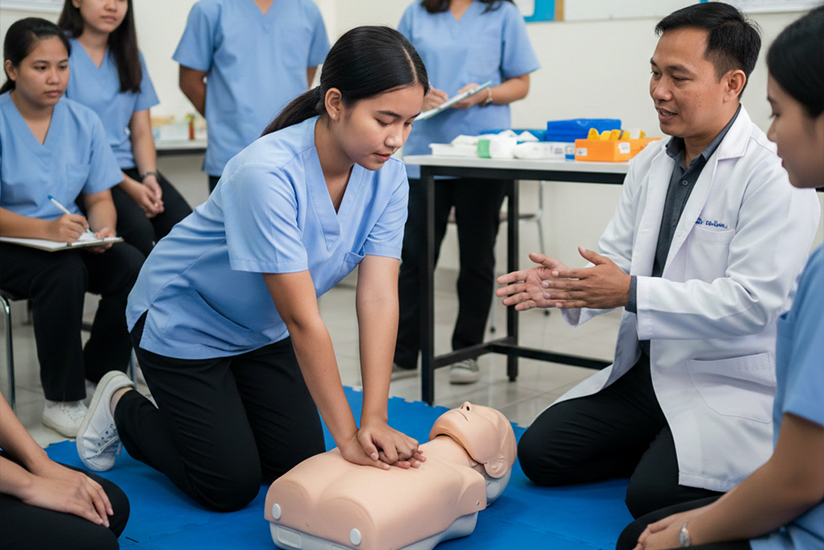
CPR training does not require complex equipment. In just one to two hours, students can learn: 

  • How to recognize cardiac arrest 
  • How to call emergency services 
  • How to perform hands-only CPR 
  • How to use an AED 

Incorporating CPR into physical education or health classes is feasible, cost-effective, and transformative. 

A CPR-trained generation is not only academically prepared — it is socially responsible and life-ready. 

Schools are not only centers of knowledge. They are centers of civic formation. 

Let us graduate students not only with diplomas — but with the power to save lives. 

Share this Article
Facebook
X
LinkedIn
WhatsApp
Email

More News

banner-copy5-copy-15
The Prayer He Could No Longer Carry
Some prayers are answered quickly. Others remain with us for months, even years, until the praying itself...
banner-copy5-copy-16
When Prevention Begins Before the Rain
Every rainy season, we Filipinos prepare almost instinctively. We check the weather forecast, bring out...
banner-copy5-copy-14
What’s in a name?: How to remember names
By Henrylito D. Tacio  “Your name is a golden bell hung in my heart. I would break my body...
banner-copy5-copy-12
Borrowed Time, Borrowed Future: Health Leadership Amid Fiscal Constraints
By Dr. Tony Leachon  The appointment of Dr. Edwin Mercado as Secretary of Health and Dr....
banner-copy5-copy-13
WHEN THE WATERS RISE, DISEASE FOLLOWS
Preventing Water-Borne and Flood-Related Infections During the Rainy Season For Filipinos, heavy rain...
banner-copy5-copy-11
The Failure of Health Governance: A Call for Competent Leadership
By Dr. Tony Leachon  The Department of Health (DOH) and PhilHealth, once envisioned as pillars...
banner-copy5-copy-10
The Door He Did Not Need to Open
We spend much of life trying to open doors—opportunities, answers, promotions, relationships, solutions....
banner-copy5-copy-9
Selective Justice Weakens the Nation
By Dr. Tony Leachon  The Ombudsman now holds the authority to determine whether Health Secretary...
banner-copy5-copy-8
Never give up: There is always hope
By Henrylito D. Tacio  “You may say I’m a dreamer, but I’m not the only one.  I hope...
banner-copy5-copy-6
Pax Silica: Primum Non Nocere
In medicine, the foundational directive is primum non nocere—first, do no harm. In public health and...