


here is a moment in every cardiac arrest when the outcome is still unwritten. It is the moment before the ambulance arrives. Before the hospital team mobilizes. Before the defibrillator shocks.
In that moment, survival depends not on a specialist — but on whoever is standing nearby.
As physicians, we see the consequences of delay. For every minute that passes without CPR, the chance of survival decreases significantly. Brain cells begin to suffer irreversible injury within minutes. Yet when bystanders start high-quality chest compressions immediately, survival rates can double or even triple.
That is not hyperbole. It is data.
Still, many hesitate. They fear doing harm. They fear doing it wrong. They fear legal consequences. But the greater harm is inaction.
Modern CPR guidelines for lay rescuers are intentionally simple: call emergency services, push hard and fast in the center of the chest, and use an AED as soon as it is available. You do not need to memorize complex algorithms. You do not need perfect technique. You need willingness.
The heart in cardiac arrest is not beating effectively. Blood is not circulating. Any attempt to manually pump blood through compressions is better than standing by.
I often tell patients and families this: CPR is not about perfection. It is about buying time. Buying time for oxygen to reach the brain. Buying time for defibrillation. Buying time for professional care to arrive.
In our country, where traffic congestion and geographic barriers can delay ambulance response, bystander CPR becomes even more critical. The first five minutes belong to the public. The first hands that touch the patient may determine whether that person will walk again, speak again, or see their loved ones again.
There is also a deeper truth here. Learning CPR is an act of love.
When you take a CPR course, you are preparing to protect not only strangers, but your spouse, your parent, your sibling, your child. Most cardiac arrests occur at home. The life you may one day save is likely someone you know.
As clinicians, we must advocate beyond prescriptions and procedures. We must encourage CPR training in schools, workplaces, churches, barangays, and sports clubs. We must normalize AED placement in public spaces. We must support dispatcher-assisted CPR programs that coach callers in real time.
Cardiac arrest is sudden. But preparedness does not have to be.
The question is not whether cardiac arrest will occur — it will, somewhere, today.
The question is whether someone nearby will know what to do.
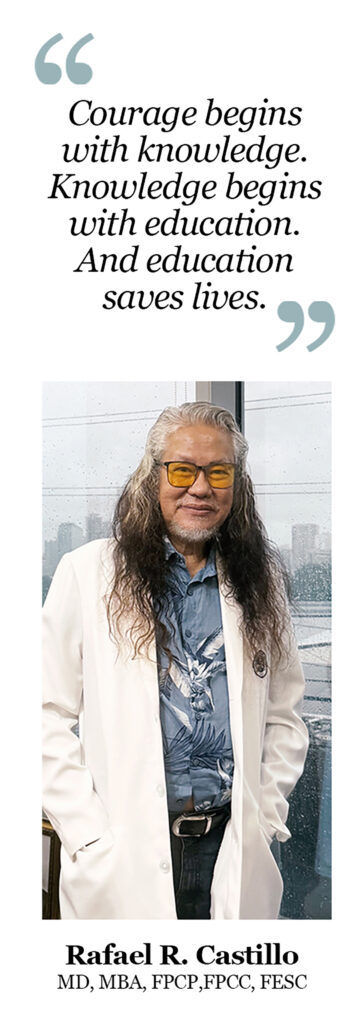
Courage begins with knowledge. Knowledge begins with education. And education saves lives.
If you ever find yourself facing that unwritten moment, remember this: Call. Push. Shock if advised.
And do not stop. Because sometimes, the difference between tragedy and survival is simply the courage to begin.
Bringing the Hospital to the People
In a country where geography and poverty often determine who lives and who suffers, healthcare must sometimes move—not wait.
H&L is proud to introduce Doctor HOW, the new column of Dr. Juan “Jim” Sanchez, founder of Hospital On Wheels. For nearly two decades, Dr. Sanchez and his team have traveled across underserved communities in the Philippines, delivering hospital-level medical and surgical care directly to those who would otherwise go without it.
In this column, Dr. Sanchez shares more than statistics. He brings us to the frontlines of compassion—into makeshift operating rooms, crowded gymnasiums turned clinics, and communities where hope arrives on wheels. Through real stories of patients and volunteers, Doctor HOW reminds us that healthcare is not merely a service—it is a moral responsibility.
At its heart, this column affirms a simple but powerful truth: when hospitals cannot reach the people, the people deserve a hospital that will reach them.
Welcome to Doctor HOW—where medicine meets mission, and healing goes the extra mile.