
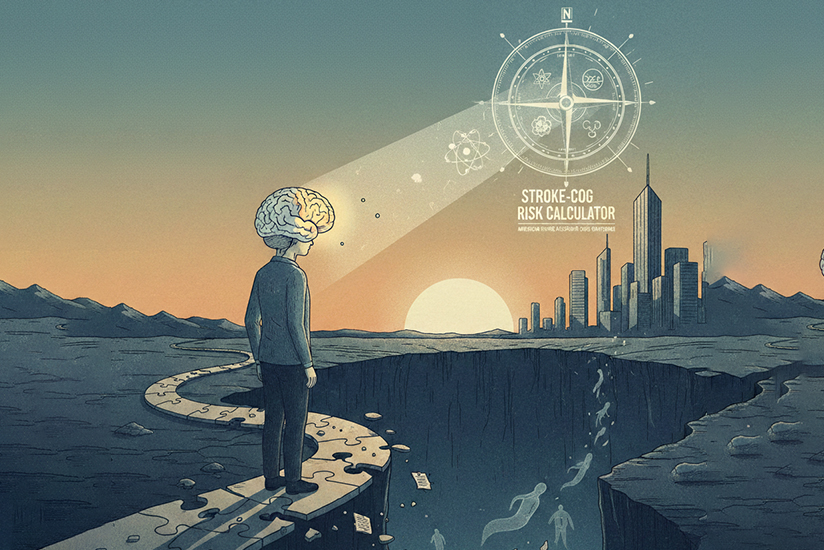
After surviving a stroke, the battle may not be over. A major new Canadian study presented at the American Stroke Association’s 2026 conference introduces a risk prediction tool that can identify stroke survivors most likely to develop dementia within a decade—raising urgent questions about long-term brain health, prevention, and life after stroke.
By Rafael R. Castillo, MD
A new risk prediction tool may help identify stroke survivors who are most likely to develop dementia within ten years of their stroke, according to a large Canadian study to be presented at the American Stroke Association’s International Stroke Conference 2026 in New Orleans.
The research, involving nearly 50,000 adults hospitalized for stroke or transient ischemic attack (TIA), suggests that dementia after stroke is both common and, to some extent, predictable—opening the door to better-designed prevention trials and earlier interventions.
A Growing But Under-Recognized Risk
Stroke survivors are known to face a higher risk of dementia, yet clinicians have lacked reliable tools to estimate who is most vulnerable. Previous studies suggest that about one in three adults may develop dementia in the long term after a stroke, making it more common than recurrent stroke over time.
To address this gap, researchers developed a bedside-friendly risk calculator that stratifies patients into five levels of dementia risk based on age, disability, stroke type, and other health factors.
“Our goal was to create a practical tool that can accurately predict dementia risk after stroke,” said Dr. Raed A. Joundi, lead author of the study and a stroke neurologist at McMaster University in Canada. “The predicted dementia rates closely matched what we actually observed over time.”
Who Is at Highest Risk?
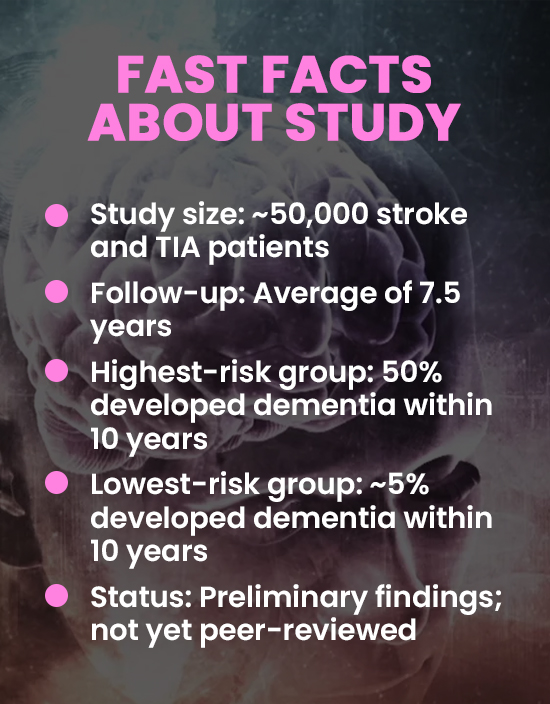
The analysis drew on data from the Ontario Stroke Registry, covering stroke admissions from 2002 to 2013, with follow-up extending to 2024. Participants had no dementia diagnosis at hospital discharge and were followed for an average of 7.5 years.
Key factors linked to a higher likelihood of developing dementia included:
• Older age
• Diabetes
• Depression
• Cognitive symptoms during hospitalization, such as memory or attention problems
• Greater disability before or after stroke
• Intracerebral hemorrhage, which carried a higher risk than ischemic stroke
• Female sex, among patients with stroke
Using these variables, the tool estimated dementia risk at 1, 5, and 10 years after stroke. Patients in the highest risk category had a 50% chance of developing dementia within 10 years, compared with about 5% among those in the lowest risk group.
A Research Tool—for Now
Importantly, the study authors stress that the calculator is not yet intended for routine clinical decision-making.
“The main purpose is to identify high-risk patients for research studies and clinical trials focused on dementia prevention,” Joundi explained. “This could help accelerate the development of effective interventions.”
Independent experts welcomed the findings. Dr. Deborah A. Levine, a neurologist at the University of Michigan who was not involved in the study, called the work “a valuable step toward speeding up dementia research for stroke survivors.”
Clinical Implications
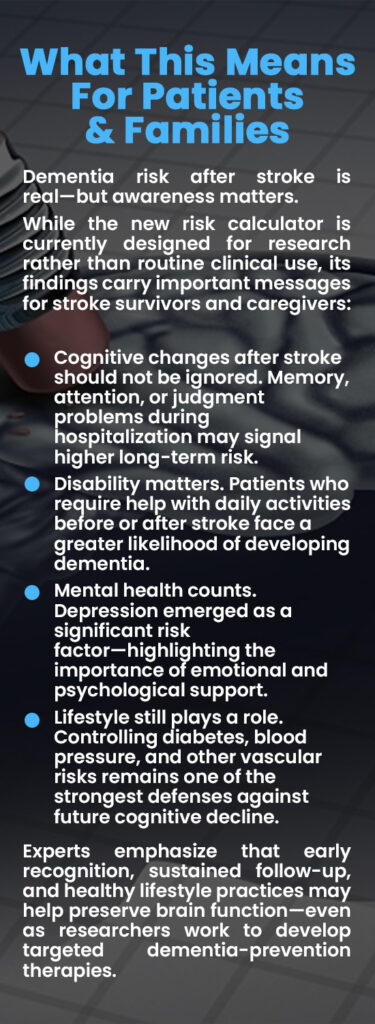
Dementia following stroke is devastating for patients and families, yet effective treatments remain limited. While controlling vascular risk factors—such as blood pressure, blood sugar, and lifestyle habits—can help reduce risk, targeted therapies are still urgently needed.
“This study reminds us that preventing dementia deserves as much attention as preventing recurrent stroke,” Joundi said.

Important Caveats
The findings are preliminary and based on a research abstract presented at a scientific meeting. The study has not yet been peer-reviewed, and researchers lacked imaging data that could clarify stroke size, location, or specific dementia subtypes.
Still, experts agree that the work provides a promising framework for future studies—and a clearer warning that cognitive decline is a major long-term consequence of stroke that can no longer be overlooked.
“Over the long term, dementia is more common than a recurrent stroke—and we need to pay much more attention to preventing it.”
— Raed A. Joundi, MD, DPhil, Lead Study Author