

By H&L Editorial Team
For many Filipino families, a cancer diagnosis brings not only fear and uncertainty, but also the crushing weight of medical expenses. Chemotherapy sessions, laboratory tests, biopsies, and medicines can quickly overwhelm household finances. Recognizing this reality, the Philippine government has been quietly expanding a key program designed to lighten that burden.
The Department of Health (DOH) recently announced that the number of Cancer Assistance Fund (CAF) Access Sites nationwide has increased from 34 to 36, bringing financial assistance closer to patients who urgently need support.
The two newest access sites are:
• Oriental Mindoro Provincial Hospital (Region IV-B)
• Democrito O. Plaza Memorial Provincial Hospital in Agusan del Sur (Region XIII)
The expansion means that more cancer patients, survivors, and individuals identified as high risk can access government assistance for diagnostic procedures, treatment, and other cancer-related medical needs without having to travel long distances to major urban centers.
A Lifeline for Cancer Patients
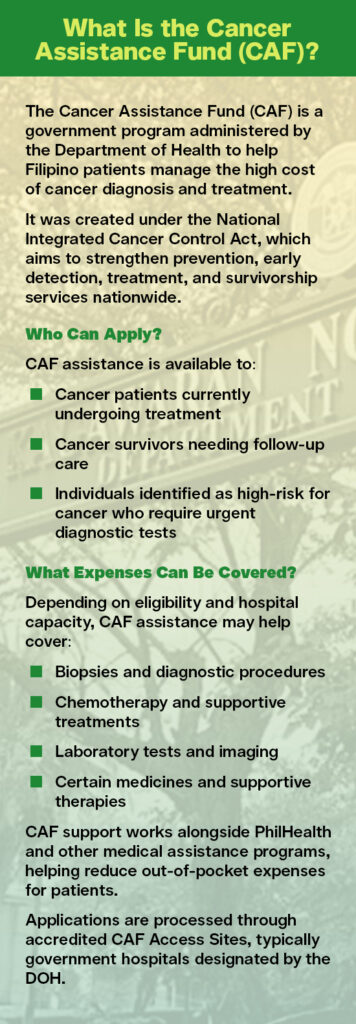
The Cancer Assistance Fund is part of the government’s broader implementation of the National Integrated Cancer Control Act (NICCA), a landmark law aimed at strengthening cancer prevention, screening, treatment, and survivorship programs across the country.
Through CAF access sites located in selected hospitals, eligible patients may receive financial assistance for services such as:
• Cancer diagnostic tests
• Chemotherapy and treatment support
• Laboratory monitoring
• Certain supportive medications and procedures
By decentralizing access points, the program seeks to reduce delays in diagnosis and treatment — a crucial factor in improving survival outcomes.
Health officials emphasize that the expansion reflects the administration’s commitment to strengthening medical support for Filipinos battling cancer.
According to the DOH, the expansion aligns with the directive of Ferdinand R. Marcos Jr. to reinforce government assistance programs that support patients with life-threatening illnesses.
Bringing Cancer Care Closer to Communities
For patients living in remote provinces, access to cancer care has long been a challenge. Many have had to travel to Metro Manila or other major cities for diagnostic tests and treatments — journeys that are costly, exhausting, and sometimes impossible.
By expanding CAF access sites in provincial hospitals, the government hopes to bridge this gap.
Oriental Mindoro Provincial Hospital, for example, now becomes a vital referral center for patients in the MIMAROPA region, while the addition of Democrito O. Plaza Memorial Provincial Hospital strengthens coverage in Caraga.
Health advocates say the geographic expansion is particularly important in a country where cancer incidence continues to rise, driven by population aging, lifestyle risk factors, and improved detection.
The Financial Reality of Cancer
Cancer treatment costs can be staggering. Even with PhilHealth coverage and other support mechanisms, many Filipino families still face significant out-of-pocket expenses.
Programs such as the Cancer Assistance Fund aim to serve as a financial safety net, complementing other government initiatives including:
• PhilHealth benefit packages
• Medical Assistance for Indigent Patients (MAIP)
• Expanded screening and prevention programs
Public health experts note that improving access to financial assistance is as important as expanding treatment facilities themselves.
“Financial toxicity is a real part of the cancer journey,” says one oncologist involved in community outreach programs. “When patients delay treatment because they cannot afford it, outcomes suffer.”
Accessing the Cancer Assistance Fund
Patients and caregivers can find the full list of the 36 CAF Access Sites nationwide through the DOH website and official platforms.
The DOH has also provided a QR code and online directory containing updated contact numbers of accredited hospitals participating in the program.
These access points serve as gateways where patients can inquire about eligibility requirements, documentation, and available assistance.
Toward a More Equitable Cancer Care System
While the expansion from 34 to 36 CAF access sites may appear incremental, health policy observers say it represents a broader effort to build a more equitable national cancer care network.
As the National Integrated Cancer Control Act continues to be implemented, further expansions of screening programs, treatment facilities, and survivorship support are expected in the coming years.
For thousands of Filipino families facing the daunting reality of cancer, even one additional access point can mean the difference between delayed treatment and timely care.
And sometimes, that difference can save a life.