


For decades, body mass index (BMI) has been the standard measure of health and weight. But emerging research suggests that what truly matters may not be how heavy we are — but where we carry that weight. A new study presented at the American Heart Association (AHA) 2026 Lifestyle Scientific Sessions, held on March 17-20 in Boston, Massachusetts, reveals that excess fat around the waist, or “belly fat,” is a stronger predictor of heart failure than BMI. In the Philippines, where central obesity is increasingly common even among individuals who appear to have “normal weight,” this finding carries urgent public health implications.
By Rafael R. Castillo, MD
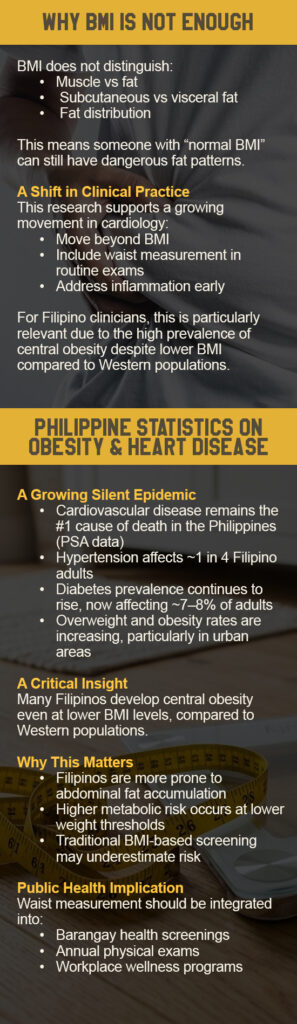
Many Filipinos proudly say, “Hindi naman ako mataba” — not overweight — based on body weight alone. Yet a growing number have central obesity, where fat accumulates around the abdomen.
This type of fat, called visceral fat, is metabolically active and harmful. Unlike fat under the skin, it surrounds vital organs and releases inflammatory substances into the bloodstream.
The recent AHA-presented study, which is still unpublished, showed:
- Waist size predicted heart failure risk better than BMI
- Individuals with normal BMI but large waistlines still had elevated risk
- Inflammation explained up to one-third of this increased risk
In short: you can look “normal” and still be at high risk.
Why Belly Fat Is Dangerous

Visceral fat is not just stored energy — it behaves like an endocrine organ.
It releases:
- Inflammatory cytokines
- Hormones that disrupt metabolism
- Substances that damage blood vessels
Over time, this leads to:
· Chronic inflammation
· Insulin resistance

· Increased blood pressure
· Structural changes in the heart
These processes gradually weaken the heart muscle, eventually leading to heart failure.
The Filipino Reality: ‘Skinny Fat’
In clinical practice across the Philippines, a common pattern is emerging:
A patient with:

- Normal or slightly elevated weight
- Visible abdominal fat (“tiyan”)
- Sedentary lifestyle
- High-carbohydrate diet
This phenotype — sometimes called “skinny fat” — is increasingly associated with metabolic disease.
Why This Happens Locally
Several cultural and lifestyle factors contribute:
· High rice consumption with low fiber intake
· Processed and fatty foods
· Sedentary work (office-based, BPO, remote work)
· Poor sleep patterns
· Chronic stress
Even without obvious obesity, these factors promote visceral fat accumulation.
The Role of Inflammation
The study highlighted a critical insight: inflammation is the bridge between belly fat and heart failure.
Inflammation:
- Damages blood vessels
- Promotes plaque formation
- Weakens heart muscle
- Leads to fibrosis (scarring)
Even individuals with normal cholesterol can develop heart disease if inflammation is high.
Prevention: Target the Waistline, Not Just the Weight
1. Eat smarter, not just less
Focus on:
- High-fiber foods (vegetables, fruits, legumes)
- Whole grains instead of refined carbohydrates
- Lean protein sources
Reduce:
- Sugary drinks
- Processed foods
- Excess rice portions
2. Move daily
At least 150 minutes per week of moderate activity:

- Brisk walking
- Cycling
- Household chores
Even short daily movement reduces visceral fat.
3. Sleep and stress matter
Poor sleep and chronic stress increase cortisol, which promotes abdominal fat storage.
Aim for 6–8 hours sleep
Practice stress management (prayer, reflection, exercise)
4. Monitor more than weight
Ask your doctor about:
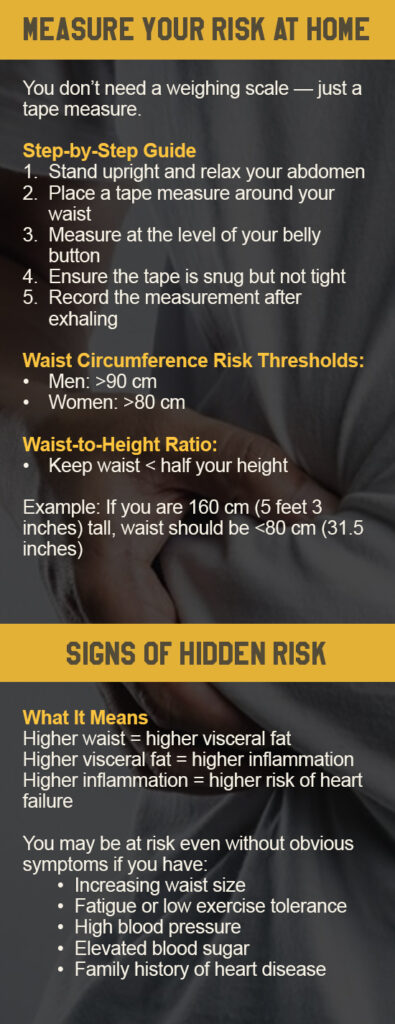
- Waist circumference
- Blood sugar
- Lipid profile
- Inflammatory markers (e.g., hs-CRP)
Looking Ahead: A Public Health Opportunity
The implications are clear:
- Screening must include waist measurement
- Public education should emphasize abdominal fat
- Prevention strategies must target lifestyle early
The Philippines faces a rising burden of heart disease. Recognizing central obesity as a major driver offers an opportunity to intervene before irreversible damage occurs.
Final Message
Heart failure does not begin suddenly. It develops silently over years, often fueled by invisible risk factors.
A growing waistline may be one of the earliest warnings.
The challenge — and opportunity — is to act before symptoms appear.
Because in heart health, what we cannot see may matter the most.
“It’s not just how much fat you have — it’s where you carry it. A growing waistline may be a silent warning sign for heart failure.”
CME Brief for Physicians
Central Adiposity, Inflammation, and Heart Failure Risk
Learning Objectives
1. Recognize central obesity as an independent risk factor
2. Understand inflammatory pathways linking visceral fat to HF
3. Incorporate waist metrics into routine assessment
4. Apply preventive strategies in high-risk populations
Key Study Insights (AHA 2026)
- Waist circumference outperformed BMI in predicting heart failure
- Normal BMI does not exclude risk if central adiposity is present
- Inflammation mediates ~25–33% of the association
- hs-CRP remains a useful clinical marker
Pathophysiologic Mechanisms
Visceral fat contributes to:
Chronic low-grade inflammation
Endothelial dysfunction
Insulin resistance
Myocardial fibrosis
Neurohormonal activation
Clinical Implications
Risk Assessment
Include:
- Waist circumference
- Waist-to-height ratio
- hs-CRP (optional)
- Metabolic panel
Patient Phenotype to Watch
“Normal BMI + high waist circumference”
→ High-risk subgroup often missed
Management Approach
Lifestyle modification (diet, exercise)
Weight redistribution focus (not just weight loss)
Control of comorbidities (HTN, DM)
Consider anti-inflammatory strategies (emerging evidence)
Practical Recommendations
- Measure waist routinely in clinic
- Educate patients on “hidden obesity”
- Integrate central adiposity into risk scoring
- Advocate early intervention
Future Directions
- Incorporation into PREVENT-HF models
- Anti-inflammatory therapeutic trials
- Population-specific thresholds (Asian cohorts)
Final Reflection
This emerging evidence reframes how we approach cardiovascular risk — especially in populations like ours.
The challenge now is translation: From research → to clinic → to community.
Because in many Filipinos, the first sign of risk is not on the scale —
it is around the waist.
References
- Chen S-H, et al. Central adiposity, inflammation, and incident heart failure: Findings from a community-based cohort. Presented at: American Heart Association EPI|Lifestyle Scientific Sessions 2026; Boston, MA. (Abstract; preliminary data).
- Khan SS, et al. Risk-based primary prevention of heart failure: A scientific statement from the American Heart Association. Circulation. 2025;151:eXXX–eXXX. doi:10.1161/CIR.000000000000XXXX
- Powell-Wiley TM, et al. Obesity and cardiovascular disease: A scientific statement from the American Heart Association. Circulation. 2021;143(21):e984–e1010. doi:10.1161/CIR.0000000000000973
- Neeland IJ, et al. Visceral and ectopic fat, atherosclerosis, and cardiometabolic disease: A position statement. Lancet Diabetes Endocrinol. 2019;7(9):715–725. doi:10.1016/S2213-8587(19)30084-1
- Piché ME, et al. Visceral adiposity and cardiometabolic risk: A review. Can J Cardiol. 2018;34(4):377–384. doi:10.1016/j.cjca.2017.12.023
- Lavie CJ, et al. Obesity and heart failure: Epidemiology, pathophysiology, clinical manifestations, and management. J Am Coll Cardiol. 2017;70(15):1911–1924. doi:10.1016/j.jacc.2017.09.002
- Ridker PM. From C-reactive protein to interleukin-6 to interleukin-1: Moving upstream to identify novel targets for atheroprotection. Circ Res. 2016;118(1):145–156. doi:10.1161/CIRCRESAHA.115.306656
- Kahn SE, et al. Mechanisms linking obesity to insulin resistance and cardiovascular disease. Nature. 2006;444(7121):840–846. doi:10.1038/nature05482
- World Health Organization. Waist circumference and waist–hip ratio: Report of a WHO expert consultation. Geneva: WHO; 2011.
- World Health Organization. Obesity and overweight. WHO Fact Sheet; updated 2024.
https://www.who.int/news-room/fact-sheets/detail/obesity-and-overweight - Philippine Statistics Authority. Leading causes of death in the Philippines, latest available data (2023–2024).
- Department of Health (Philippines). National Nutrition Survey and Noncommunicable Disease reports; latest editions.
- International Diabetes Federation. IDF Diabetes Atlas, 10th ed. Brussels: IDF; 2021.
- Lear SA, et al. The use of waist circumference and waist-to-height ratio in identifying cardiovascular risk. Am J Clin Nutr. 2010;92(4):841–846. doi:10.3945/ajcn.2010.29474
- Yusuf S, et al. Obesity and the risk of myocardial infarction in 27,000 participants from 52 countries. Lancet. 2005;366(9497):1640–1649. doi:10.1016/S0140-6736(05)67663-5