

The Belly That Speaks Before the Heart Fails

In the clinic, we often rely on numbers — weight, BMI, cholesterol levels — to assess cardiovascular risk. But increasingly, one of the most important indicators is something far simpler: the waistline.

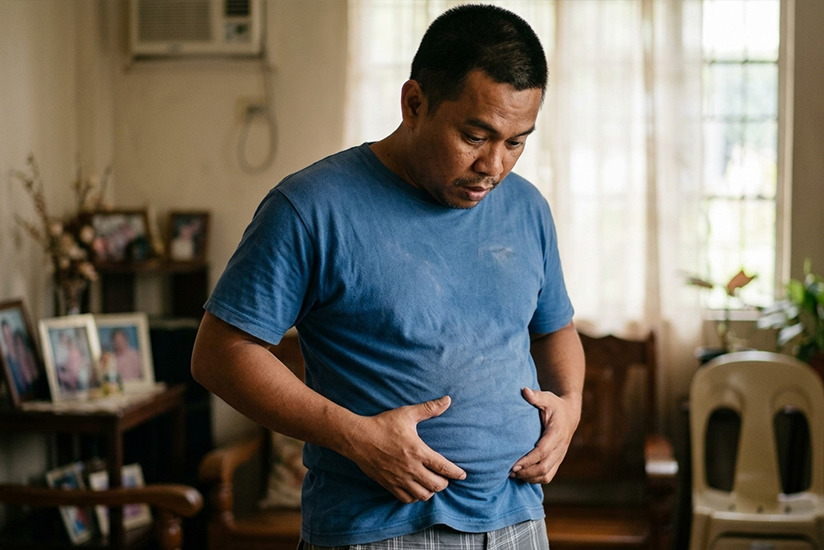
Many patients come in reassured. “Normal naman ang timbang ko, Doc.” And yet, as they sit down, one detail stands out — a prominent abdomen. This is not merely a cosmetic concern. It is a clinical signal.

Visceral fat, the type of fat that accumulates around the abdominal organs, behaves differently from other fat. It actively releases inflammatory substances that damage blood vessels, disrupt metabolism, and gradually weaken the heart muscle. Over time, this silent process may culminate in heart failure.

What makes this especially concerning in the Philippine setting is the prevalence of individuals who are not visibly obese but carry excess abdominal fat — the so-called “payat pero may tiyan.” These patients often fall through the cracks of traditional screening because their BMI appears acceptable.

The emerging evidence reminds us that cardiovascular prevention must evolve. Measuring waist circumference should become as routine as checking blood pressure. Counseling should go beyond weight loss to emphasize fat distribution, diet quality, and inflammation control.

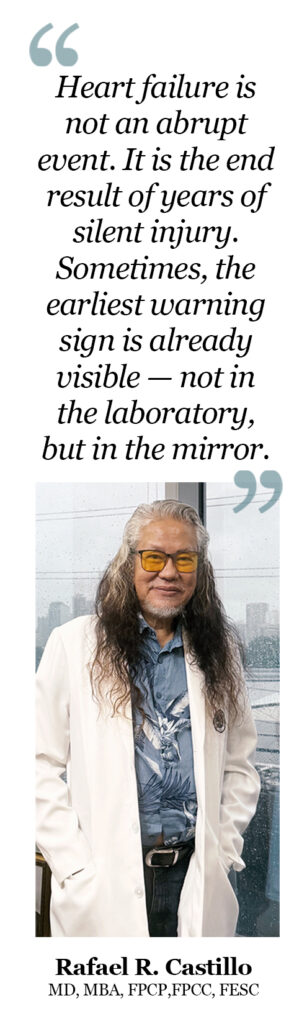
Heart failure is not an abrupt event. It is the end result of years of silent injury.

Sometimes, the earliest warning sign is already visible — not in the laboratory, but in the mirror.


Share this Article
Facebook
X
LinkedIn
WhatsApp
Email

More News

banner-copy5-15
The People’s Right to Know the President’s Health Constitutional Foundation
By Dr. Tony Leachon  The 1987 Philippine Constitution enshrines transparency in governance....
banner-copy4-copy-35
Kindness: That small, intentional act of compassion
By Henrylito D. Tacio  “Three things in human life are important: the first is to be kind;...
banner-copy4-copy-33
Salt, Sugar, and Survival: The Filipino Diet Problem
What we eat daily is quietly shaping our future health The Filipino diet is rich in memory, comfort,...
banner-copy5-14
The Message He Didn’t Send
In a world where responses are expected instantly and silence can be misread, we often feel compelled...
banner-copy5-12
The Middle Class as the New Poor in the Philippines
By Dr. Tony Leachon  The middle class—long considered the backbone of our economy—is increasingly...
banner-copy4-copy-32
Prayer: A personal conversation with God
By Henrylito D. Tacio  “True prayer is neither a mere mental exercise nor a vocal performance....
banner-copy6-5
Navigating Rising Drug Costs Amid Global Uncertainty
By Dr. Tony Leachon  The Philippines is entering a period of heightened vulnerability in...
banner-copy6-4
Becoming the numbers in our lives
By Eugene F. Ramos, MD What becomes of us as the years pass? Do we become what we always wanted,...
banner-copy5-10
Polypharmacy: When Too Many Medicines Harm
Why the pills meant to heal may sometimes make us sick In modern medicine, prescriptions have become...
banner-copy4-copy-28
When Treatment Becomes Too Much
In medicine, we are trained to act—to diagnose, to treat, to prescribe. Every symptom calls for a response,...