
By Rafael R. Castillo, MD
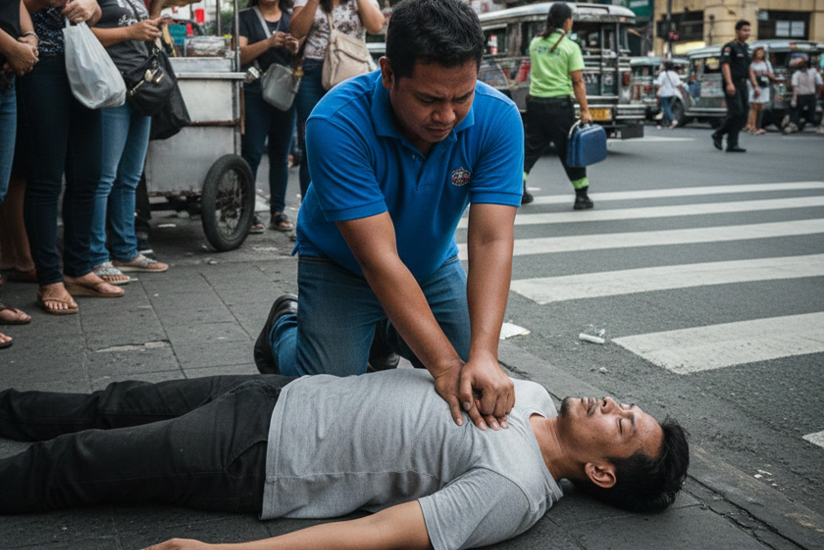
Cardiac arrest can happen anywhere—at home, in a mall, during a basketball game, or in traffic. When it happens, every minute without CPR drastically lowers the chance of survival. The most powerful “first responder” is often not a doctor—it’s an ordinary bystander who knows basic CPR and is willing to act. This guide explains what to do, step-by-step, how to use an AED, what changes for children, and what policies the Philippines should prioritize to make CPR truly nationwide.
The key idea: CPR buys time
When the heart stops, oxygen stops reaching the brain and organs. CPR (cardiopulmonary resuscitation) keeps blood moving until an AED (defibrillator) or professional help arrives. High-quality CPR is defined by rate, depth, full recoil, and minimal interruptions.
Step-by-step CPR for laypeople (Adults and teens)
Step 1: Check safety and responsiveness
- Make sure the area is safe (traffic, electricity, fire, violence).
- Tap the person and shout: “Are you okay?”
Step 2: Call for help immediately
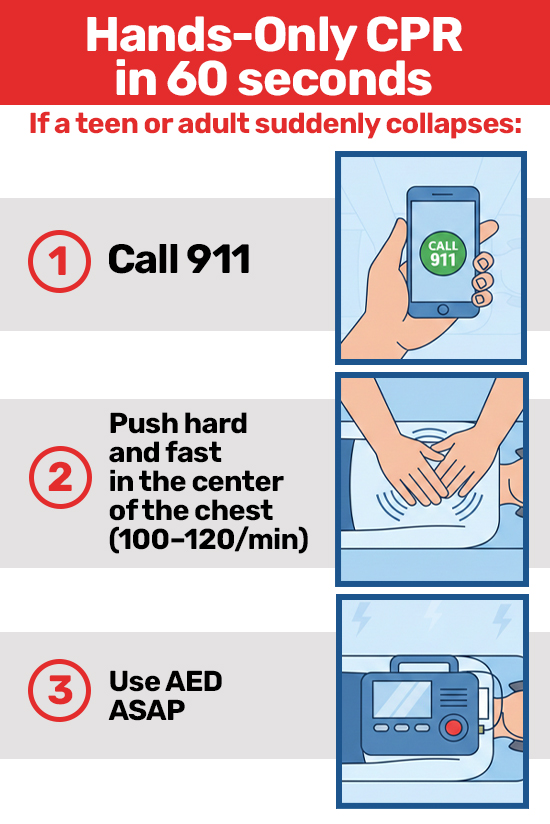
- Call 911 or similar hotlines in the Philippines for emergency response.
- If someone is with you: point to a specific person—“Ikaw, tumawag ng 911. Ikaw, kumuha ng AED.”
(Many communities also use local ambulance hotlines; the Philippine Red Cross publicizes emergency support through hotlines such as “143” in some materials, depending on location and availability.)
Step 3: Check breathing (no more than 10 seconds)
If the person is not breathing or is only gasping (agonal gasps), treat it as cardiac arrest and start CPR.
Step 4: Start chest compressions (Hands-Only CPR)
- Place the heel of one hand in the center of the chest (lower half of the breastbone), other hand on top.
- Lock your elbows, shoulders over hands.
- Push hard and fast:
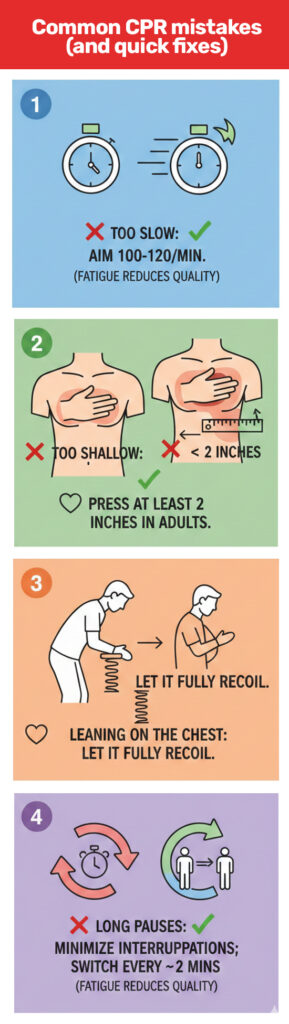
- Rate: 100–120 compressions/min
- Depth: at least 2 inches (5 cm) for the average adult, avoiding excessive depth (>2.4 inches / 6 cm)
- Let the chest fully recoil after each push.
- Minimize pauses—every pause drops blood flow.
Tip: If you know the Bee Gees song “Stayin’ Alive,” its beat helps you keep the right pace.
Step 5: Use an AED as soon as it arrives
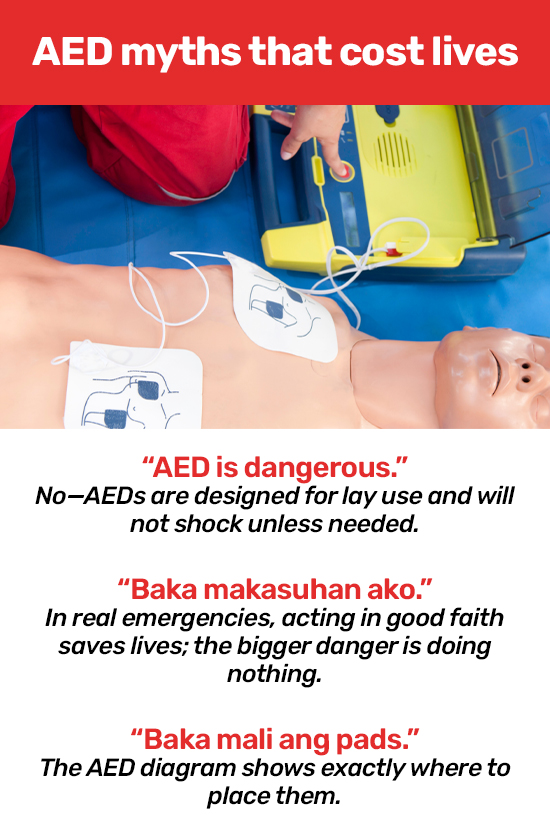
- Turn it on and follow voice prompts.
- Expose the chest, apply pads exactly as shown.
- Clear everyone before shock is delivered.
- Resume compressions immediately after shock or “no shock advised.”
Step 6: Continue until:
- The person wakes up, breathes normally, or moves,
- A trained team takes over,
- You are too exhausted and another rescuer cannot continue.
What about rescue breaths?
For most untrained bystanders, Hands-Only CPR is recommended for adult sudden collapse. If you are trained and willing, conventional CPR uses 30 compressions : 2 breaths.
If the victim has a pulse but is not breathing normally, trained rescuers may give 1 breath every 6 seconds (10/min).
Children and infants: when breaths matter more
Children often arrest from asphyxia (respiratory failure) rather than sudden rhythm problems. That’s why breaths are especially important in pediatric CPR, if you are trained.
Simplified rule for lay rescuers:
- If you can do breaths: do CPR with breaths for children/infants.
- If you cannot: do chest compressions anyway—something is better than nothing.
How to recognize cardiac arrest vs fainting
Cardiac arrest signs:
- Unresponsive
- Not breathing normally (or gasping)
- No normal movement
Fainting usually:
- Person is breathing normally and becomes responsive within seconds to a minute
If unsure—treat as arrest and start CPR. The risk of harm from CPR in someone not in arrest is generally outweighed by the benefit of acting fast when it is arrest.
Special situations (brief but important)
Choking (adult)
If the person can cough or speak: encourage coughing.
If unable to breathe/speak: call for help and perform abdominal thrusts (trained first aid). If they collapse, start CPR and use AED.
Drowning
Start CPR and include rescue breaths if trained; drowning is primarily oxygen deprivation.

Policy statement: What the Philippines should do now
If we want more Filipinos to survive sudden collapse, CPR must become a national habit, not a niche skill.
1) CPR training as a standard life skill
- Integrate CPR/AED training into high school and college curricula.
- Require regular CPR refreshers in workplaces with high foot traffic (malls, transport hubs, factories, schools).
2) Public-access AEDs where cardiac arrest actually happens
- AEDs should be mandated and maintained in:
- malls, airports, stations
- sports venues
- large offices and schools
- barangay halls in dense areas
- AED readiness must include signage, battery/pad replacement, and staff drills.
3) Dispatcher-assisted CPR and AED retrieval
International guidance increasingly emphasizes dispatchers coaching callers to start CPR and retrieve an AED quickly. This is one of the fastest ways to raise bystander CPR rates.
4) Strengthen emergency access and public trust in “one number”
The move toward a unified 911 system is crucial; public education should ensure people know the number, trust it, and use it early.
Bottom line: A CPR-ready Philippines is a safer Philippines—because the first 5 minutes belong to the public.
Closing message
CPR is not about perfection. It’s about starting. If you remember only one thing: Call 911, push hard and fast, use an AED as soon as possible.
“You don’t have to be a doctor to save a life—you just have to start.”
References
- American Heart Association. What is CPR? Hands-Only and conventional CPR basics; adult compression rate 100–120/min and depth at least 2 inches, avoid >2.4 inches.
- American Heart Association. 2025 AHA Guidelines for CPR and ECC (professional update and guideline hub).
- Kleinman ME, et al. Part 7: Adult Basic Life Support: 2025 AHA Guidelines. Circulation. 2025.
- International Liaison Committee on Resuscitation (ILCOR). Executive Summary: 2025 CoSTR (dispatcher-assisted AED retrieval and CPR).
- Bray JE, et al. Basic Life Support: 2025 ILCOR Consensus. Resuscitation. 2025 (full-text summary available).
- DILG. Unified 911 to launch nationwide (public emergency access).
- Philippine Red Cross. Emergency Medical Services (hotlines and EMS response information).