
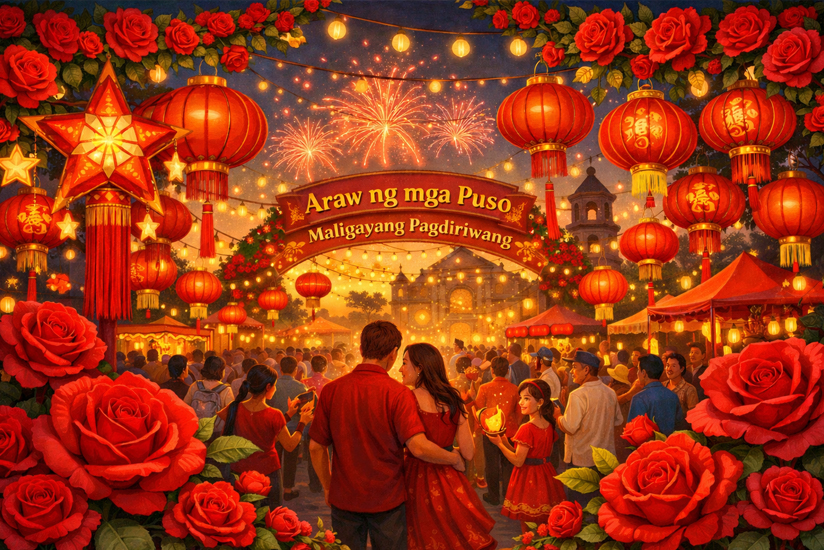
From Lunar New Year festivities to Valentine’s Day traditions, February in the Philippines becomes a vibrant celebration of love, prosperity, and togetherness—reflecting the warmth and resilience of the Filipino spirit.
By Marth Mora
February in the Philippines feels like a season all its own—a time when traditions of the heart and hopes for a brighter year overlap, creating a stretch of days that feels both festive and meaningful.
We are, after all, a people who love to celebrate. From town fiestas to binyag and weddings, Filipinos know how to turn special moments into warm, personal gatherings. This month, two celebrations sit side by side on the calendar—Chinese New Year and Valentine’s Day—offering different but complementary ways to honor what matters most: family, love, and good fortune.
For many Filipinos, Valentine’s Day is familiar territory. On February 14, affection is expressed not only through romantic gestures, but through simple, thoughtful acts of appreciation—sharing chocolates with classmates, surprising a friend with a handwritten note, or spending time with someone who matters. Here, Valentine’s Day isn’t just for couples. It’s an invitation to recognize love in its many forms: friendship, family, gratitude, and kindness.
Just before that, another celebration fills the streets with color and energy: Chinese New Year, also known as Lunar New Year. While not all Filipinos come from Filipino-Chinese (Tsinoy) families, many have grown up seeing its traditions year after year—especially in places like Binondo, Cebu, and Davao, where lion dances, red lanterns, and ang pao (red envelopes) have become part of February’s rhythm.
Chinese New Year is a celebration of renewal, good luck, and family unity. Falling sometime between late January and mid-February, it is marked by preparations that begin well in advance. Homes are cleaned to sweep away bad luck, and tables are filled with symbolic food: tikoy (sticky rice cake) for togetherness, long noodles for longevity, and whole fish for abundance.
Soon, greetings of gong xi fa cai (Mandarin) or kung hei fat choi (Cantonese) echo through shopping districts dressed in red and gold, as lion and dragon dances wind through streets and plazas. Even non-Chinese Filipinos often join in—drawn by the colors, the movement, and the sense of shared celebration.
What binds Valentine’s Day and Chinese New Year together is something deeply Filipino: our love for togetherness. Whether it’s sharing a heart-shaped box of chocolates, saying “I love you” over dinner, gathering for a reunion feast, or watching a lion dance in Binondo, these moments aren’t measured by how grand they are—but by shared joy and connection.
Unlike holidays that sometimes feel overly scripted or commercial, this pairing of celebrations highlights two cultural truths we hold dear:
Family and community come first. Chinese New Year’s reunion dinners echo the same values we place on Noche Buena and Christmas gatherings—moments when everyone comes home, no matter how far they’ve gone.
Love is bigger than romance. In the Philippines, Valentine’s Day has evolved to include all kinds of affection—platonic, familial, and romantic—reminding us that love is both a feeling and something we practice every day.
Together, these celebrations turn February into a season of color and warmth. One moment, we’re wishing for prosperity and luck; the next, we’re celebrating companionship and gratitude. One looks forward to renewal and hope for the year ahead; the other reminds us to cherish the people already in our lives.
In a world that often pushes single stories and singular themes, this dual celebration feels refreshingly whole. It invites us to honor beginnings and connections—intergenerational, relational, cultural—without choosing one tradition over the other.
Because in the Filipino spirit, joy is meant to be shared, traditions are meant to be lived, and every reason to gather is another chance to say, “Mabuhay!”
“In a season of festivals, we celebrate not just one thing—but family, love, community, and hope for a year full of both.”
Takeaway:
This February, let’s enjoy every celebration that brings us closer—whether under red lanterns or over shared sweets—and appreciate how our traditions continue to enrich the Filipino way of life.