
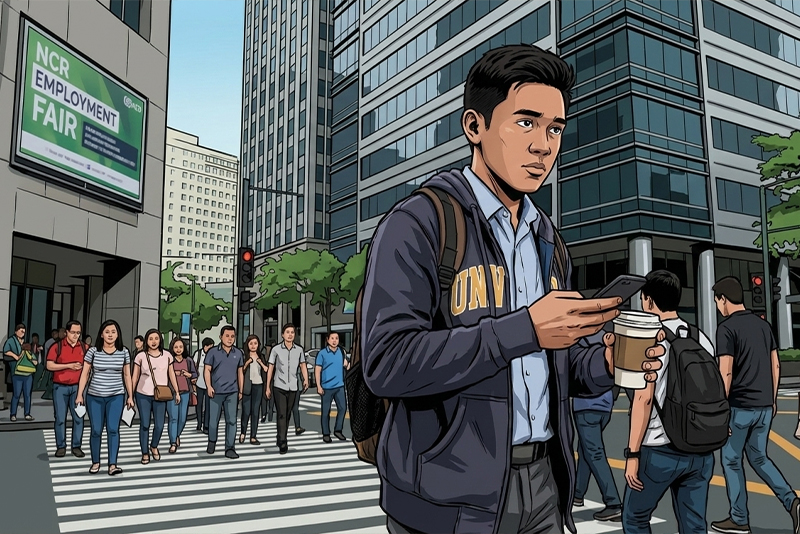
Many Filipinos wear resilience like armor, pushing through stress and exhaustion in silence. But for young professionals navigating the transition from school to the workplace, that silence can come at a cost.
By Natasha Claudia Bautista
Filipinos are known around the world for resilience. We work hard, push through challenges, and stay cheerful even when life weighs heavily on our shoulders. It is a beautiful trait—one that has carried our families and our country through countless storms.
But sometimes, resilience becomes a mask we wear too long.
Sometimes, we use “Filipino resilience” as a reason to stay quiet even when we’re overwhelmed, anxious, or running on empty. We tell ourselves, “Kaya ko pa (I can still endure).”
We tell our colleagues, “Okay lang ako (I’m okay).”
We push through, even as our bodies and minds whisper, “You need help.”
Losing What Once Protected Us
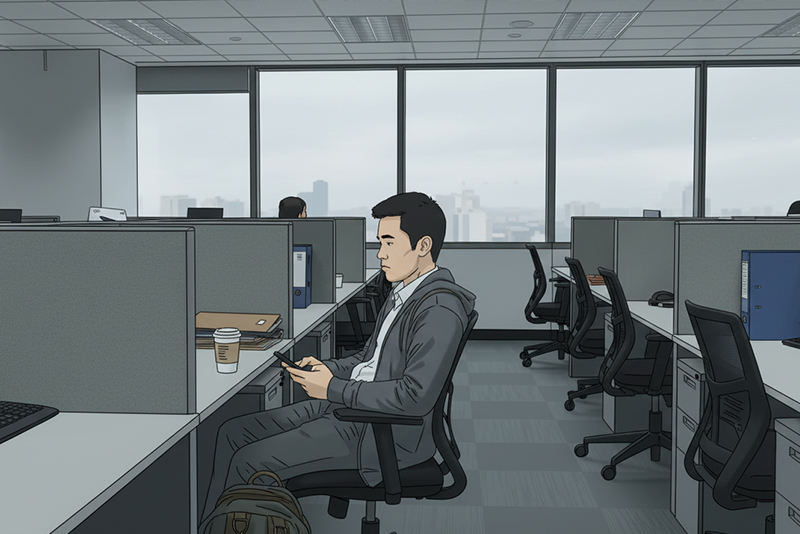

As a student then, I was fortunate to have access to free guidance counseling services in school. It was a safety net—a space to breathe, to process, to be heard. Back then, reaching out for help felt normal. It was part of the academic environment.
But the shift to professional life is a shock many of us don’t talk about.
Suddenly, the guidance counseling office is gone.
Self-care becomes a privilege.
Mental health support becomes “optional.”
And the workplace—where we spend most of our waking hours—rarely offers an equivalent safe space.
I miss that privilege. Many young professionals do.
When Advocacy Turns Performative
In recent years, the conversation around mental health in the Philippines has shifted dramatically. The passage of the Mental Health Act (RA 11036) marked a turning point—finally acknowledging that emotional well-being is not just a personal concern but a public responsibility. Schools and universities began launching mental health weeks, peer-support programs, and student-led initiatives. What was once whispered about became part of campus culture.
Even online, the change is visible. Influencers, creators, and public figures now openly share their experiences with burnout, therapy, anxiety, and pressure. Their honesty has helped normalize the idea that it’s okay to take a break, to set boundaries, and to ask for help.
But with this rise in awareness comes an uncomfortable truth: sometimes, mental health becomes trendy instead of meaningful. Some individuals or organizations speak loudly about empathy and “mental health advocacy,” yet continue to shame, exclude, or bully others—intentionally or not. Advocacy becomes a tagline instead of a mindset. A performance rather than a practice.
This is the danger of treating mental health as a movement to “join” rather than a discipline to live out.
Because real advocacy is quiet. Consistent. Often inconvenient.
It shows up in how we treat people when no one else is watching.
Awareness is a start. But authenticity is what sustains real change.
The Silent Cost of Unspoken Struggles
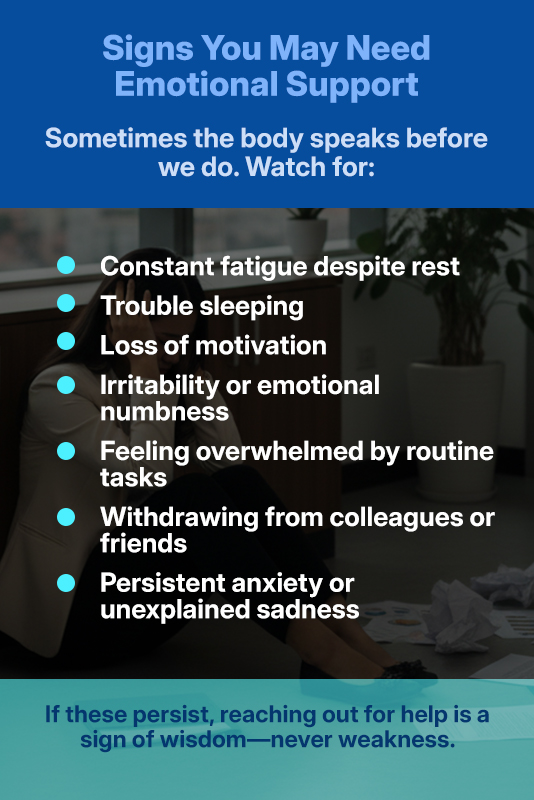
Despite this cultural progress, many workplaces remain emotionally unsafe. Productivity is celebrated, but emotional overload is minimized.
Modern workplaces celebrate productivity and adaptability but often fail to acknowledge the toll they take on emotional well-being. When burnout is brushed aside as “part of the job,” employees suffer in silence.
But the real cost is deeper:
Lower creativity and engagement
Higher turnover
Poorer teamwork
Chronic stress that evolves into physical illness
We don’t lose good employees because they are weak.
We lose them because no one asked if they were okay—and they didn’t know if they were allowed to say they weren’t.
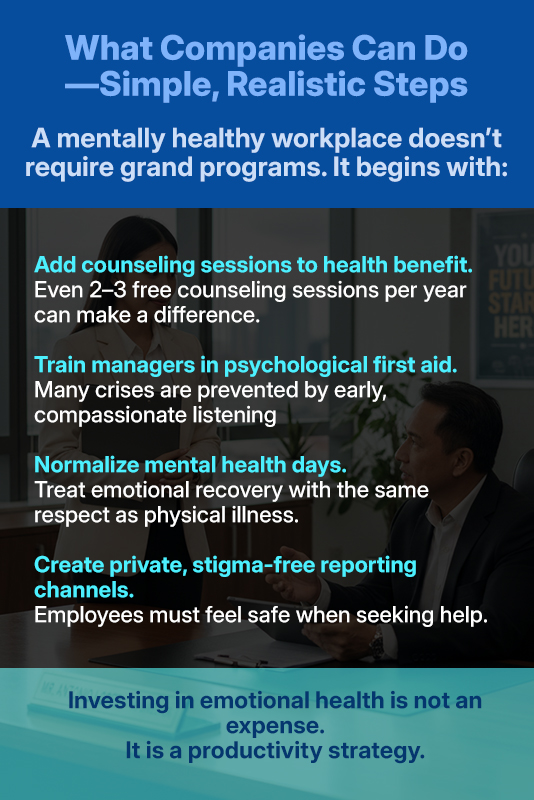
The Role of Companies: Compassion Is a Form of Competitiveness


I applaud the nonprofit organizations stepping in to provide free counseling in exchange for volunteer work. Their creativity and compassion fill an important gap. These communities prove something essential: people heal when someone makes space for them.
But companies must go further.
Mental health should not be a luxury. It should be part of the basic architecture of employee care—a necessity in a world where stress has become one of the biggest threats to productivity and well-being.
Imagine if every Filipino employee knew that they could talk to a professional coach or counselor—confidentially, and without stigma. Imagine how many crises could be prevented. How many careers could be saved. How many lives could be steadied before they reached breaking point.
The Courage to Ask For Help
Ultimately, emotional health in the workplace begins with something both simple and difficult: permission—permission to feel, to ask for help, and to take mental well-being seriously.
We must redefine resilience. It is not silent suffering. It is not carrying everything alone.
Resilience is knowing when you’re at the edge and choosing to reach out before you fall.
A Healthier Workplace Starts With One Brave Voice
If we want emotionally healthier workplaces, we must normalize help-seeking behavior. Employers must build systems of support. Colleagues must learn to look out for one another. And we, as individuals, must understand that vulnerability is not weakness—it is wisdom.
When we speak up, others find the courage to speak, too. And maybe, one day, resilience will no longer mean endurance in silence, but strength in community—where every Filipino worker feels supported, valued, and emotionally safe.
“Resilience should not mean suffering in silence. Sometimes the bravest thing we can do is ask for help.”