



or years, we reassured younger patients: “You’re still young. Your heart is strong.”
That reassurance is becoming more complicated. The latest data showing rising in-hospital heart attack deaths among adults younger than 55 — particularly women — should make every clinician pause.
Heart disease has always been biologically complex. But what we are seeing now reflects something broader. It is not simply cholesterol numbers or blood pressure readings. It is stress. It is socioeconomic strain. It is kidney disease in patients who never had consistent primary care. It is substance exposure. It is delayed hospital arrival because someone thought they were “too young” for a heart attack.
In clinic, younger patients often present later. They are shocked. Their families are shocked. “Doc, how could this happen? Bata pa siya.” (He’s still young.)
Youth reduces probability — but it does not eliminate risk.
What concerns me most is not only the rise in mortality, but the pattern: women, especially younger women, are dying more often in the hospital. Some receive fewer procedures. Many present atypically. Some are under-triaged because their symptoms do not match textbook descriptions.
We must adapt.
Younger adults with multiple stressors deserve aggressive risk screening. Women deserve equal vigilance in emergency evaluation. Nontraditional risk factors must be documented and acted upon, not ignored.
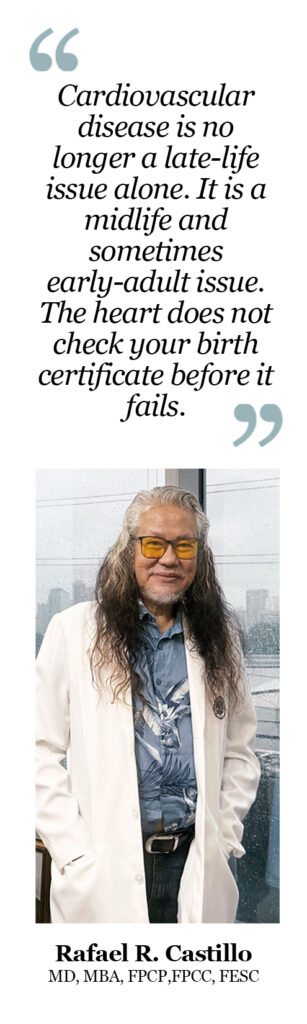
Cardiovascular disease is no longer a late-life issue alone. It is a midlife and sometimes early-adult issue. If we want to bend the curve again, we must intervene earlier — not when arteries are critically blocked, but when risk begins accumulating.
The heart does not check your birth certificate before it fails.