


When Youth Is No Longer a Shield

or years, we reassured younger patients: “You’re still young. Your heart is strong.”

That reassurance is becoming more complicated. The latest data showing rising in-hospital heart attack deaths among adults younger than 55 — particularly women — should make every clinician pause.

Heart disease has always been biologically complex. But what we are seeing now reflects something broader. It is not simply cholesterol numbers or blood pressure readings. It is stress. It is socioeconomic strain. It is kidney disease in patients who never had consistent primary care. It is substance exposure. It is delayed hospital arrival because someone thought they were “too young” for a heart attack.

In clinic, younger patients often present later. They are shocked. Their families are shocked. “Doc, how could this happen? Bata pa siya.” (He’s still young.)

Youth reduces probability — but it does not eliminate risk.

What concerns me most is not only the rise in mortality, but the pattern: women, especially younger women, are dying more often in the hospital. Some receive fewer procedures. Many present atypically. Some are under-triaged because their symptoms do not match textbook descriptions.

We must adapt.

Younger adults with multiple stressors deserve aggressive risk screening. Women deserve equal vigilance in emergency evaluation. Nontraditional risk factors must be documented and acted upon, not ignored.

Cardiovascular disease is no longer a late-life issue alone. It is a midlife and sometimes early-adult issue. If we want to bend the curve again, we must intervene earlier — not when arteries are critically blocked, but when risk begins accumulating.

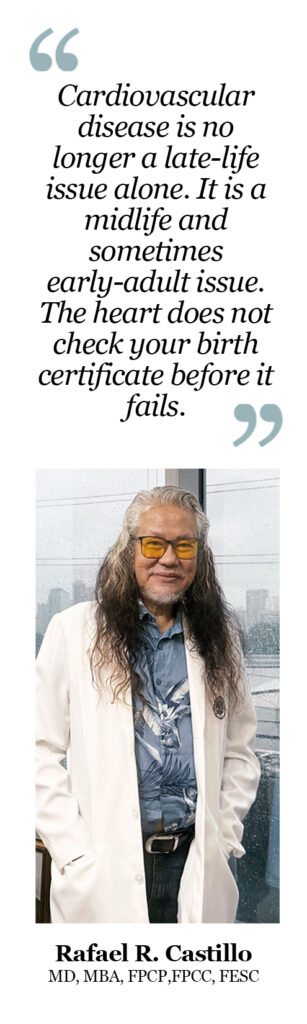
The heart does not check your birth certificate before it fails.

Share this Article
Facebook
X
LinkedIn
WhatsApp
Email

More News

banner-copy6-3
Stroke: The 5-Minute Emergency Filipinos Must Recognize
Why every minute matters when the brain begins to die Stroke remains one of the leading causes...
banner-copy5-copy
The Healing Power of Song
Why Singing Is Good for the Mind, Body, and Soul In a world increasingly burdened by stress,...
banner-copy4-copy-15
The Pace He Was Never Meant to Keep
Modern life quietly teaches us that faster is better—that if we slow down, we will lose ground. But this...
banner-copy4-copy-3
The Heart of It All: Small Choices, Real Life, and the Habits We Keep
By Reinard Erick G. Dollente At the start of the year, I told myself I would finally get my health...
banner-copy4-copy-14
PhilHealth Funding Row Returns to Supreme Court Spotlight
Dr. Anthony Leachon Seeks Urgent Oral Arguments on Continuing UHC Funding Crisis By Reuben...
banner-copy4-copy-12
Service: Love in Action
By Henrylito D. Tacio  “Service is what prayer looks like when it gets up off its knees...
banner-copy5-2
Double Jeopardy in Public Health Finance: Why Recto’s PhilHealth Transfer Demands Accountability
By Dr. Tony Leachon  The ₱60-billion diversion from PhilHealth reserves is not only unconstitutional—it...
banner-copy4-copy-13
Small Daily Habits That Quietly Improve Your Health
By the H&L Editorial Team Most people think health requires dramatic changes—a strict diet, expensive...
banner-copy4-copy-11
The Conversation Many Men Avoid
In medicine, there are diseases that frighten people because of pain. Others because of disability. Prostate...
banner-copy4-copy-10
Prostate Cancer in Filipino Men: The Disease Many Fear—but Few Talk About
Understanding the risks, myths, warning signs, and modern treatment of one of the most common cancers...