


After the Stroke: The Brain’s Quiet Second Battle

or decades, stroke care has focused—rightly—on survival. We count minutes to thrombolysis, celebrate when patients walk again, and breathe a sigh of relief when another stroke is prevented. But emerging evidence now tells us that for many stroke survivors, the most profound battle begins after discharge—not in the arteries, but in the mind.

The new Canadian study presented at the American Stroke Association’s 2026 meeting and reported in this issue of H&L is sobering. It confirms what many clinicians have long suspected: dementia after stroke is common, predictable, and often overlooked. Over the long term, cognitive decline may occur more frequently than recurrent stroke.

What makes this study important is not fear—but clarity. By identifying who is most at risk, we gain an opportunity to act earlier, follow patients more closely, and design interventions that go beyond preventing the next stroke to preserving memory, independence, and dignity.

Cognitive symptoms, depression, diabetes, and disability are not merely “side issues.” They are signals. And listening to them may shape the future of post-stroke care.

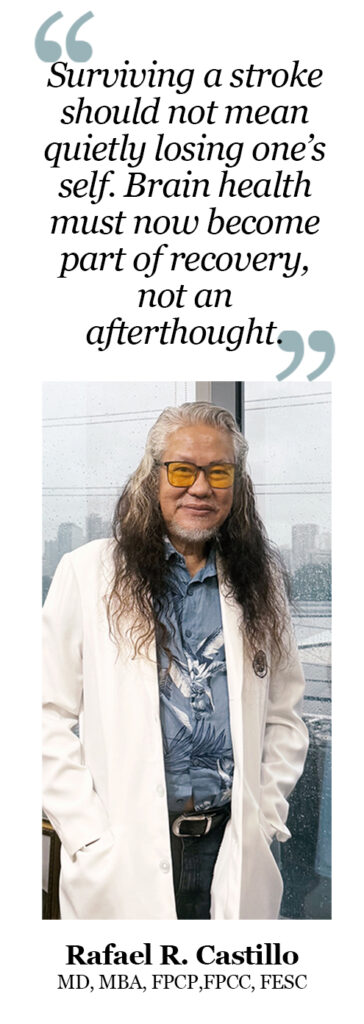
Surviving a stroke should not mean quietly losing one’s self. Brain health must now become part of recovery, not an afterthought.


Share this Article
Facebook
X
LinkedIn
WhatsApp
Email

More News

banner-copy5-7
The Day He Turned It Off
In a world that never stops notifying, updating, and demanding attention, silence can feel almost unnatural....
banner-copy5-copy-4
Strength Rising from Inner Doubt
By Roshell She Travilla There are seasons when even progress feels heavy – when achievements come with...
banner-copy6-2
Balancing the Mind in a World That Never Slows Down
By Cathlyn Cabrera In today’s fast-paced and demanding environment, caring for the mind is no longer...
banner-copy5-5
DOH & PhilHealth: Expanding Care, Closing Gaps
By Reuben Ricallo The promise of Universal Health Care in the Philippines has always been simple but...
banner-copy4-copy-16
You Don’t Have to Carry It Alone
By Natasha Claudia Bautista, RPh Stress shows up in different ways – figuring out the future, adjusting...
banner-copy4-copy-19
Mental Strength in Everyday Life: Seeing the Beauty in Work and Life Together
By Chamuel Josh Aguas In a world that often separates work from life, we forget that both are part...
banner-copy5-2
Strong Minds, Steady Hearts: Building Emotional Resilience in Everyday Life
By Reinard Erick G. Dollente In a fast-paced world where pressure is constant, true strength is often...
viber_image_2026-04-16_11-20-35-372
The Payatas Healthcare and Hospital On Wheels Surgical Center
By Dr. Juan “Jim” Sanchez People gathered and waited patiently to be served at the Payatas Healthcare...
banner-copy4-copy-14
Breathing Your Way Back: Simple Exercises to Restore Lung Function—Especially for Smokers
By Reuben Ricallo For smokers and former smokers, the lungs often carry a hidden burden—reduced elasticity,...
banner-copy6-1
Quitting Smoking Effectively
Practical Strategies That Actually Work By the H&L Editorial Team Quitting smoking is not about...