

After the Stroke: The Brain’s Quiet Second Battle

or decades, stroke care has focused—rightly—on survival. We count minutes to thrombolysis, celebrate when patients walk again, and breathe a sigh of relief when another stroke is prevented. But emerging evidence now tells us that for many stroke survivors, the most profound battle begins after discharge—not in the arteries, but in the mind.

The new Canadian study presented at the American Stroke Association’s 2026 meeting and reported in this issue of H&L is sobering. It confirms what many clinicians have long suspected: dementia after stroke is common, predictable, and often overlooked. Over the long term, cognitive decline may occur more frequently than recurrent stroke.

What makes this study important is not fear—but clarity. By identifying who is most at risk, we gain an opportunity to act earlier, follow patients more closely, and design interventions that go beyond preventing the next stroke to preserving memory, independence, and dignity.

Cognitive symptoms, depression, diabetes, and disability are not merely “side issues.” They are signals. And listening to them may shape the future of post-stroke care.

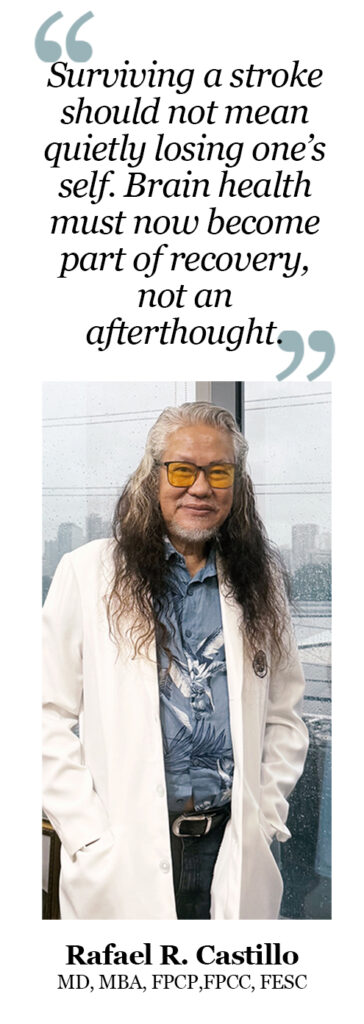
Surviving a stroke should not mean quietly losing one’s self. Brain health must now become part of recovery, not an afterthought.

Share this Article
Facebook
X
LinkedIn
WhatsApp
Email

More News

banner-copy5-12
The Middle Class as the New Poor in the Philippines
By Dr. Tony Leachon  The middle class—long considered the backbone of our economy—is increasingly...
banner-copy4-copy-32
Prayer: A personal conversation with God
By Henrylito D. Tacio  “True prayer is neither a mere mental exercise nor a vocal performance....
banner-copy6-5
Navigating Rising Drug Costs Amid Global Uncertainty
By Dr. Tony Leachon  The Philippines is entering a period of heightened vulnerability in...
banner-copy6-4
Becoming the numbers in our lives
By Eugene F. Ramos, MD What becomes of us as the years pass? Do we become what we always wanted,...
banner-copy5-10
Polypharmacy: When Too Many Medicines Harm
Why the pills meant to heal may sometimes make us sick In modern medicine, prescriptions have become...
banner-copy4-copy-28
When Treatment Becomes Too Much
In medicine, we are trained to act—to diagnose, to treat, to prescribe. Every symptom calls for a response,...
banner-copy5-9
The Meeting He Didn’t Attend
There are days when saying yes feels responsible—and saying no feels like failure. But this Sabbath story,...
banner-copy5-8
Holy Week at Serene Mountain Crest Homecare 🤍
By Princess Lhean Yape-Arriola  From Lunes Santo all the way to Easter Sunday, our home was filled...
banner-copy4-copy-25
A Crisis of Vision: Healthcare and Energy at the Brink
By Dr. Tony Leachon  The Filipino people are now bearing the brunt of decisions made without...
banner-copy9-copy
Forgiveness: The deliberate act of letting go
By Henrylito D. Tacio  “I had a brother once, and I betrayed him.” That sentence seemed...