


The Habit That Quietly Takes Everything


In medicine, we often confront diseases at their most advanced stages—when breath is already short, arteries are already blocked, or a mass is already visible on imaging. In many of these cases, one factor appears again and again: cigarette smoking.

What makes smoking uniquely dangerous is not just its toxicity, but its subtlety. The damage it causes is gradual, often unnoticed, and easily normalized. A morning cough becomes “part of life.” Shortness of breath becomes “signs of aging.” Fatigue becomes “just stress.”

But the body is already signaling distress.

Smoking is not a single-organ disease. It is a systemic process that injures blood vessels, inflames tissues, disrupts immune defenses, and alters cellular function across the body. Over time, these effects converge into the conditions we see every day—heart disease, stroke, lung disease, cancer.

And yet, despite this, there remains one powerful truth that we must emphasize to every patient:

It is never too late to quit.
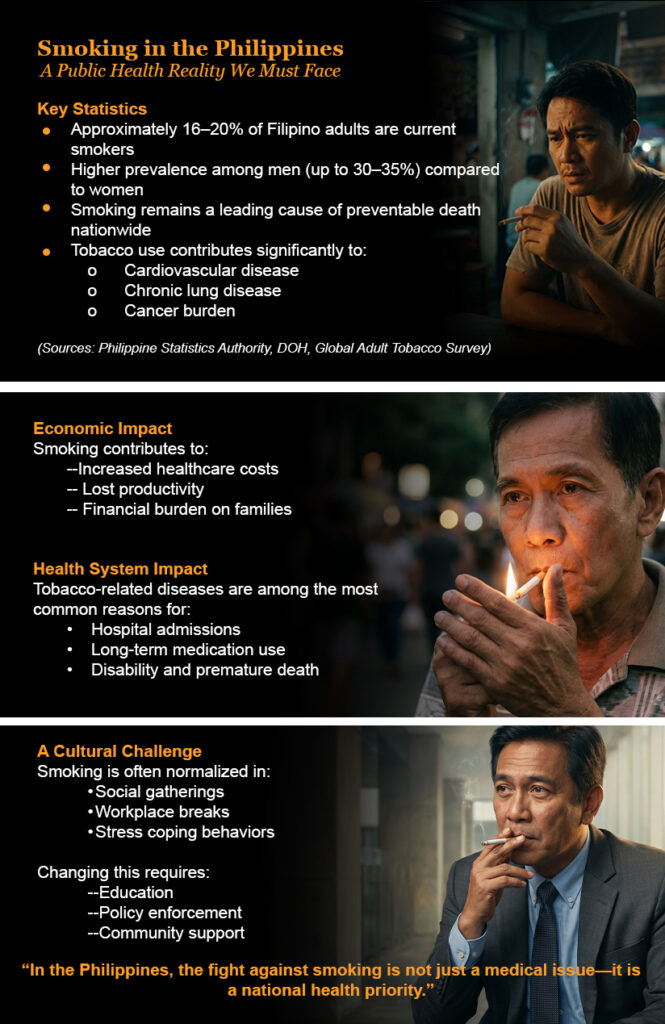
Within days of stopping, the body begins to recover. Circulation improves. Carbon monoxide levels normalize. Over time, the risks of heart disease, stroke, and cancer decline significantly. While not all damage is reversible, the trajectory can still be changed.

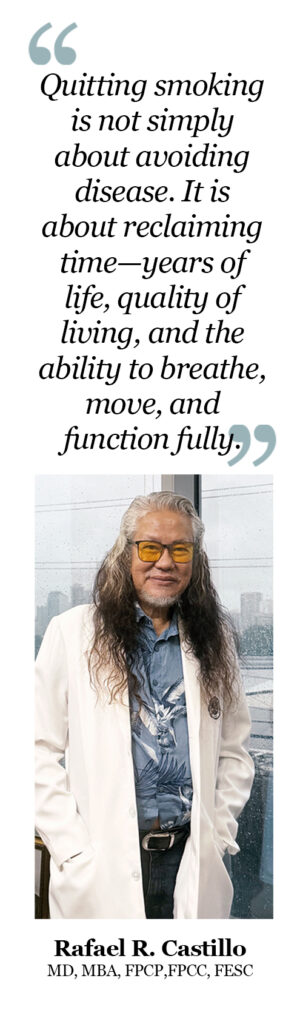
Quitting smoking is not simply about avoiding disease. It is about reclaiming time—years of life, quality of living, and the ability to breathe, move, and function fully.

As physicians, our role is not only to treat disease, but to prevent it. And in the case of smoking, prevention begins with one decision—repeated daily.

To stop.

Share this Article
Facebook
X
LinkedIn
WhatsApp
Email

More News

banner-copy5-7
The Day He Turned It Off
In a world that never stops notifying, updating, and demanding attention, silence can feel almost unnatural....
banner-copy5-copy-4
Strength Rising from Inner Doubt
By Roshell She Travilla There are seasons when even progress feels heavy – when achievements come with...
banner-copy6-2
Balancing the Mind in a World That Never Slows Down
By Cathlyn Cabrera In today’s fast-paced and demanding environment, caring for the mind is no longer...
banner-copy5-5
DOH & PhilHealth: Expanding Care, Closing Gaps
By Reuben Ricallo The promise of Universal Health Care in the Philippines has always been simple but...
banner-copy4-copy-16
You Don’t Have to Carry It Alone
By Natasha Claudia Bautista, RPh Stress shows up in different ways – figuring out the future, adjusting...
banner-copy4-copy-19
Mental Strength in Everyday Life: Seeing the Beauty in Work and Life Together
By Chamuel Josh Aguas In a world that often separates work from life, we forget that both are part...
banner-copy5-2
Strong Minds, Steady Hearts: Building Emotional Resilience in Everyday Life
By Reinard Erick G. Dollente In a fast-paced world where pressure is constant, true strength is often...
viber_image_2026-04-16_11-20-35-372
The Payatas Healthcare and Hospital On Wheels Surgical Center
By Dr. Juan “Jim” Sanchez People gathered and waited patiently to be served at the Payatas Healthcare...
banner-copy4-copy-14
Breathing Your Way Back: Simple Exercises to Restore Lung Function—Especially for Smokers
By Reuben Ricallo For smokers and former smokers, the lungs often carry a hidden burden—reduced elasticity,...
banner-copy6-1
Quitting Smoking Effectively
Practical Strategies That Actually Work By the H&L Editorial Team Quitting smoking is not about...