
By Reuben Ricallo
The promise of Universal Health Care in the Philippines has always been simple but profound: no Filipino should be denied care because of cost.
In recent months, that promise is being tested—not in legislation, but in execution.
From expanded PhilHealth benefits to the rollout of outpatient medicines under YAKAP, and the strengthening of government medical assistance programs, the health system is quietly evolving. The question now is no longer “Are the policies in place?”—but rather, “Are they reaching the patient?”
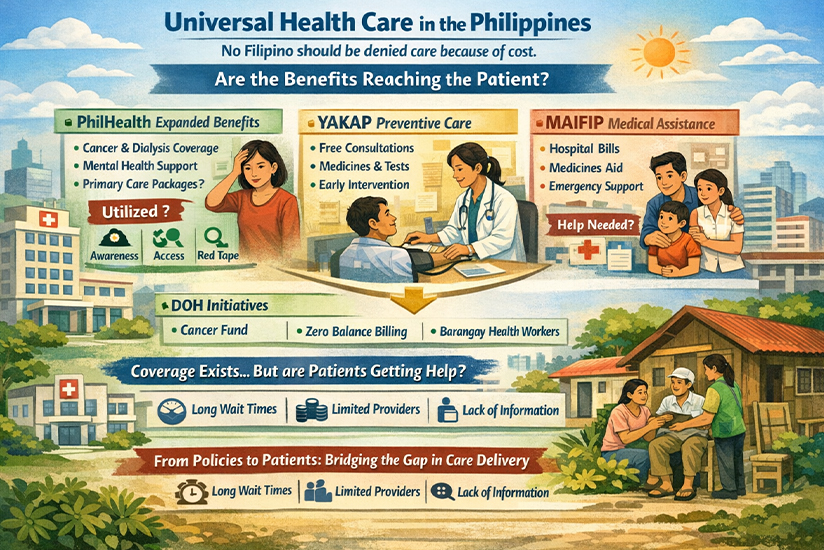
1. PhilHealth: More Benefits, But Are They Being Used?
The Philippine Health Insurance Corporation continues to expand its benefit packages, with particular emphasis on:
• Expanded Z Benefits for catastrophic illnesses (cancer, stroke, dialysis)
• Increased case rates and coverage limits
• Strengthened outpatient packages under primary care
Notably, PhilHealth has drawn attention to a surprising reality:
some benefit packages—especially mental health—remain significantly underutilized.
What this means
Coverage exists. But access is uneven.
Barriers include:
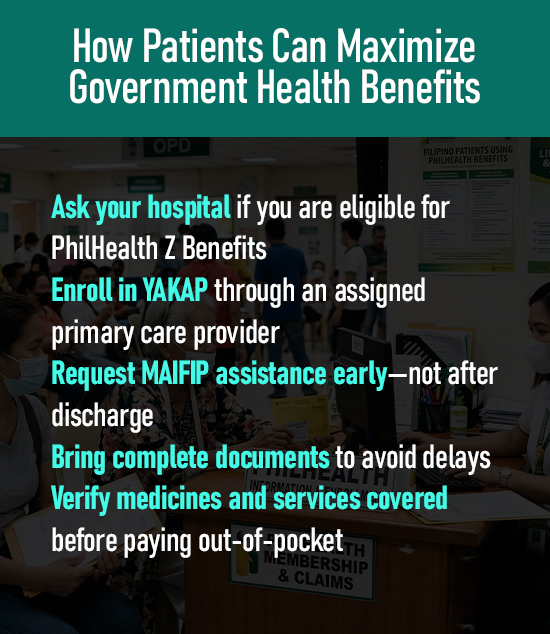
• Lack of awareness among patients
• Limited accredited providers
• Administrative complexity
Until these are addressed, expanded benefits risk becoming “paper coverage” rather than real protection.
2. YAKAP Program: The Shift Toward Preventive Care
PhilHealth’s YAKAP (primary care benefit expansion) marks one of the most important structural shifts in recent years.
From a system historically focused on hospitalization, YAKAP moves care upstream—into clinics, communities, and early intervention.
What YAKAP offers
• Free consultations with assigned providers
• Selected laboratory tests and diagnostics
• Outpatient medicines (GAMOT component)
• Preventive services for chronic diseases
Why this matters
This is where health systems succeed or fail.
A country that invests in prevention over hospitalization:
–detects disease earlier
–reduces long-term costs
–improves quality of life
The challenge
YAKAP’s success depends on:
–Provider availability
–Supply of medicines
–Patient awareness and enrollment
Without these, even the best-designed primary care system will struggle.
3. MAIFIP: The Quiet Safety Net
Beyond PhilHealth, the government continues to rely on the Medical Assistance for Indigent and Financially Incapacitated Patients (MAIFIP) as a crucial backstop.
Often accessed through DOH hospitals, MAIFIP helps cover:
–Hospital bills
–Medicines
–Procedures not fully covered by PhilHealth
For many patients, MAIFIP is the difference between: delayed care and immediate treatment.
The reality
MAIFIP works—but unevenly.
Access often depends on:
• Hospital processes
• Documentation requirements
• Awareness at the patient level
It remains a lifeline, but not yet a fully systematized solution.
4. DOH Programs: Bringing Care Closer to Home
The Department of Health continues to push for decentralization of care, with recent efforts including:
Cancer Assistance Fund (CAF) Expansion
Now at 36 access sites nationwide, allowing more patients to receive financial support closer to their communities.
Zero Balance Billing (ZBB)
Expanding implementation in government hospitals to eliminate out-of-pocket costs for basic services.
Community Health Workforce Support
Support for legislation strengthening barangay health workers, the frontline of preventive care.
The Real Gap Is Not Policy—It Is Delivery
We often celebrate new benefits, new programs, and new laws.
But patients don’t experience policy.
They experience:
• Waiting lines
• Availability of medicines
• Whether their bill is truly zero
The gap today is not in design—it is in delivery.
Bridging that gap requires:
• Faster PhilHealth reimbursements
• Stronger hospital systems
• Better patient navigation and information
Bottom Line
The Philippine health system is no longer lacking in programs.
It now has:
• Insurance coverage
• Financial assistance
• Preventive care structures
What it needs is alignment, awareness, and execution.
Because in the end, Universal Health Care is not about how much is allocated—
but how much actually reaches the patient’s bedside.
“Universal Health Care is not measured by laws passed—but by bills no longer paid out-of-pocket.”