
By Henrylito D. Tacio
“Take the first step in faith. You don’t have to see the whole staircase, just take the first step.”—Martin Luther King, Jr.
***
The Holy Bible, the Book of All Seasons, gives much importance on faith: “If you have faith as a grain of mustard seed, nothing shall be impossible unto you.”
Norman Vince Peale shares this impression on the above statement: “The implication is that while you may not have perfect faith, or considerable faith, or even faith as small as a tiny mustard seed, yet, if what you have is real faith, then life will be predicated, not on an impossibility concept, but rather upon the fact of great possibilities. Faith strongly held can move you out of the area of the impossible into a way of life that is full of exciting possibilities.”
Peale, author of several inspirational books, corrects the impression that if you practice faith you will get everything you desire. Nor does it mean avoiding difficulties, failures, pains and disappointments in life. Far from it.
“The real difference between faith and no faith is shown by how creatively you handle the troubles of life,” he explains. “Having even a mustard-seed category of faith, it will be quite impossible for the hard things, no matter how hard they may be, to defeat you. Indeed, your spiritual perception and control will be such that you will see and develop the vast possibilities that are almost invariably inherent in difficulties.”
The term “faith” originated in the mid-13th century from the Middle English word feith, which evolved from the Anglo-French and Old French terms feid or foi. It ultimately traces back to the Latin word fidēs, which signifies trust, confidence, reliance, or belief.
Initially, it denoted faithfulness to a trust, promise, or loyalty to an individual before its meaning transitioned to encompass religious belief. In early English usage (12th-13th century), it referred to a pledge or loyalty, with its definition expanding to include “assent of the mind” or religious faith by the 14th century.
Faith, whether it pertains to trust in another individual or in a higher power, involves accepting something based on another’s assurance. It suggests a form of knowledge that can only be acquired by “accepting someone else’s assurance.”
For instance, if you elucidate a mathematical problem to me and I grasp your explanation, I do not need to rely on your assertion that the solution is accurate. I can confirm it independently. Therefore, I do not need to place any trust in you.
Conversely, if you express your love for me and assure me that you will endeavor to bring me happiness, there is no means by which you can substantiate this claim, nor can I independently verify it. As such, I must place my trust in you and your promises to me.
“We live by faith or we do not live at all,” Harold Walker points out. “Either we venture – or we vegetate. If we venture, we do so by faith simply because we cannot know the end of anything at its beginning. We risk marriage on faith or we stay single. We prepare for a profession by faith or we give up before we start. By faith we move mountains of opposition or we are stopped by molehills.”
The late Bishop William A. Quayle used to tell of an experience during a sleepless night. After rolling and tossing far into the night, he said that he seemed to hear God’s voice telling him to go on to sleep and let God run the world the rest of the night. That’s what faith is all about.
“Faith is one of the most precious treasures a man can possibly possess,” said a statement which appeared in Weekly Review. “It is a pity that so few understand what the Bible teaches about it. Faith is often confused with presumption, optimism, determination, superstition, and imagination. Actually, it is simply believing.” Period.
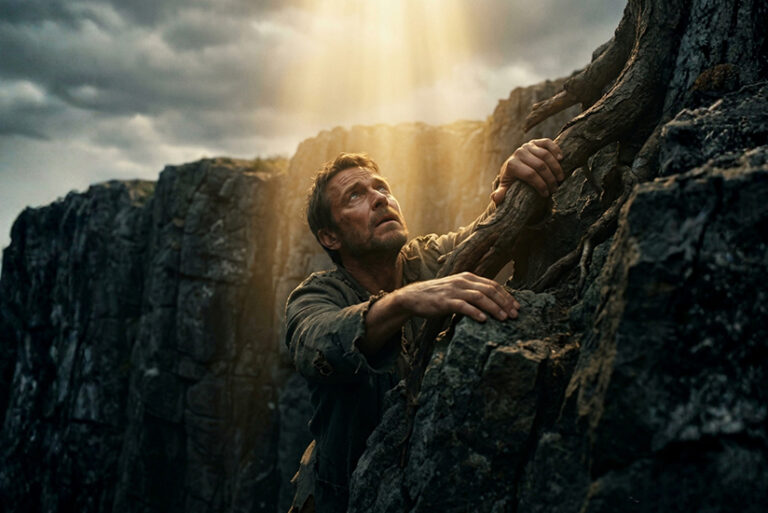
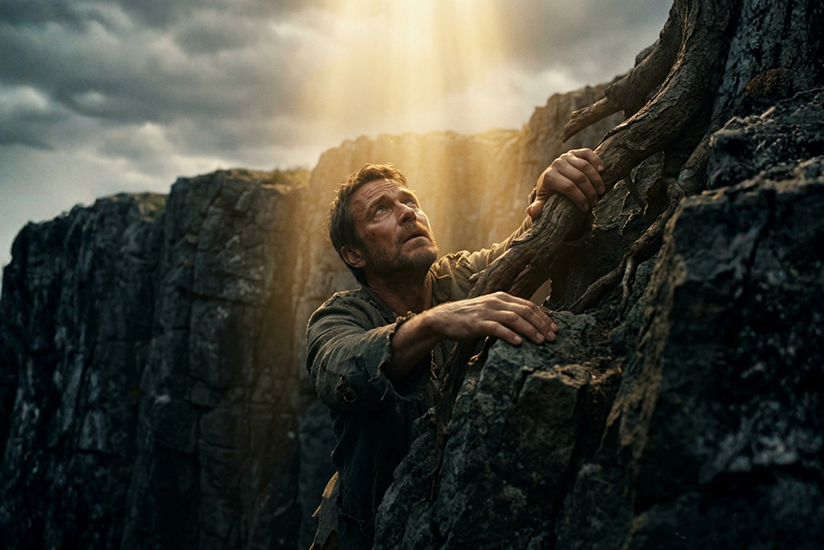
There was a tale of a man who had plummeted from the edge of a steep cliff during the night. As he descended, he managed to grasp the root of a tree that was protruding from the cliff, and he was literally hanging on for his life.
The man started to pray. Then he heard the voice of God asking him: “Do you truly believe in me?” “I do!” exclaimed the unfortunate man whose life was at stake. “Do you trust me?” inquired the voice of God. “Yes! Yes!” the man replied.
Then the voice of God responded: “Then I will ensure that you are saved. Now, follow my instructions. Now… let go!”
If you were that man, what would you choose to do?
Faith perceives the unseen, believes the unbelievable, and attains the unattainable. “Faith is more than thinking something is true,” said W. T. Purkiser. “Faith is thinking something is true to the extent that we act on it.”
Have confidence in your abilities. You will not progress far in life if you lack self-belief. This was exemplified by Jesus when he entered this world. As one of the most assured individuals to have ever existed, he saw himself as a crucial guide for the people. He was convinced that his purpose was also to support others. He stated that he came to illuminate the path. In essence, he had unwavering faith in himself throughout his entire being.
Jesus had complete faith in himself. “Perhaps we think 100 percent belief equals arrogance,” observed Laurie Beth Jones, author of Jesus, CEO. “Arrogance, however, is lack of self-confidence, not self-belief. Jesus was never arrogant or cocky to anyone. Even when he was bound and thrown before the Sanhedrin for trial, he was not arrogant. Nor did he deny his own power.”
Never estimate yourself. “You don’t look exactly like anyone else, you don’t live exactly like anyone else,” reminds Marcus Bach. “There are things you can do better than anyone else can do them, and there are qualities and talents that no one else can possess in exactly the same way that you do. There are thoughts that are your own special revelation. That which makes you unique and exclusive.
Bach further states: “Talk about how to be a success! The successful person is simply the one who does his best with the things he can do better than anyone else. Talk about living well! Who lives better than the one who is true to his own inner light? Talk about being interesting! What is more interesting than the person being himself?”
The author ends his observation with this statement: “In this world within, your world, you are the most important figure. There is a place that no one else can fill. There is an influence that no one else can impart. There is a life that no one else can live quite as well as you can live it. What you do with your life within, in terms of self-realization, self-awareness, self-denial and self-expression, is the greatest challenge that can come to you.”
Let me end this column with a short story which some people said American novelist Robert Louis Stevenson told first:
It seems a storm caught a sea-faring vessel off a rocky coast. The wind and waves threatened to drive the ship to its destruction.
In the midst of the terror, one daring passenger, contrary to orders, made his way across the ship. Groping along a passageway, he found the pilot house. There he beheld an intriguing sight: the ship’s pilot was lashed to his post. Secure against the raging elements, he held the wheel fast, turning the ship inch by inch once more out to the sea. The pilot saw the man and smiled.
The daring passenger found his way below deck where the other passengers huddled. Encouragingly he told them, “I have seen the face of the pilot, and he smiled. All is well.”
His words remind me of the statement of British-born American philosopher Alan M. Watts. “To have faith is to trust yourself to the water,” he said. “When you swim you don’t grab hold of the water, because if you do you will sink and drown. Instead, you relax, and float.”