

By Henrylito D. Tacio
“The death of the Lord our God should not be a cause of shame for us; rather, it should be our greatest hope, our greatest glory.” — St. Augustine
***
What is the most significant story in the Bible? Some of you may reply: the birth of Jesus Christ. But for me, it is His crucifixion at Calvary.
As John 3:16 points out: “For God so loved the world that He gave His only Begotten Son, that whosoever believeth in Him should not perish but have everlasting life.”
As we reflect during this Lenten Season, let us keep in mind that our lives and material possessions are simply on loan to us. We are transient beings in this world, not immigrants, but pilgrims traveling along the journey. At the age of 33, His earthly ministry came to an end.
Jesus Christ offered Himself for our sins—on behalf of all humanity. This is underscored in I Peter 3:18: “For Christ also suffered once for sins, the just for the unjust, that he might bring us to God.”
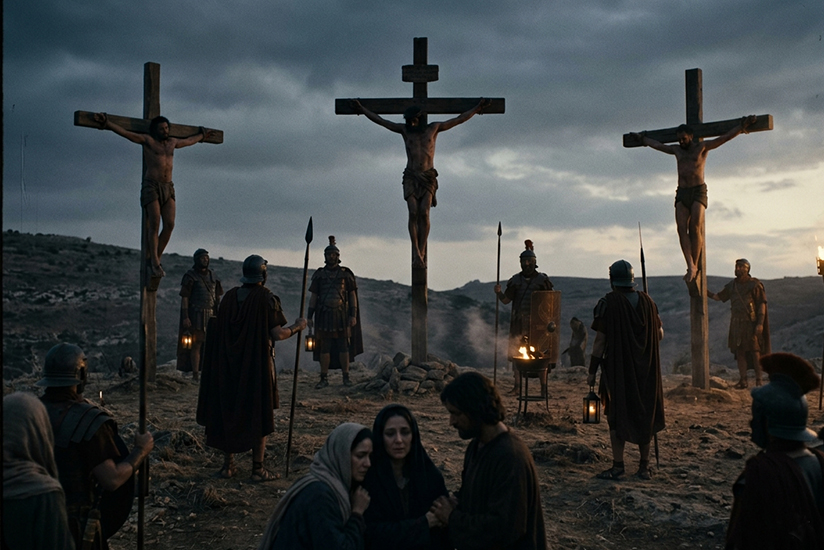
So many movies have been made about the life of Christ before His death. The book, Great People of the Bible and How They Lived, chronicled Christ’s last day on earth in these words: “At about 9 a.m., a small procession left the Antonia and slowly made its way to Golgotha (“place of the skull”), a hill outside the walls of Jerusalem where prisoners were executed. It was so named because its contour resembled a human skull. Jesus was accompanied by two other prisoners, a centurion and a few Roman soldiers.
“When they reached Golgotha, the soldiers stripped off the men and divided them among themselves as the crosses were assembled. Jesus suffered in silence as the soldiers nailed his wrists to the crosspiece with large iron spikes and drove another spike through both ankles. As they lifted his cross upright, his weight was supported by a peg jutting out from the cross between his legs. The soldiers placed a sign on the cross, proclaiming, ‘This is Jesus the King of the Jews.’
His death was gradual and excruciating. Dr. Alexander Metherell, a consultant for the National Heart, Lung, and Blood Institute at the National Institutes of Health in Bethesda, Maryland, was interviewed by Lee Strobel for his book, The Case for Christ, where he elaborated on the manner of Christ’s death:
“Once a person is hanging in the vertical position, crucifixion is essentially an agonizingly slow death by asphyxiation. The reason is that the stresses on the muscles and diaphragm put the chest into the inhaled position; basically, in order to exhale, the individual must push up on his feet so the tension on the muscles would be eased for a moment. In doing so, the nail would tear through the foot, eventually locking up against the tarsal bones.
“After managing to exhale, the person would then be able to relax down and take another breath in. Again, he’d have to push himself up to exhale, scraping his bloodied back against the coarse wood of the cross. This would go on and on until complete exhaustion would take over, and the person wouldn’t be able to push up and breathe anymore.
“As the person slows down his breathing, he goes into what is called respiratory acidosis – the carbon dioxide in the blood is dissolved as carbonic acid, causing the acidity of the blood to increase. This eventually leads to an irregular heartbeat. In fact, with his heart beating erratically, Jesus would have known that he was at the moment of death…. Jesus died of cardiac arrest.”
But before he died, Christ delivered His last words. As chronicled in Luke 23:44: “It was now about the sixth hour, and there was darkness over the whole land until the ninth hour, while the sun’s light failed. And the curtain of the temple was torn in two. Then Jesus, calling out with a loud voice, said, ‘Father, into your hands I commit my spirit!’ And having said this he breathed his last.”
The book, The Great People, shared this information as to what happened next: “Later that afternoon, one of Jesus’ wealthy Jerusalem followers, Joseph of Arimathea, went to Pontius Pilate and asked him for Jesus’ body, so that he might give him a proper burial. After making sure that Jesus was in fact dead, Pilate agreed to let Joseph take the body. The kind man removed Jesus’ corpse from the cross and prepared it for burial.”
John 19:39-42 relates that Joseph was assisted by Nicodemus.
“Joseph bound the body from head to foot in clean, white linen strips, sprinkling fragrant species between the layers,” the book continues. “When he had finished, Joseph carried Jesus’ body into his garden, where there was a tomb that had been hewn out of a large rock. Inside near the rear of the tomb was a couch, also of stone, and Joseph gently placed the corpse upon it. Then he rolled a heavy stone across the entrance and returned to his home.”
“The death of Christ has a prominent place in the New Testament of the Bible. The last three days of our Lord’s earthly life occupy about one-fifth of the narratives in the four Gospels (Matthew, Mark, Luke, and John),” writes Henry Thiessen in Lectures in Systematic Theology. “If all the three and a half years of His public ministry had been written out as fully as the last three days, we would have a ‘Life of Christ’ of some 8,400 pages!”
One Bible scholar commented that the death of Christ is mentioned directly in the New Testament more than 175 times. Since there are 7,959 verses in the New Testament, this would mean that one out of every 53 verses refer to this theme.
More than that, the death of Christ is the essential thing in Christianity. Writes Thiessen: “Other religions base their claim to recognition on the teaching of their founders; Christianity is distinguished from all of them by the importance it assigns to the death of its Founder. Take away the death of Christ as interpreted by the Scriptures, and you reduce Christianity to the level of the ethnic religions.
“Though we would still have a higher system of ethics, were we to take away the cross of Christ, we would have no more salvation than these other religions. Napoleon said when banished to St. Helena, that Alexander, Caesar, Charlemagne, and he found mighty kingdoms on force, but that Jesus Christ had founded His on love. This is true, if we mean love expressed in His substitutionary death.”
In his book, Jesus Christ Our Lord, Dr. John Walvoord agrees: “Christ in His death fully satisfied the demands of a righteous God for judgment upon sinners and, as their infinite sacrifice, provided a ground not only for the believer’s forgiveness, but for his justification and sanctification.”