

By Dr. Tony Leachon
Across the world, medical bankruptcy is virtually unheard of in countries with universal healthcare. In France, Japan, Norway, the UK, and Canada, families rarely face financial ruin because of hospital bills. Their systems—anchored in strong public insurance—protect citizens from catastrophic costs. Even in countries with partial gaps like Australia or Germany, medical bankruptcies remain in the single‑digit percentages.
Contrast this with the United States, where medical debt is the leading cause of personal bankruptcy. Each year, around 500,000–643,000 families are forced into bankruptcy because of medical bills. This stark difference highlights the protective power of universal healthcare systems.
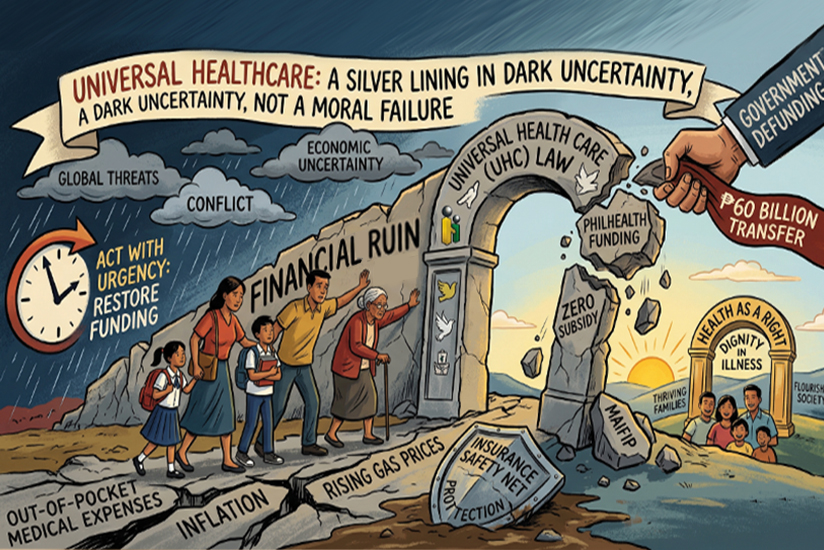
Here at home, the Philippines faces a similar crisis. Studies show that 44% of bankruptcies in our country are linked to medical expenses, reflecting the heavy burden of out‑of‑pocket costs and the weakness of our insurance safety net. Instead of strengthening PhilHealth, recent policies have defunded it—through the unconstitutional transfer of ₱60 billion, zero subsidy allocations, and the MAIFIP program of the Department of Health. These actions undermine the very foundation of the Universal Health Care (UHC) Law, leaving millions of Filipinos vulnerable.
This is happening at a time when global and local threats are intensifying:
• The Middle East conflict threatens economic stability.
• Rising gasoline prices and inflation erode household budgets.
• Families like ours, with children entering grade , high school, and college degrees face mounting costs for education and daily living.
In such extraordinary times, weakening PhilHealth is not just a policy misstep—it is a moral failure. Universal healthcare is meant to be the silver lining in a dark age of uncertainty. It should shield families from financial ruin, preserve dignity in illness, and ensure that health is not a privilege but a right.
We must act with urgency: restore funding, strengthen PhilHealth, and honor the UHC Law. As citizens, we must also take responsibility—saving where we can, keeping ourselves healthy, and demanding accountability from institutions entrusted with our welfare.
The lesson from countries with universal healthcare is clear: when the state protects its people from medical bankruptcy, families thrive, economies stabilize, and societies flourish. The Philippines deserves no less.
#RelentlessForChange