

Understanding Insomnia—and How to Win Back the Night
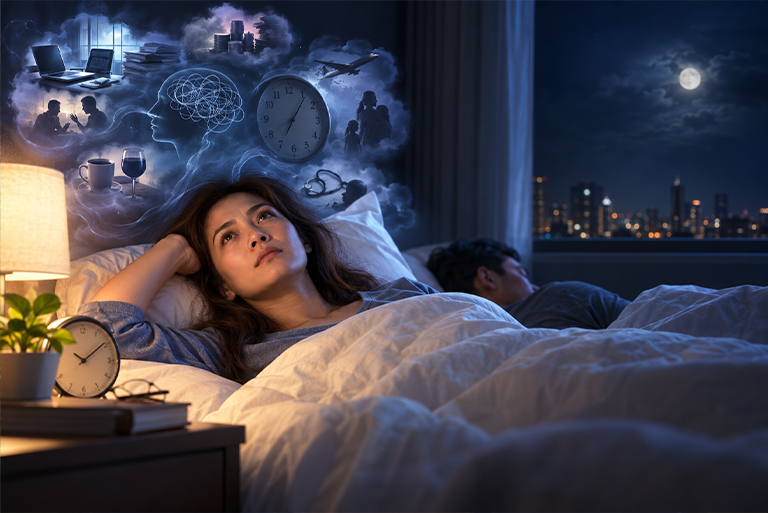
Why are millions exhausted yet unable to sleep—and what actually works?
You are exhausted. You desperately want to sleep. Yet the moment your head touches the pillow, your mind seems to wake up. You look at the clock: 11:47 p.m. Then 1:16 a.m. Then 3:08. Or perhaps falling asleep is easy, but you awaken repeatedly—or at 4 a.m., unable to return to sleep.
An occasional bad night is part of being human. Insomnia is different. It involves persistent difficulty falling asleep, staying asleep, or obtaining good-quality restorative sleep despite adequate opportunity and circumstances for sleep, with consequences during the day. When it occurs at least three nights weekly and persists for three months or longer, it meets the usual duration/frequency threshold for chronic insomnia disorder.
The good news is that insomnia is treatable. But treatment often requires changing our approach from “What can I take to knock myself out?” to the more important question:
“What is preventing my brain and body from sleeping normally?”
“Sleep cannot be commanded. The harder we chase it, worry about it and watch the clock waiting for it, the more elusive it can become.”
By Rafael R. Castillo, MD
The 2:17 A.M. Club
The bedroom is dark. Your spouse is asleep. The house is silent. You have an important meeting tomorrow. And you are completely awake.
You calculate. If I fall asleep now, I can still get five hours and 43 minutes.
Twenty minutes later: Five hours and 23 minutes.
Then comes the dangerous thought: What if I don’t sleep at all?
Your heart seems faster. You turn the pillow over. Check your phone. Try another position.
You begin worrying about tomorrow. Soon you are no longer simply awake. You are anxious about being awake.
That distinction helps explain chronic insomnia. A stressful event may start it. Our attempts to control sleep can then unintentionally help perpetuate it.
What Is Insomnia—Really?
Insomnia is not synonymous with sleeping fewer than eight hours. Some people naturally require somewhat more or less sleep than others. Nor does insomnia simply mean going to bed late because you chose to watch television or work until 1 a.m.
The key elements are difficulty sleeping despite adequate opportunity, plus impaired daytime functioning.
It may appear as:
Sleep-onset insomnia — difficulty falling asleep.
Sleep-maintenance insomnia — repeated awakening during the night.
Early-morning awakening — waking earlier than intended and being unable to return to sleep.
Some people experience combinations of all three.
Chronic insomnia generally means symptoms at least three nights per week for three months or longer.
And here is an important distinction:
Insomnia is not the same as sleep deprivation.
Someone who stays up until 2 a.m. scrolling through social media but could sleep normally if given the opportunity may be sleep-deprived without having insomnia.
The person with insomnia has the opportunity to sleep—but cannot reliably do so.
Why Can’t I Sleep?
Usually there is no single universal answer.
1. Stress and the Racing Mind
Work. Money. Illness. Relationships. Bereavement. Family responsibilities. Even worrying about sleep itself.
Stress activates systems designed to keep us alert when danger is present. That was useful when our ancestors needed to escape predators. It is less useful when the “predator” is tomorrow’s board meeting.
NHLBI identifies stress and worrying about work, school, relationships, finances or bereavement among important insomnia risk factors. Even repeatedly checking the clock and worrying about obtaining enough sleep can perpetuate the problem.
2. Our 24/7 Lifestyle
Our biology evolved around light and darkness. Modern life did not. We bring work into the bedroom. We answer messages at midnight. We stream one more episode. We cross time zones. We work night shifts.
Artificial light and irregular schedules can disturb the sleep-wake system. Caffeine, nicotine and alcohol can further interfere with sleep.
Alcohol deserves particular mention. It may make someone drowsy initially, creating the illusion that it is a sleep aid. But it can fragment sleep later in the night.
Sedation is not necessarily healthy sleep.
3. The Medical Causes Hiding Behind the Sleeplessness
Sometimes insomnia accompanies another condition. Pain. Reflux. Nocturia. Hyperthyroidism. Menopausal symptoms. Depression or anxiety. Neurologic disease. Certain medications.
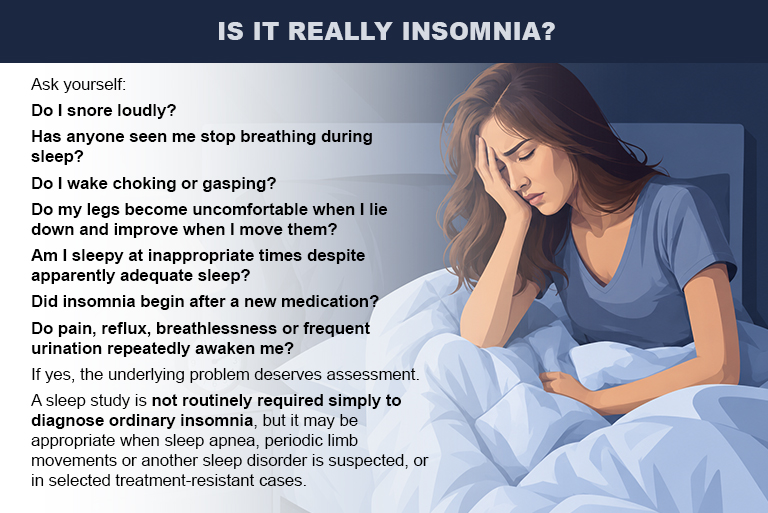
And sometimes the person who says, “Doctor, I have insomnia,” actually has a different sleep disorder:
Obstructive sleep apnea–Loud snoring, choking or gasping during sleep, witnessed breathing pauses, morning headaches or excessive daytime sleepiness should raise suspicion.
Restless legs syndrome–An uncomfortable urge to move the legs, typically worse during rest and in the evening, can make sleep initiation miserable.
Circadian-rhythm disorders–The body’s internal clock may be out of alignment with the desired sleeping schedule.
This is why treating every sleepless person with the same sleeping tablet is poor sleep medicine.
What Happens When Insomnia Becomes Chronic?
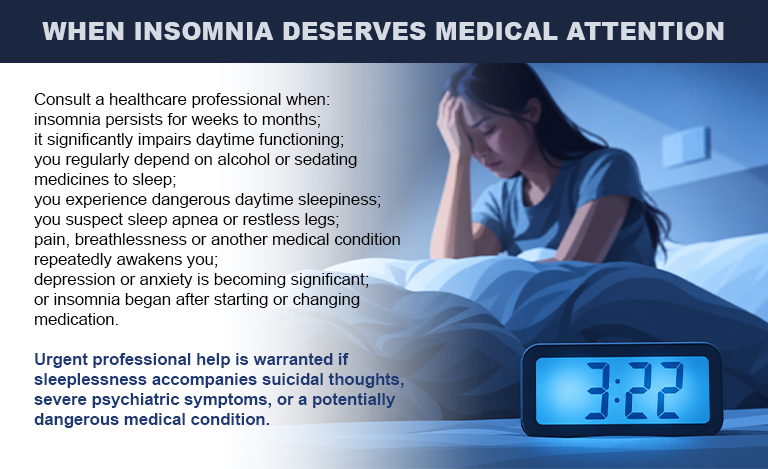
After one terrible night, you may feel awful. After months of poor sleep, the consequences become much broader. Insomnia can impair concentration, memory, reaction time and decision-making. People may become irritable, anxious, depressed and less productive. It can increase the likelihood of falls, road accidents and missed work.
The relationship between insomnia and chronic disease is complex and often bidirectional: illness can disturb sleep, while persistent insomnia and insufficient sleep are associated with adverse health outcomes. Chronic insomnia has been associated with hypertension, coronary heart disease and other cardiovascular problems, metabolic disease, depression and anxiety.
Sleep also matters to blood pressure. During normal sleep, blood pressure generally falls. Persistent sleep problems can interfere with this normal nighttime pattern.
Importantly, association does not mean that insomnia single-handedly “causes” every one of these diseases. Shared risk factors and bidirectional relationships matter. But sleep health is increasingly recognized as an important component of overall health.
“Sleep is not dead time between two productive days. It is biologically active time essential to brain, cardiovascular, metabolic and emotional health.”
The Treatment That Many Patients Have Never Heard Of
Ask the average person how insomnia is treated and the answer will probably be: Sleeping pills.
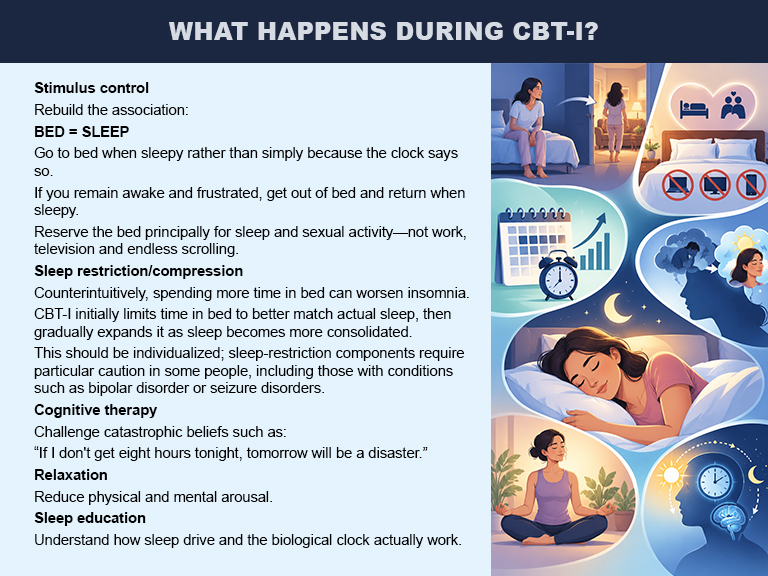
Modern sleep medicine says something different. For chronic insomnia, first-line treatment is CBT-I—Cognitive Behavioral Therapy for Insomnia.
The 2025 VA/DoD guideline gives CBT-I a strong recommendation and suggests it over pharmacotherapy as first-line treatment. The European insomnia guideline likewise recommends CBT-I first-line for adults of any age, including those with comorbidities.
CBT-I is not simply “think positive.” Nor is it just a list telling you not to drink coffee. It is a structured treatment, often delivered over several weeks, designed to retrain the behaviors and thought patterns that perpetuate insomnia. NHLBI describes a typical program as approximately six to eight weeks, although formats vary.
Sleep Hygiene Helps—but It Is Not CBT-I
This distinction deserves emphasis. Healthy sleep habits are useful. But telling someone with chronic insomnia simply to:
“avoid coffee,”
“turn off your phone,”
and
“sleep at the same time”
may not be sufficient treatment.
In fact, the 2025 VA/DoD guideline specifically recommends against using sleep-hygiene education as a stand-alone treatment for chronic insomnia disorder.
Sleep hygiene is the foundation.
CBT-I is the treatment.
What About Sleeping Pills?
Sleeping medicines have a legitimate role. But the question should never simply be: “Which pill is strongest?”
It should be: “Which treatment fits this patient, for this type of insomnia, for how long, and with what risks?”
Available prescription classes include certain benzodiazepine-receptor agonists, benzodiazepines, melatonin-receptor agents and dual orexin-receptor antagonists, among others. Recommendations vary somewhat among major guidelines and according to the specific medicine and patient.
Some medications are better suited to difficulty falling asleep.
Others may better address staying asleep.
Age matters. Fall risk matters. Other medications matter. Kidney and liver function may matter. Sleep apnea matters. Alcohol use matters. And duration matters.
A Special Warning for Older Adults
A tablet that makes a 35-year-old sleepy can have very different consequences in an 80-year-old. Sedative-hypnotic drugs can contribute to next-day sedation, impaired balance, confusion and falls in susceptible older people. Benzodiazepines can also produce dependence and interact dangerously with other sedating medications. NHLBI notes risks including dizziness, confusion and muscle weakness.
This does not mean that no older adult should ever receive pharmacotherapy. It means prescribing should be deliberate, individualized and periodically reviewed.
Can Natural Supplements Help?
Three commonly used supplements—melatonin, magnesium glycinate and L-theanine—may help sleep in selected individuals, although their evidence and mechanisms differ.
Melatonin is a naturally occurring hormone that helps regulate circadian timing and signals biological night; supplementation can be particularly useful when the body clock is misaligned, such as with jet lag or certain circadian-rhythm disorders. Magnesium glycinate (or bisglycinate) is popular because magnesium participates in nervous-system and muscle function and the glycinate form is generally well tolerated. A recent randomized trial in 155 adults with poor sleep found that 250 mg/day of elemental magnesium as bisglycinate produced a modest but statistically significant improvement in insomnia severity after four weeks. L-theanine, an amino acid naturally present in tea, appears to promote relaxation without acting as a conventional sedative. A 2025 systematic review and meta-analysis of 19 studies involving 897 participants found small improvements in subjective sleep-onset latency, daytime dysfunction and overall subjective sleep quality, although more trials of pure L-theanine in patients with clinical insomnia are needed.
Melatonin is not a universal sleeping pill, but neither should it be dismissed. Its strongest rationale is as a regulator of circadian timing, while certain formulations may provide modest sleep benefits in selected patients. As with magnesium and L-theanine, the key is matching the supplement to the right person and the right sleep problem—not simply taking more because sleep has become difficult.
“Melatonin may help tell the brain when it is nighttime; magnesium may modestly support sleep in some people; and L-theanine may help quiet the transition into sleep. But supplements should complement—not replace—the diagnosis and evidence-based treatment of persistent insomnia.”
REFERENCES
- Department of Veterans Affairs & Department of Defense. VA/DoD Clinical Practice Guideline for the Management of Chronic Insomnia Disorder and Obstructive Sleep Apnea. Version 2025. The guideline strongly recommends CBT-I and suggests CBT-I rather than pharmacotherapy as first-line treatment for chronic insomnia.
- Riemann D, Espie CA, Altena E, et al. The European Insomnia Guideline: An update on the diagnosis and treatment of insomnia 2023. J Sleep Res. 2023;32:e14035.
- National Heart, Lung, and Blood Institute. Insomnia: What Is Insomnia? National Institutes of Health.
- National Heart, Lung, and Blood Institute. Insomnia: Causes and Risk Factors. National Institutes of Health.
- National Heart, Lung, and Blood Institute. Insomnia: Diagnosis. National Institutes of Health.
- National Heart, Lung, and Blood Institute. Insomnia: Treatment. National Institutes of Health.
- National Heart, Lung, and Blood Institute. Insomnia: Living With Insomnia. National Institutes of Health.
- National Heart, Lung, and Blood Institute. Sleep Disorder Treatments: Cognitive Behavioral Therapy for Insomnia. National Institutes of Health.
- Centers for Disease Control and Prevention. About Sleep and Your Heart Health. CDC.
- Ng AE, Black LI, Adjaye-Gbewonyo D. Short Sleep Duration and Sleep Difficulties Among Adults: United States, 2024. NCHS Data Brief No. 559. National Center for Health Statistics; April 2026.









Leave a Reply