

Remembering Martial Law—and the Responsibility of Memory
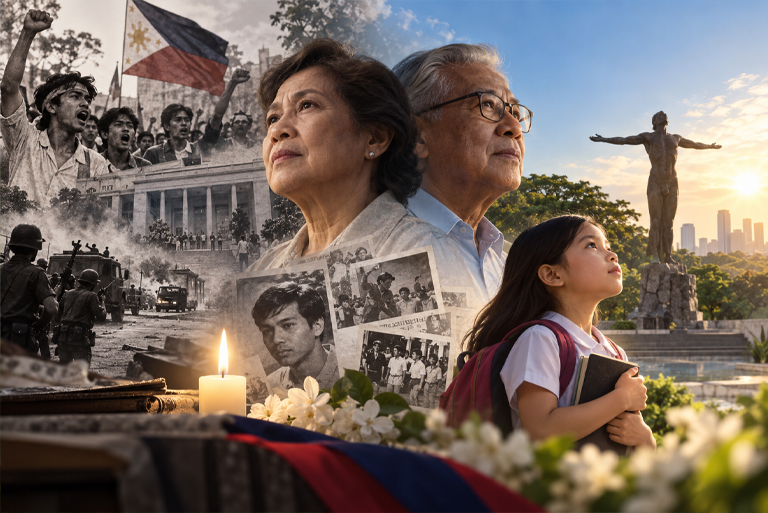
History lives not only in books and monuments, but in the memories of people who were there. As another generation grows up with no personal recollection of Martial Law, those memories become more—not less—important.
By Raffy Castillo
There are moments when a movie does more than entertain.
It opens a door.
For Dr. Ross Alonzo, watching the newly released film “Edjop,” based on the life of student leader Edgar “Edjop” Jopson, opened a door more than half a century into the past. The film, which opened in Philippine cinemas in September 2026, portrays Jopson’s journey from privileged student leader to underground activist during the Marcos era.
Suddenly, Doc Ross was young again.
She remembered the University of the Philippines in those turbulent years—the barricades, a professor’s burning car, the Molotov cocktails, and UP President Salvador P. Lopez resisting the entry of government forces into the campus.
“We will never forget,” she wrote after seeing the film.
Then came perhaps the more important thought:
“People should watch it. Sana ipa-movie review ng mga teachers so young people would know what Martial Law is.”
Her recollections concern the Diliman Commune of February 1–9, 1971, more than a year before Martial Law. It began when students supported striking jeepney drivers protesting an increase in fuel prices. Barricades went up. Violence followed. Mathematics professor Inocentes Campos fired at students after being prevented from driving through a barricade; freshman Pastor Mesina was fatally wounded, and Campos’s car was subsequently burned. UP’s historical records also document students preparing and using improvised incendiary devices and President Lopez opposing the use of police and military force to clear the university.
It was a volatile and complicated period. Protesters themselves sometimes resorted to violence, and armed communist insurgency and social unrest were real parts of the national context. Remembering history faithfully means acknowledging these realities too.
But none of that makes the abuses that followed imaginary.
When History Becomes Personal
For another physician, esteemed ophthalmologist and former Department of Health undersecretary, Dr. Jade del Mundo, remembering those years carries an almost spiritual dimension.
“I’m blessed that my memory is still intact to narrate this story which enriched my life,” he writes.
His hope is not simply that people remember dates, names or political arguments, but that personal testimony may move Filipinos “to ponder upon the events that happened in one of the most profound historical eras of our country.”
And then Doc Jade looks beyond politics:
“Pay homage to the God who ultimately holds our lives in His hand… acknowledge His grace and blessings in our lives.”
His reflection ends simply:
“To God be the glory.”
There is something powerful about hearing history from people who lived through it.
Eventually, eyewitnesses grow old. Their voices become fewer.
And memory passes from experience to history.
That transition is happening now.
What Happened Under Martial Law?
President Ferdinand E. Marcos placed the Philippines under Martial Law through Proclamation No. 1081 in September 1972. Military rule formally lasted until January 1981, although Marcos remained president until February 1986.
The historical record of human-rights violations is not based merely on partisan recollection.
Amnesty International documented widespread arbitrary arrests and detention, torture, enforced disappearances and killings during the period. Marcos himself told an Amnesty mission in 1975 that more than 50,000 people had been arrested and detained under Martial Law between 1972 and 1975.
Decades later, the Philippine government itself formally recognized victims.
Congress enacted Republic Act No. 10368, the Human Rights Victims Reparation and Recognition Act of 2013, acknowledging human-rights violations committed during the Marcos regime and establishing a process for recognition and reparation.
After evaluating claims, the Human Rights Victims’ Claims Board approved 11,103 claimants for monetary reparation, with another 125 recognized motu proprio.
These numbers deserve careful interpretation. They are the number of people officially recognized through that particular statutory process—not necessarily a complete census of everyone who suffered.
Behind every number was a person. A student. A journalist. A labor leader. A mother. A father. A son who never came home. And a family that continued living after him.
Why Remember Painful History?
Not so that children inherit their parents’ anger. Not so that one generation can perpetually condemn another. And certainly not so that political disagreement becomes hatred.
We remember because democracy depends partly upon institutional memory.
A society that understands how institutions can weaken is better equipped to protect them.
The purpose of remembering should therefore not be vengeance. It should be vigilance.
“The opposite of remembering is not forgiveness. We can forgive and still remember. The opposite of remembering is forgetting—and a nation that forgets loses one of its defenses against repeating its mistakes.”
The Lessons Martial Law Leaves Us
1. Democracy is more than elections.
Voting is indispensable, but constitutional democracy also depends upon independent courts, a functioning legislature, a free press, accountable security forces, academic freedom, civil society and citizens able to criticize government without fear.
Institutions matter precisely because no leader—whatever his or her popularity—should depend solely upon personal restraint.
2. Human rights belong even to people with whom we disagree.
Rights become meaningful when they protect the unpopular, the dissenter and the accused—not merely people whose views we share.
Government has both the authority and responsibility to confront violence, rebellion and crime. But constitutional government requires that state power itself remain bounded by law.
3. A free press is an early-warning system.
Journalists can be irritating to those in power. That is partly their purpose.
A press that investigates wrongdoing, questions official claims and presents competing viewpoints provides citizens information necessary for self-government.
The answer to inaccurate journalism should be correction, evidence and accountability—not the elimination of independent scrutiny.
4. Institutions must be stronger than personalities.
History repeatedly demonstrates the danger of concentrating power without effective checks. The lesson is not that every strong leader becomes a dictator. It is that democratic societies should never have to rely solely upon the goodness of whoever happens to hold office.
Could Martial Law Happen Again?
The Philippines learned constitutionally from its experience.
The 1987 Constitution deliberately placed safeguards around presidential martial-law powers. Martial law may initially be proclaimed for no more than 60 days and only in cases of invasion or rebellion when public safety requires it. The President must report to Congress within 48 hours; Congress may revoke or extend the proclamation; and the Supreme Court may review whether sufficient factual basis exists.
Perhaps most importantly, the Constitution explicitly states that martial law does not suspend the Constitution, replace civilian courts or legislative assemblies, automatically suspend the privilege of the writ of habeas corpus, or permit military jurisdiction over civilians where civil courts can function.
Those provisions represent lessons written into constitutional law. But constitutions ultimately require people and institutions willing to defend them.
Let the Young Watch—and Then Ask Questions
This is where Doc Grace’s suggestion about Edjop deserves attention.
Let students watch historical films. But do not stop with the movie.
Let them compare the screenplay with original documents. Let them read UP President Salvador Lopez’s own 1971 account of the Diliman barricades. Let them examine Martial Law proclamations, newspapers, court decisions, survivor testimonies, government records and accounts representing different experiences of the period. Teach them to distinguish a dramatized film from a documentary and an eyewitness memory from a complete historical record.
Then let them debate. Let them disagree. Let them ask uncomfortable questions. That, too, is democracy.
Edjop need not tell every viewer what to think. Its greater value may be making a generation born decades later curious enough to ask:
What happened? Why did it happen? And what can we learn from it?

Key References
University of the Philippines Diliman. History of UP Diliman and Diliman Commune Timeline—official institutional accounts of the February 1971 Commune.
Lopez SP. Developments in the University, February 1–5, 1971 During the Week of the Barricades. Report to the UP Board of Regents, reproduced in the UP Gazette.
Republic Act No. 10368. Human Rights Victims Reparation and Recognition Act of 2013.
Commission on Human Rights of the Philippines. Statement on the End of Operations of the Human Rights Victims’ Claims Board. May 18, 2018.
Amnesty International. Historical documentation of human-rights violations during Martial Law, including its 1975 mission to the Philippines.
Constitution of the Republic of the Philippines, 1987, Article VII, Section 18—constitutional safeguards governing martial law and suspension of the privilege of the writ of habeas corpus.







Leave a Reply