

By Henrylito D. Tacio
“Be thankful for the smallest blessing and you will deserve to receive greater. Value the least gifts no less than the greatest, and simple graces as special favors. If you remember the dignity of the Giver, no gift will seem small or mean.”—Thomas a Kempis
***
Reading is one of my favorite pastimes. I have a collection of books and magazines. Recently, while reading some back issues of Reader’s Digest, one of the features that caught my attention was the story of Major Frederick Franks.
Here’s how Suzanne Chazin wrote the story:
Major Frederick Franks stared at the Christmas tree in his drab hospital room. It was the time of year for joy, but Franks felt only sadness. Seven months earlier, in May 1970, while he was in Cambodia, grenade shrapnel had torn into the lower half of his left leg. Doctors were preparing to amputate it.
Franks had graduated from the US military academy at West Point, where he was captain of the baseball team, and he had planned to make the army his career. Now, retirement seemed the only option. Although Franks felt he still had a lot to offer the army – combat experience, technical knowledge, an ability to solve problems – he knew that soldiers with severe injuries seldom return to active duty. They must pass a yearly physical-fitness test, which includes a three-kilometer run or walk. Franks wasn’t sure he would be up to the task with prosthesis.
After the surgery, Franks felt saddest of all about giving up his prowess on the baseball diamond. At weekly games, he batted while someone else ran the bases for him.
Waiting to bat one day, he watched a teammate slide into base. ‘What’s the worst that could happen if I tried the same thing?’ he thought.
In his next turn with the bat, Franks hit the ball into center field. Waving away his runner, he began a painful, stiff-legged jog. Between first and second, he saw the outfielder throw the ball towards the second baseman. Closing his eyes, he willed himself forward and slid into second. The umpire called “Safe!” and Franks smiled triumphantly.
A few years later, Franks led a squadron through military exercises in rough terrain. His superiors wondered if an amputee was up to the challenge, but Franks showed them he was. “Losing a leg has taught me that a limitation is as big or small as you make it,” he said. “The key is to concentrate on what you have, not what you don’t have.”
In simpler terms, count your blessings each day. Sweat that small stuff, so goes a popular saying. “The things that count most cannot be counted,” a friend once told me. William A. Ward agrees: “The more we count the blessings we have, the less we crave the luxuries we haven’t.”
I once had the opportunity to visit a lovely home during sunset. As I gazed out of the expansive window, I commented on the stunning view they enjoyed with the sun setting. “Oh,” our host replied, “that occurs so frequently that we hardly notice it anymore.”
I ponder how many of us resemble my friend in his perception of the sunset. We possess numerous blessings that we often neglect to appreciate or acknowledge.
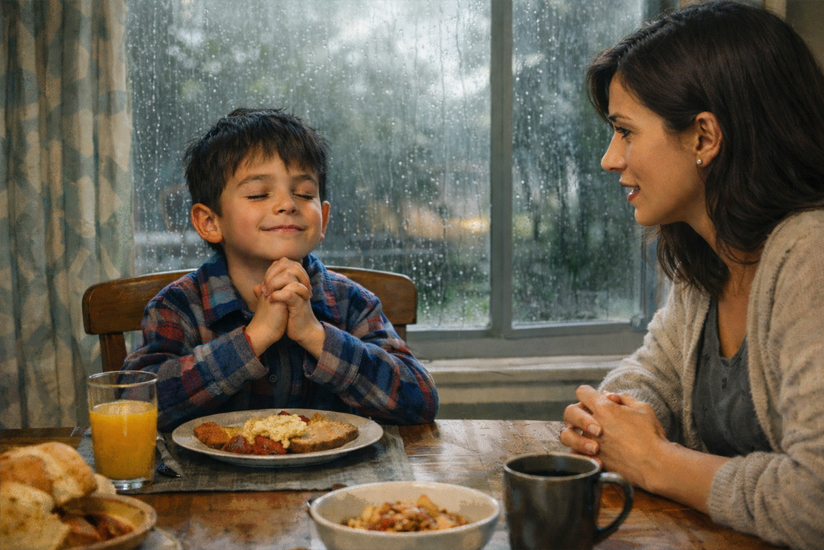
On a dreary, rainy morning, it was an eight-year-old boy’s turn to offer the blessing at breakfast. “We thank Thee for this beautiful day,” he prayed.
His mother, somewhat taken aback, inquired why he expressed that sentiment when the day was far from beautiful. “Mother,” he replied, displaying remarkable wisdom, “never judge a day by its weather.”
“People have been wonderful to me in the good times and the bad, and I’ve come to believe that you do indeed reap what you sow,” said Bob Losure. “For those who constantly gripe about life, I turn and walk away. For those who speak negatively about people behind their backs, I move on.”
“Look at the sunny side of everything,” Christian D. Larsen urges. “Think only of the best, work only for the best, and expect only the best. Be as enthusiastic about the success of others as you are about your own. Forget the mistakes of the past and press on to the greater achievements of the future. Give everyone a smile. Spend so much time improving yourself that you have no time left to criticize others. Be too big for worry and too noble for anger.”
In some instances, it may not be enough to count your blessings. You must share your blessings to others, too.
“Make something beautiful of your life,” Kathie Lee Gifford wrote in her 1992 book, I Can’t Believe I Said That. “Be a blessing, not a burden. Bloom wherever you are planted.”
Now, allow me to share a story.
A few years prior, a sailing vessel was destroyed during a tempest at sea. Fortunately, there were two survivors – both of whom were male – who managed to swim to a small, desert-like island.
Unsure of what to do next, the two survivors concurred that their only option was to pray to God. However, to determine whose prayer held more power, they decided to split the island into two territories and remain on opposite sides.
The first man prayed for food as his initial request. The following morning, he discovered a fruit-bearing tree on his side of the island, allowing him to eat its fruit. Meanwhile, the other man’s section of land remained unproductive.
After a week of solitude, the first man felt lonely and chose to pray for a wife. The next day, another ship was wrecked, and the sole survivor was a woman who swam to his side of the island. On the opposite side, there was nothing.
Soon, the first man prayed for a house, clothing, and more food. The following day, as if by magic, all of these were provided to him. However, the second man remained empty-handed.
Eventually, the first man prayed for a ship so that he and his wife could depart from the island. Upon waking, he discovered a ship anchored at his side of the island.
The first man boarded the ship with his wife and made the decision to leave the second man behind on the island. He deemed the other man unworthy of receiving God’s blessings, as none of his prayers had been fulfilled.
As the ship was preparing to depart, the first man heard a voice from heaven resounding, “Why are you abandoning your companion on the island?”
“My blessings are solely mine, as I was the one who prayed for them,” the first man replied. “His prayers went unanswered, and therefore he does not merit anything.”
“You are mistaken!” the voice chastised him. “He had only one prayer, which I granted. If it were not for that, you would not have received any of my blessings.
“Please tell me,” the first man inquired of the voice, “what did he request in his prayers that would make me indebted to him?”
The voice responded, “He prayed for the fulfillment of all your prayers.”
It is possible that our blessings are not solely the result of our own prayers, but rather the outcome of someone else praying on our behalf.
Charles Dickens reminds: “Reflect upon your present blessings, of which every man has many; not on your past misfortunes, of which all men have some.” And a Chinese proverb states, “Blessings never come in pairs; misfortunes never come alone.”