
By Reinard Erick G. Dollente
At the start of the year, I told myself I would finally get my health right – eat better, move more, be more disciplined. The intention was clear. The execution, not always.
The Routine vs. Real Life
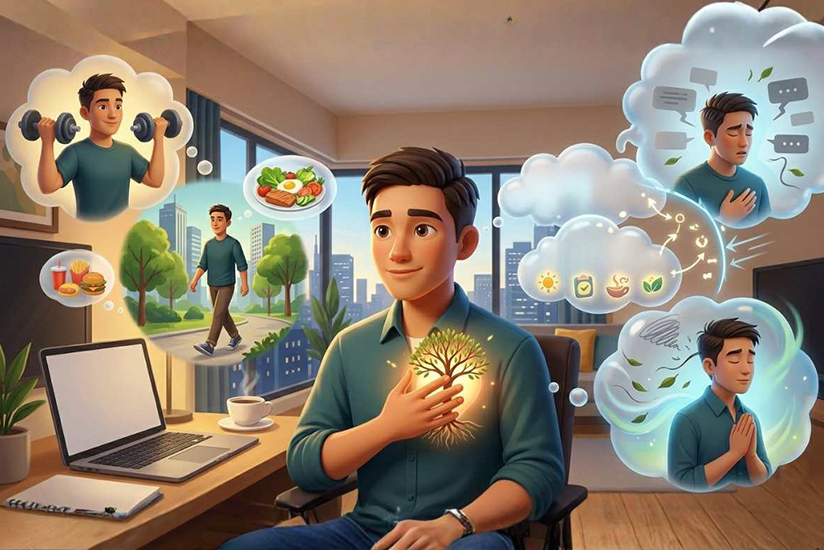
I work as a brand marketing associate, which means most of my day is spent sitting, thinking, planning, and managing deadlines. On paper, my routine looks decent. I get seven to eight hours of sleep. I try to eat balanced meals when I can. I even lift dumbbells and stretch in the morning. After work, I walk around BGC before heading back to my apartment.
But routines only tell part of the story.
Real life happens in between those routines – in the moments when convenience wins over discipline. There are days when cooking feels like another task I cannot handle after a long day, and fast food becomes the easiest option. Living alone means there is no one preparing meals for you. You either make the effort or choose what is available. And sometimes, what is available is not the healthiest choice.
When Stress Shows Up Physically
I used to think being healthy meant not getting sick. Now I realize it is about how you take care of yourself every single day, even in small, imperfect ways.
That realization did not come overnight. It came from noticing patterns, especially during moments of stress.
For me, stress does not stay in my head – it shows up in my body. Since college, I have noticed that whenever I am overwhelmed or exhausted, I get sick. I catch a cold. It is as if my body is forcing me to slow down when I refuse to do it on my own.
That same pattern followed me into work.
Being new in my role, I carried expectations that did not always match reality. I wanted to perform well, to prove myself, to keep up with everything at once. Over time, the pressure built quietly until it started showing physically. I noticed my hair falling more than usual, and that was when it hit me – something had to change.
“Your body keeps score of the stress you try to ignore.”
Protecting Your Peace
That moment forced me to pause. But pausing is easier said than done. Stress does not disappear just because you acknowledge it. It requires constant management, and sometimes, the simplest ways are the most effective.
There are still moments when I react, complain, or feel overwhelmed. But I have learned to interrupt that pattern, even briefly. Sometimes I just stop, say a quick prayer, and then continue. It is not a complete reset, but it gives me enough space to regain control.
From there, I began to understand that taking care of your heart is not just about physical habits. It is also about what you allow to occupy your mind.
I realized that one of my biggest energy drains was getting involved in things I could not control – situations, opinions, and outcomes that were never mine to carry. The more attention I gave them, the more exhausted I felt.
Not everything you think about deserves your attention. Not everything you feel deserves your energy.
The Habits That Actually Matter
Letting go of that habit is still a work in progress, but it has made me more aware of where my energy goes. And once you become aware, you start making better choices, even in small ways.
That is where daily habits come in – not the ideal ones, but the realistic ones.
Walking after work, even when I feel tired. Prioritizing sleep because I know how it affects my mood and focus. Choosing better food options when I have the chance, even if it is not perfect.
It is not about doing everything right. It is about doing something consistently.
At the same time, there are still gaps. Health check-ups, for example, are not something I prioritize unless necessary. Like many people, I rely on annual company exams and assume everything is fine unless something feels wrong.
But the more I reflect on it, the more I realize that waiting for symptoms is not really taking care of your health – it is reacting to it.
Prevention is quiet. That is why it is often overlooked.
Building Health Daily
And that brings me back to what taking care of the heart really means. It is not just about food or exercise. It is not just about avoiding illness. It is about living in a way that supports your overall well-being – physical, mental, and emotional.
Because once one area is neglected, the others eventually follow.
Looking back, one realization stands out: living a healthy lifestyle is not something you fix overnight – it is something you build daily. And if you continue to delay it, you will eventually feel the consequences.
If I could talk to the version of myself who kept postponing health, I would keep it simple: eat better, move more, and take care of your mind. Not because you need to be perfect, but because you deserve to feel better.
Ending
Because heart health is not built in big moments. It is built in the quiet decisions no one sees.
Takeaway Message
Small, consistent choices shape your long-term health – what you do daily matters more than what you intend occasionally.










Leave a Reply