


Could this deadly infection reach Philippine shores—and are we prepared?

Most people fear viruses spread by coughing crowds, mosquito bites, or contaminated food. But one of the world’s deadliest viral infections may arrive much more quietly—through rodent droppings, urine, saliva, or dust contaminated by infected rats and mice. Hantavirus disease, though relatively rare, carries a frightening mortality rate and can rapidly progress from flu-like symptoms to life-threatening respiratory failure or kidney injury. As climate change, urban crowding, flooding, and poor sanitation reshape the global infectious disease landscape, health experts warn that countries like the Philippines cannot afford complacency. The good news is that the risk of this dreaded virus reaching our shores is still low at this point; but awareness and prevention are essential and remain powerful defenses.
By Rebecca Lorenzo-Castillo
The Virus Hidden in the Dust
Imagine cleaning an old storage room after months of neglect.
There are signs of rats:
- droppings in corners
- shredded paper
- stale odor
- nests behind boxes
You sweep vigorously. Dust rises into the air.
What many people do not realize is that under certain conditions, microscopic viral particles from rodent waste may also become airborne—and inhaled.
This is one of the primary ways hantavirus spreads to humans.
Unlike COVID-19 or influenza, hantavirus is not primarily spread from person to person in most strains. Instead, it is largely linked to infected rodents.
That makes environmental sanitation critically important.
What Is Hantavirus?
Hantaviruses are a group of viruses carried mainly by rodents.
Different strains cause different syndromes:
Hantavirus Pulmonary Syndrome (HPS)
- Seen mainly in the Americas
- Causes severe lung disease
Hemorrhagic Fever with Renal Syndrome (HFRS)
- Seen more commonly in Asia and Europe
- Primarily affects kidneys and blood vessels
Both forms can be severe and potentially fatal.
Where Did the Recent Hantavirus Cases Originate?
Recent reports of hantavirus infections that have alarmed health authorities largely originated from isolated cases and localized outbreaks in parts of the Americas, Europe, and Asia where rodent populations carrying hantaviruses are naturally found.
As of May 8, 2026, the WHO and CDC are monitoring a cluster of Andes virus (a hantavirus) cases linked to a cruise ship that traveled from Argentina to Cape Verde. There were 8 reported cases (6 confirmed) and 3 deaths (CFR of ~38%).
In the United States and parts of Latin America, most cases involve Hantavirus Pulmonary Syndrome (HPS), a severe respiratory illness linked to exposure to infected wild rodents, particularly deer mice. Meanwhile, several Asian and European countries have long monitored another form called Hemorrhagic Fever with Renal Syndrome (HFRS), which primarily affects the kidneys.
These infections are considered zoonotic diseases—meaning they are transmitted from animals to humans rather than spreading efficiently between people.
This distinction is important.
Unlike highly contagious respiratory viruses such as COVID-19, influenza, or measles, hantavirus does not typically spread easily from person to person. In most documented outbreaks worldwide, transmission occurs through direct environmental exposure to contaminated rodent urine, droppings, saliva, or aerosolized particles from infested areas.
Because of this, experts currently consider the likelihood of widespread community transmission in the Philippines to be relatively low under ordinary circumstances. The Andes virus strain (the one in the news right now) is the only hantavirus known to spread between humans through prolonged close contact. This as “uncommon” and “limited,” which is the expert consensus.
However, “low risk” does not mean “no risk.”
The Philippines possesses several environmental conditions that could theoretically support sporadic cases if infected rodent reservoirs or imported exposures occur. Urban crowding, flooding, poor waste management, and close human-rodent interaction remain public health vulnerabilities that deserve attention—not panic, but preparedness.
The reassuring reality is that hantavirus outbreaks are generally controllable through:
- proper sanitation
- rodent control
- safe cleaning practices
- public awareness
In many ways, hantavirus serves less as a signal for alarm and more as a reminder of the critical importance of environmental hygiene and disease surveillance in an interconnected world. The greater danger may not be imminent widespread transmission—but complacency toward the environmental conditions that allow zoonotic diseases to emerge.
“The greater danger may not be imminent widespread transmission—but complacency toward the environmental conditions that allow zoonotic diseases to emerge.”
Is the Philippines at Risk?
This is the critical question.
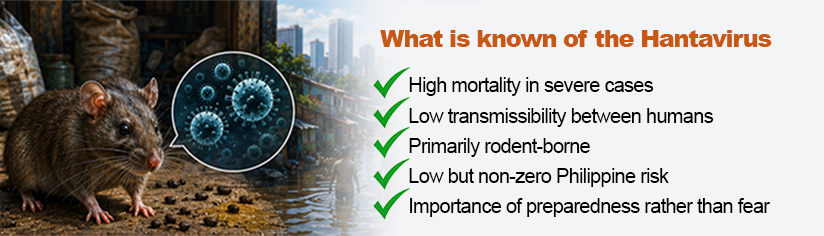
At present, the Philippines has not reported any outbreak of classic hantavirus pulmonary syndrome comparable to those seen in the Americas. However, the country possesses several risk factors that warrant vigilance:
—Tropical climate favorable to rodents
—Urban overcrowding
—Flooding and poor sanitation
— Informal settlements with rodent exposure
—Expanding human encroachment into wildlife habitats
Rodents are abundant in both urban and rural Philippine settings.
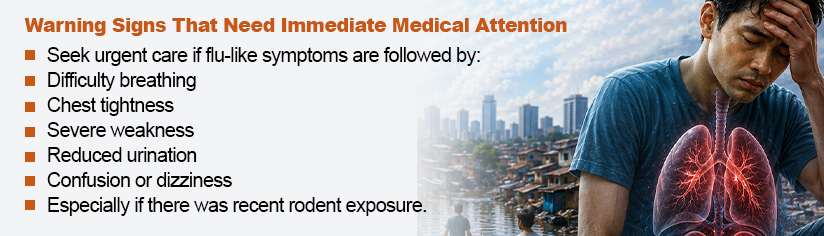
While confirmed human hantavirus disease remains uncommon locally, experts recognize that underdiagnosis is possible because early symptoms resemble many other tropical infections.
Why Hantavirus Can Be Missed
Early symptoms are nonspecific:
· Fever
· Muscle pain
· Fatigue
· Headache
· Nausea
These resemble:
- influenza
- dengue
- leptospirosis
- COVID-19
- other viral illnesses
Later stages may rapidly worsen.
In HPS:
—Severe shortness of breath
—Respiratory failure
—Shock
In HFRS:
—Kidney injury
—Bleeding problems
—Low blood pressure
How Is Hantavirus Transmitted?
The virus is carried by infected rodents and shed through:
- urine
- saliva
- droppings
Humans become infected mainly by:
· Inhaling contaminated dust
· Touching contaminated surfaces then touching the face
· Rarely, rodent bites
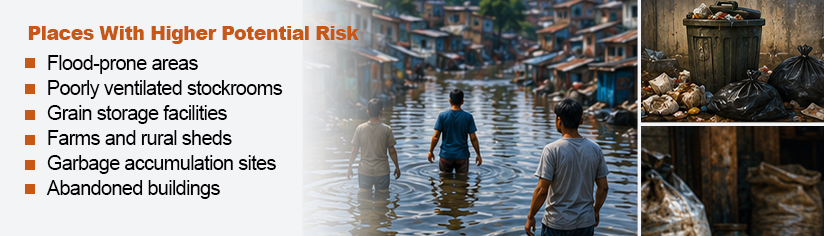
Activities associated with risk include:
- cleaning infested areas
- entering abandoned buildings
- handling stored materials
- farming or field work
- sleeping in rodent-infested areas
The Filipino Context: Why Rodent Control Matters
Rodents are more than a nuisance.
In the Philippines, rats are already linked to diseases such as:
- leptospirosis
- salmonellosis
- plague historically
- other zoonotic infections
Climate-related flooding increases rodent displacement and human exposure. Urban congestion and improper waste disposal further worsen risk. The lesson is broader than hantavirus alone: Rodent control is public health protection.
How Do We Prevent Hantavirus?
- There is currently no widely available specific vaccine for most hantavirus infections.
- Prevention focuses heavily on avoiding rodent exposure.
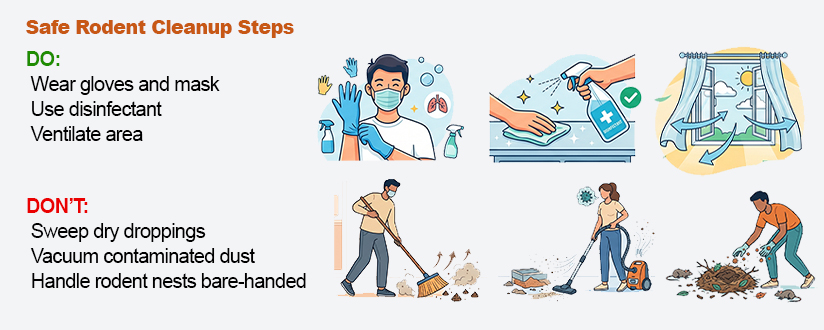
- Safe Cleaning Practices
- Never aggressively sweep or vacuum rodent droppings.
Instead:
- Ventilate the area first
- Wear gloves and mask
- Spray disinfectant or bleach solution
- Wipe gently with disposable material
This reduces aerosolization of viral particles.
Rodent Control
- Seal holes in homes
- Store food properly
- Dispose of garbage correctly
- Eliminate clutter where rodents nest
- Flood and Disaster Preparedness
After floods:
—Use protective equipment during cleanup
—Avoid direct contact with contaminated water or debris
Workplace Protection
Important for:
- farmers
- warehouse workers
- janitorial staff
- disaster response personnel
How Is Hantavirus Diagnosed?
Diagnosis involves:
- clinical suspicion
- exposure history
- laboratory testing
Tests may include:
- Serology
- PCR testing
- Blood tests showing platelet abnormalities or kidney injury
Is There a Treatment?
There is no universally specific antiviral cure for most hantavirus infections.
Treatment is mainly:
- supportive care
- oxygen therapy
- intensive care support
- dialysis in severe kidney involvement
Early recognition significantly improves survival.
A Broader Public Health Lesson
Hantavirus reminds us of something modern society often forgets:
Human health is deeply connected to environmental health.
Poor sanitation, climate disruption, flooding, urban overcrowding, and ecological imbalance all create conditions where zoonotic diseases emerge more easily.
The next infectious threat may not arrive dramatically through airports alone.
Sometimes, it may emerge quietly from neglected corners, contaminated dust, and unchecked environmental decay.
Final Reflection
The fear surrounding hantavirus comes not only from its severity—but from its invisibility.
A virus carried by ordinary rodents. Exposure during ordinary cleaning. Symptoms beginning like an ordinary fever. Yet hidden within these ordinary moments is the possibility of extraordinary danger.
Fortunately, awareness changes outcomes. Because in infectious disease prevention, knowledge is often the first—and most effective—form of protection.
References
- Centers for Disease Control and Prevention (CDC). Hantavirus information and prevention guidelines.
- World Health Organization (WHO). Hantavirus diseases overview.
- Jonsson CB, et al. A global perspective on hantavirus ecology, epidemiology, and disease. Clin Microbiol Rev. 2010;23(2):412–441.
- Vaheri A, et al. Hantavirus infections in Europe and their impact on public health. Rev Med Virol. 2013.
- Kruger DH, et al. Hantaviruses—globally emerging pathogens. J Clin Virol. 2015.
- Department of Health (Philippines). Zoonotic disease and sanitation advisories.
- CDC. Cleaning and disinfection guidelines for rodent infestation.
- Hjelle B, Torres-Pérez F. Hantaviruses in the Americas and their role as emerging pathogens. Viruses. 2010.










Leave a Reply