

By Dr. Tony Leachon
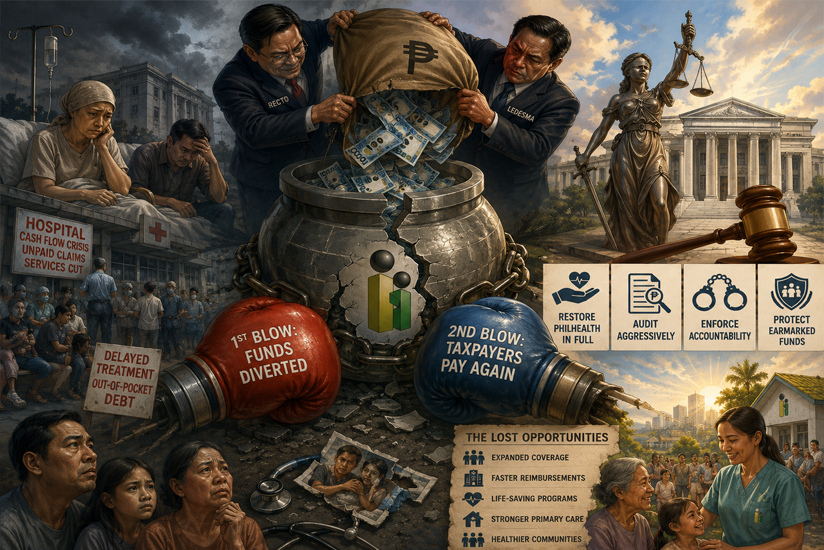
The ₱60-billion diversion from PhilHealth reserves is not only unconstitutional—it is a double blow to the Filipino people. First, protected health funds were taken away. Then, when the Supreme Court struck down the transfer, the government “restored” the money not by undoing the original disbursements but by charging the replacement to the 2026 General Appropriations Act (GAA). In effect, taxpayers are asked to pay twice: once when the funds were siphoned off, and again when the Treasury refills the hole.
The Double Whammy
• September 20, 2025: President Marcos announced at Fabella Hospital that PhilHealth would be funded. Technically, the national treasury should have immediately released the subsidy.
• December 5, 2025: The Supreme Court declared the ₱60-billion transfer unconstitutional. Instead of restoring the funds directly, the Department of Finance waited for the ruling and then charged the replacement to the 2026 GAA.
• April 2026: DBM records show a ₱60-billion allotment release to PhilHealth, fulfilling the Court’s order—but through fresh taxpayer money.
This sequence creates a double jeopardy for citizens: the original health fund was depleted, and the restoration is now borne by the same public purse.
The Immediate Impact
While the restoration is booked in the 2026 budget, the damage was already done. The absence of funds at the time of diversion had real, immediate consequences:
• For a cancer patient: Without expanded benefit packages or timely reimbursements, treatment may have been delayed or paid out-of-pocket, forcing families into debt.
• For a struggling hospital: Cash flow disruptions meant unpaid claims, delayed salaries, and reduced services. Some hospitals faced closures or cutbacks, undermining care delivery.
• For the health system: The diversion eroded trust in earmarked funds, showing how quickly reserves meant for universal health care can be treated as disposable cash.
Restoration is not reversal. The injustice has already been inflicted, and the human cost cannot be undone by a budget entry.
The Lost Opportunities
Beyond the double payment lies a deeper injustice: the lost opportunities for the ₱60 billion that was taken. That amount could have:
• Expanded PhilHealth coverage to millions of uninsured Filipinos.
• Accelerated reimbursements to hospitals, preventing closures and service interruptions.
• Funded life-saving programs for cancer, dialysis, and heart disease patients.
• Strengthened primary care and preventive health services in underserved communities.
Instead, the diversion meant delayed treatments, unpaid hospitals, and foregone improvements in universal health care. Every peso lost translated into a patient denied care, a hospital left struggling, or a family forced into debt.
The Right Response
1. Restore PhilHealth in full. Leaving the insurer unrepaired would punish patients and hospitals further.
2. Audit aggressively. Every peso of the original ₱60 billion must be traced. If ghost projects, fraud, or unlawful spending are found, recovery actions must follow.
3. Enforce accountability. Recto and Ledesma must face plunder charges. The act was not only legally wrong but morally bankrupt, undermining the Universal Health Care Law and the Sin Tax Law’s earmarking provisions.
4. Protect earmarked funds. This case proves the need for stronger safeguards so that health, education, and social protection funds cannot be casually reclassified as “excess” and swept into the Treasury.
Conclusion
The PhilHealth diversion is a cautionary tale. It shows how quickly protected funds can be treated as disposable cash, and how easily taxpayers can be made to pay twice for the same abuse.
The greater tragedy is the lost opportunity injury inflicted on millions of Filipinos—patients who could have been healed, hospitals that could have been sustained, and communities that could have been strengthened. When government betrays health funds, it betrays the people’s trust, their dignity, and their right to care.
The Supreme Court was right to reject the transfer. Now, accountability must follow. Otherwise, the double whammy—and the lost opportunities—will remain a wound without justice.
#RelentlessForChange
References
• Supreme Court of the Philippines – Decision on PhilHealth Fund Diversion, December 5, 2025
• Department of Budget and Management – Allotment Release Records for PhilHealth, April 2026
• Department of Finance – Statement on PhilHealth Funding, January 2026
• Daily Tribune – PhilHealth Diversion Sparks Accountability Debate, April 2026









Leave a Reply