
Dr. Anthony Leachon Seeks Urgent Oral Arguments on Continuing UHC Funding Crisis

By Reuben Ricallo
The long-running constitutional controversy surrounding government funding for the Philippine Health Insurance Corp. (PhilHealth) has once again intensified, as independent health reform advocate and H&L columnist, Dr. Anthony C. Leachon, through Nabua Law Offices, filed an Urgent Manifestation and Motion to Admit Supervening Events and for Immediate Calendar of Oral Arguments before the Supreme Court of the Philippines on May 14, 2026.
The filing revives national attention on one of the most consequential public health financing debates since the enactment of the Universal Health Care (UHC) Act in 2019.
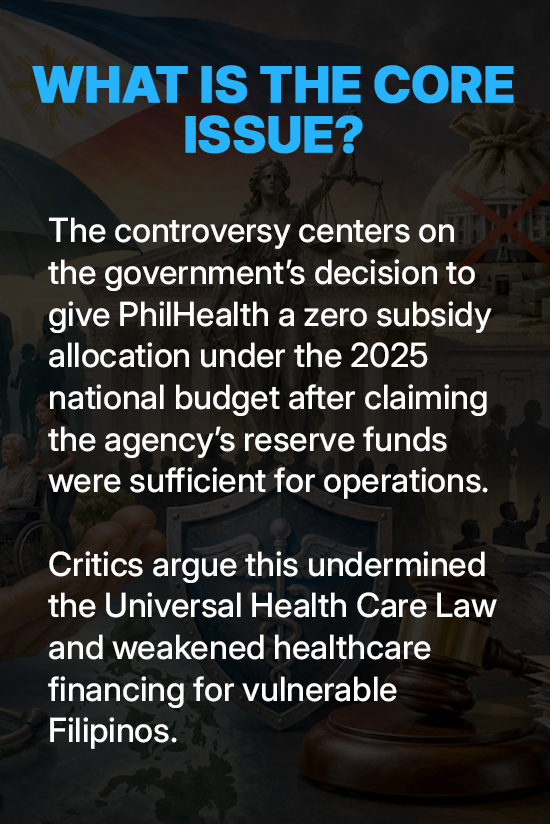
At the center of the controversy is the zero subsidy allocation for PhilHealth under the 2025 General Appropriations Act (RA 12116). Critics argued that removing government subsidy support from PhilHealth—on the assumption that the state insurer possessed sufficient reserve funds—undermined the very spirit of universal health care.
Dr. Leachon initially challenged the measure before the Supreme Court on February 25, 2025, questioning its constitutionality and warning of long-term consequences for healthcare financing, especially for indigent and vulnerable Filipinos.
More than a year later, the petition remains unresolved, with no oral arguments yet conducted.
The “Double Payment” Controversy
The issue became even more politically and fiscally charged after the Supreme Court’s December 5, 2025 ruling declaring unconstitutional the ₱60-billion transfer of PhilHealth reserve funds to the National Treasury.
However, according to the motion filed by Dr. Leachon’s legal team, the eventual restoration of these funds through the 2026 General Appropriations Act effectively means taxpayers may be “paying twice” for funds that critics argue should never have been diverted in the first place.
The motion argues that several “supervening events” now justify urgent judicial intervention, including:
- The continued implementation of the 2026 GAA without full subsidy allocations for indirect contributors;
- The lingering fiscal and operational consequences of the reserve fund diversion;
- Continuing public and legislative debate over PhilHealth financing and hospital support;
- The ongoing impact on indigent patients, senior citizens, and medically vulnerable sectors.
According to the filing, these developments demonstrate that the constitutional controversy remains “live, actual, and of transcendental public importance.”
More Than a Budget Dispute
The controversy extends far beyond technical budgetary arguments.
Health policy experts note that the case strikes at the core of the Universal Health Care Act’s implementation framework, where PhilHealth serves as the central financing mechanism for expanding healthcare access nationwide.
The petition also raises broader constitutional questions:
- Are earmarked healthcare funds sufficiently protected from diversion?
- Can government treat PhilHealth reserves as excess fiscal resources during budgetary shortfalls?
- To what extent does the Constitution obligate the State to sustain healthcare financing for vulnerable populations?
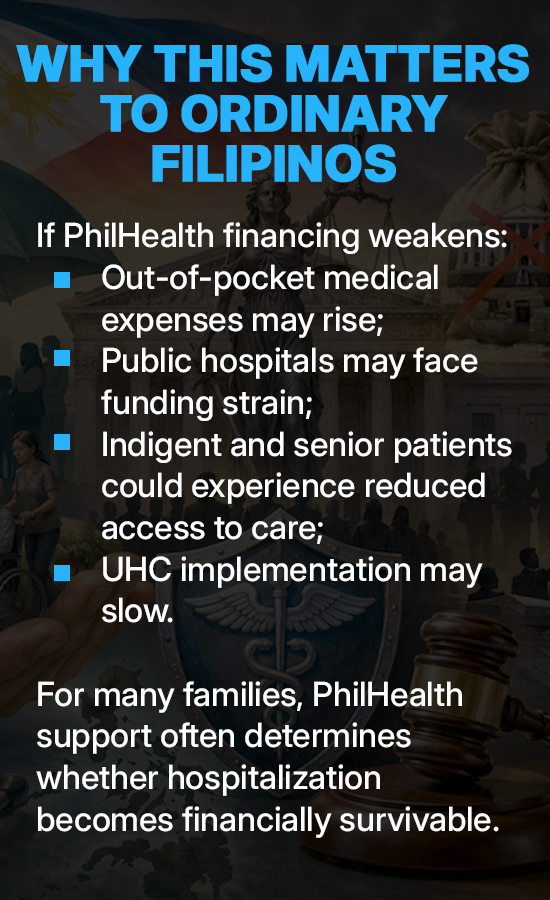
These issues have become increasingly urgent as hospitals continue facing operational strain, healthcare costs rise, and many Filipino families remain heavily dependent on out-of-pocket spending despite UHC reforms.
Healthcare Financing and Public Trust
The controversy has also evolved into a public trust issue.
For many Filipinos, the optics of removing PhilHealth subsidies while millions continue struggling with hospitalization costs created a profound disconnect between fiscal policy and healthcare realities.
Public health advocates argue that healthcare financing should not merely be viewed as an accounting exercise, but as a core social protection mechanism.
Critics of the subsidy removal maintain that in a country where catastrophic health spending remains common, there is effectively “no such thing as excess healthcare funds.”
A Defining Test for UHC
The motion filed before the Supreme Court may ultimately become a defining legal and policy test for Philippine Universal Health Care.
Its outcome could influence not only future budget allocations, but also the broader principles governing the protection, management, and constitutional treatment of healthcare funds.
In its concluding statement, Dr. Leachon’s legal team described the action as “Herculean for a private citizen,” but necessary “to ensure that this abuse is never forgotten, and never repeated again.”
Whether the Supreme Court grants immediate oral arguments may now determine how quickly the country confronts one of the most consequential healthcare financing disputes in recent Philippine history.
“In a country where catastrophic health spending remains common, many public health advocates argue there is effectively no such thing as ‘excess healthcare funds.”









Leave a Reply