
Health reform advocate says financing Universal Health Care requires both adequate public funding and stronger prevention, as Filipinos still pay 41.2 percent of current health expenditures directly from their pockets
By Rafael R. Castillo, MD
The debate over the country’s 2027 health budget is increasingly becoming a debate over a larger question: Who should ultimately pay when a Filipino gets sick?
Health reform advocate Dr. Tony Leachon is calling on the government and Congress to address the roughly P170-billion gap between PhilHealth’s proposed 2027 allocation and its projected claims payments for government-subsidized members, while supporting stronger health taxes on products associated with preventable disease.
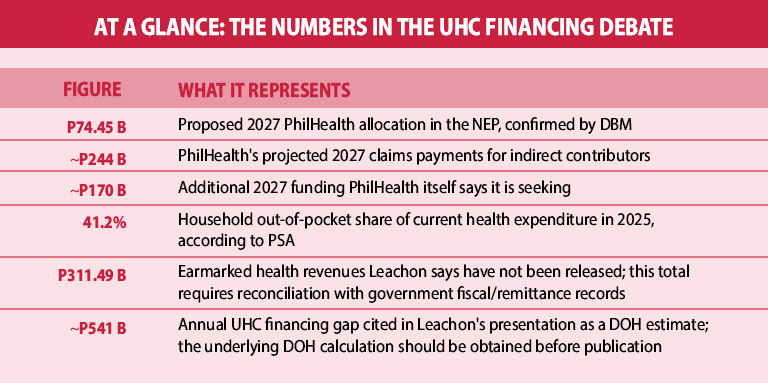
Under the proposed 2027 national budget, the Department of Budget and Management has allocated P74.45 billion to PhilHealth, including P19 billion for benefit improvements and other priority health interventions. DBM says the allocation would support premium subsidies for approximately 11.09 million qualified beneficiaries.
But PhilHealth itself says considerably more will be required.
During Senate budget deliberations earlier this month, PhilHealth President and CEO Beverly Lorraine Ho said the state insurer expects payments for claims of indirect contributors to reach about P244 billion in 2027. With only about P74 billion currently provided under the National Expenditure Program, PhilHealth is seeking approximately P170 billion more.
Leachon argues that closing that gap should be an immediate health-financing priority.
“The minimum budget is P540 billion every year for Universal Health Care to be real,” Leachon said in a Bilyonaryo interview on September 29.
For Leachon, however, the issue goes beyond PhilHealth’s 2027 appropriation. His presentation argues that the country must address the broader financing requirements of the Universal Health Care program and ensure that revenues legally intended for health ultimately finance health services.
The number patients feel most: 41.2%
Behind the billions being debated in government lies a much more personal number.
41.2%.
According to the Philippine Statistics Authority’s latest National Health Accounts, Filipino households directly paid 41.2% of the country’s current health expenditure in 2025. Government and compulsory contributory schemes accounted for 46.5%, while voluntary healthcare payment schemes represented 12.3%. Total Philippine health expenditure reached P1.87 trillion in 2025.
Although the out-of-pocket share improved from 42.7% in 2024, it means households still directly shoulder a substantial portion of healthcare costs.
That is where abstract arguments about billions of pesos become painfully concrete.
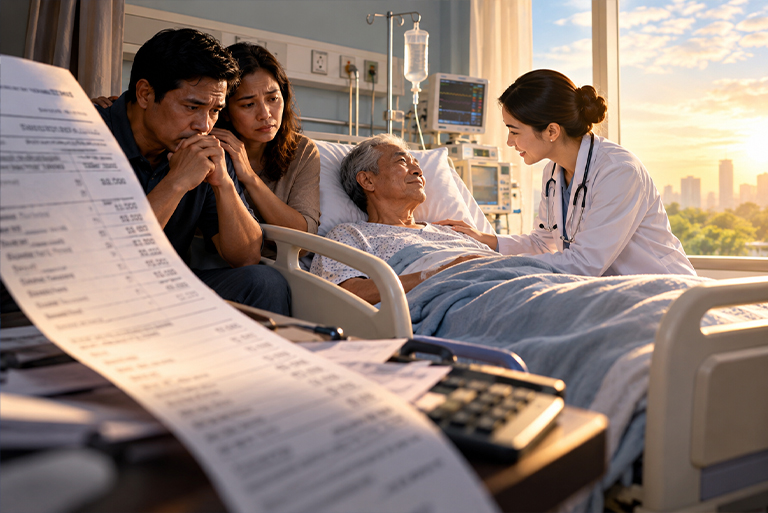
For an ordinary Filipino family, out-of-pocket expenditure can mean money for medicines instead of food, a diagnostic test postponed until payday, savings depleted by hospitalization, or relatives borrowing money because PhilHealth and other coverage do not meet the entire bill.
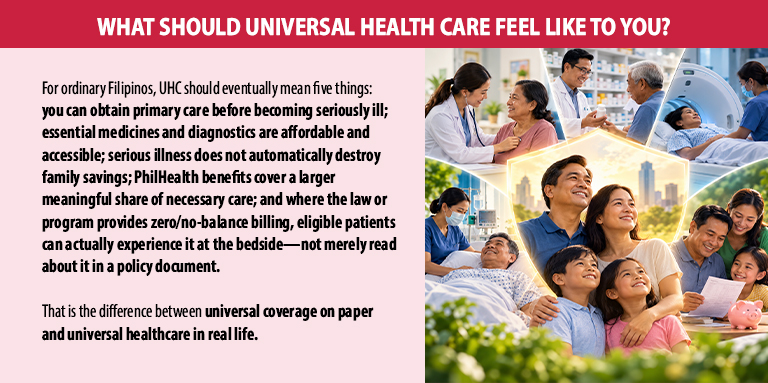
Reducing that burden is one of the central promises of Universal Health Care.
Where are the earmarked funds?
Leachon is also seeking the release of what his presentation calculates as P311.49 billion in funds legally earmarked for health, which he says include unreleased revenues associated with sin taxes and mandated contributions from PAGCOR and PCSO.
“P311 billion ang hindi binibigay,” he said, arguing that revenues intended by law for healthcare should reach their intended health-financing destinations.
The precise P311.49-billion total requires reconciliation against government fiscal and remittance records. It should therefore be understood at this stage as Leachon’s calculation and policy claim, rather than an independently established government accounting figure.
Similarly, Leachon’s presentation cites a Department of Health estimate of an approximately P541-billion annual UHC financing gap. That figure warrants confirmation against the underlying DOH financing projection, particularly because “UHC funding gap,” PhilHealth’s subsidy requirement, total health-system expenditure and PhilHealth claims obligations describe different financial concepts and should not be used interchangeably.
What is independently documented, however, is PhilHealth’s immediate budget concern: the corporation has publicly asked for roughly P170 billion more for 2027 because projected claims payments for indirect contributors alone are expected to reach about P244 billion.
Health taxes: raising money while preventing disease
Leachon’s second major proposal approaches the financing problem from the other end.
Instead of asking only how government can raise more money to treat disease, he asks whether taxation can simultaneously help prevent some of that disease.
“Health taxes are not simply about raising revenue. They are also about preventing disease and protecting Filipinos from the costs of illness,” he said.
Leachon expressed support for the Department of Finance’s proposed ProGRESS Bill—Promoting Growth, Revenue, and Equity towards Socio-Economic Sustainability—which is undergoing nationwide stakeholder consultations.
The DOF describes ProGRESS as a broader tax-reform package intended to provide tax relief while strengthening government revenue for public services and long-term development. Among its headline proposals is raising the annual personal income-tax exemption threshold from P250,000 to P350,000.
Leachon supports the package’s health-tax component but argues that its provisions should be strong enough both to discourage consumption of harmful products and generate meaningful resources for health.
His recommendations include a unified P80-per-mL tax on freebase and nicotine-salt vape products, inclusion of cigarettes in the health-tax package, inclusion of fermented liquor in proposed alcohol-tax reforms, and removal of exemptions for products such as 3-in-1 coffee and flavored and fermented milk under sweetened-beverage taxation.
Those proposals remain policy recommendations and would ultimately be matters for Congress to debate, including their health effects, revenue implications, distributional impact and possible effects on consumers and industries.
Prevention and financing must meet
Leachon’s larger argument is that Universal Health Care cannot depend indefinitely on paying larger bills after Filipinos become ill.
The financing side matters: PhilHealth must have sufficient resources to pay claims, expand benefits and reduce what patients pay themselves.
But so does prevention.
Tobacco use, harmful alcohol consumption, unhealthy diets, obesity, hypertension and other preventable or modifiable risks eventually translate into heart attacks, strokes, cancers, diabetes, kidney disease and other costly illnesses.
Thus, in Leachon’s formulation, health taxes have a dual purpose: reduce exposure to harmful products and help finance the health consequences that remain.
“The health system needs sustainable financing, but it also needs to prevent people from getting sick in the first place,” he said.
More money—but also measurable results
The administration, for its part, says the proposed 2027 budget contains other measures intended to reduce patients’ financial burden.
DBM has approved P10.377 billion for Zero Balance Billing, including P9.377 billion for DOH hospitals and P1 billion for six pilot LGU hospitals. The proposed budget also provides P25.39 billion for the National Health Workforce Support System and proposes P3.75 billion for the Cancer Assistance Fund.
These investments illustrate an important distinction in the health-budget debate.
The question is not simply whether government is spending more or less.
It is whether each peso produces better financial protection and better health.
For patients, the meaningful outcomes are simpler: Are medicines available? Are doctors and nurses accessible? Can illnesses be detected earlier? Are PhilHealth benefits sufficient? Can someone enter a government hospital without the family having to borrow heavily or sell property?
And, ultimately: When illness strikes, how much does the Filipino family still have to pay?
The unfinished promise of UHC
Seven years after the Universal Health Care Act was enacted, the Philippines has built important elements of a system intended to make healthcare accessible to all Filipinos.
But financing remains one of its central challenges.
The latest official statistics show some movement: government’s share of current health spending rose while the household out-of-pocket share declined from 42.7 percent in 2024 to 41.2 percent in 2025. Yet four pesos out of every ten pesos of current healthcare expenditure still come directly from households.
The coming congressional deliberations over PhilHealth’s 2027 budget and the government’s ProGRESS tax package therefore represent more than arguments over fiscal tables.
They raise fundamental choices about how healthcare should be financed, how much should be raised through health-related taxation, how earmarked revenues should be accounted for, and how government can demonstrate that additional spending actually reaches patients.
Leachon’s prescription combines four elements: adequately fund PhilHealth, account for and release revenues legally earmarked for health, strengthen prevention, and design health taxes capable of both discouraging harmful consumption and supporting UHC.
Whether lawmakers adopt those specific recommendations will be decided through the legislative and budget processes.
But the standard by which any resulting policy should ultimately be judged is much closer to home: Does it make getting sick less financially devastating for an ordinary Filipino family?
“Health taxes are not simply about raising revenue. They are also about preventing disease and protecting Filipinos from the costs of illness.” — Dr. Tony Leachon

KEY REFERENCES
For the H&L print/online version, I would keep the bibliography authoritative and relatively compact:
- Republic Act No. 11223 — Universal Health Care Act. Particularly Sections 7–10 and 37, covering financial protection, PhilHealth entitlement and UHC financing sources.
- Philippine Statistics Authority. Philippine National Health Accounts 2025. Government and compulsory schemes accounted for 46.5% of current health expenditure; household out-of-pocket payments accounted for 41.2% or approximately P714.63 billion.
- Department of Budget and Management. Proposed FY 2027 PhilHealth allocation. The proposed allocation is P74.45 billion, including P19 billion for benefit improvements and other priority interventions; DBM also reports P10.377 billion approved for Zero Balance Billing implementation.
- House of Representatives of the Philippines. 2027 DOH budget deliberations. PhilHealth President Beverly Lorraine Ho sought restoration of at least ₱170 billion beyond the amount contained in the NEP to help finance indirect contributors.
- Senate budget deliberations/PhilHealth 2027 financing. PhilHealth projects approximately P244 billion in claims payments for indirect contributors and has requested roughly P170 billion above the current allocation. PhilHealth also reported a goal of reducing household out-of-pocket spending to 37% by 2028.
- Department of Finance. ProGRESS Bill stakeholder consultations, 2026. The proposed package combines tax relief with revenue measures involving products with health, social and environmental costs; DOF says revenues from these measures would help support UHC and other priority programs.
WHEN GETTING SICK MEANS GOING INTO DEBT
Why out-of-pocket spending may be the most important number in Universal Health Care

By the H&L Editorial Team
Universal Health Care can sound like an enormous government project made up of appropriations, actuarial estimates, premium subsidies and billions of pesos.
For the patient, however, UHC can ultimately be reduced to a much simpler question:
When I get sick, how much will my family still have to pay?
That is why one figure deserves special attention in the debate over PhilHealth’s 2027 budget:
41.2%.
According to the Philippine Statistics Authority, Filipino households directly paid P714.63 billion, or 41.2% of the country’s current health expenditure, in 2025. Government and compulsory contributory schemes accounted for 46.5%, while voluntary healthcare payment schemes accounted for 12.3%.
That 41.2% is more than an economic statistic.
It is the cancer patient buying medicines not fully covered by insurance.
It is the father paying for laboratory tests from his salary.
It is the elderly widow purchasing maintenance medications every month.
It is the family borrowing from relatives after an unexpected hospitalization.
It is the patient delaying a diagnostic test because payday is still two weeks away.
And sometimes it is the Filipino who simply does not seek care because he cannot afford to discover what is wrong.
Why 41.2% still matters
There has been progress. Health officials told the Senate that out-of-pocket spending has declined from roughly 55% of health spending a decade ago to 41.2% in 2025. PhilHealth’s share increased to about 19.5%. The government’s current target is to bring household out-of-pocket spending down further, to 37% by 2028.
But even 41.2% means that a very large part of healthcare financing still lands directly on families.
And health expenses differ from many household purchases.
We can postpone buying a new television.
We can choose a cheaper restaurant.
But when a child develops appendicitis, a father suffers a stroke or a mother discovers a breast lump, the family cannot simply decide that this month’s budget is inconvenient.
Illness does not wait for payday.
The real test of UHC
The Universal Health Care Act already provides an ambitious framework. Every Filipino is automatically included in the National Health Insurance Program, and the law envisages population-based services financed by government while individual services are financed primarily through prepayment mechanisms such as social health insurance.
But universal enrollment and universal financial protection are not identical.
A patient may technically be insured and still receive a hospital bill that is financially devastating.
That is why the success of UHC should eventually be visible not only in government appropriations but in Filipino homes.
Did fewer families borrow money for hospitalization?
Did fewer cancer patients abandon treatment?
Did medicines become affordable?
Did primary care catch hypertension and diabetes before they produced strokes, kidney failure and heart attacks?
Did the hospital bill become smaller?
The ultimate measure of Universal Health Care is not how much government spends. It is how much illness stops impoverishing Filipino families.
WHERE DOES THE MONEY FOR UHC COME FROM?
Sin taxes, PAGCOR, PCSO, premiums and the national budget explained

By the H&L Editorial Team
The financing of Universal Health Care can appear bewilderingly complicated.
But the UHC Act itself identifies several major sources.
Republic Act No. 11223 provides that funding necessary to implement UHC may come from incremental sin-tax collections, 50% of the national government’s share of PAGCOR income, 40% of the PCSO Charity Fund after specified deductions and mandatory contributions, PhilHealth member premiums, annual DOH appropriations, and the national-government subsidy to PhilHealth.
There is an important detail.
The law says the specified PAGCOR and PCSO funds are to be transferred to PhilHealth quarterly, subject to budgeting, accounting and auditing rules, and used to improve benefit packages.
This helps explain why arguments over earmarked revenues are not merely accounting disputes.
They go directly to the financing architecture Congress created for UHC.
Why tax unhealthy products?
Health taxes have two potential functions.
The first is fiscal: raise revenue.
The second is public health: change behavior by making harmful products more expensive.
Tobacco provides the clearest example. If taxation reduces consumption while simultaneously generating revenue for healthcare, government potentially benefits on both sides of the equation: fewer future illnesses and additional resources for those who still become sick.
The Department of Finance’s proposed ProGRESS Bill follows this broader principle. The DOF says the package includes revenue measures involving products carrying health and social costs, with revenues intended in part to support UHC and other government priorities. The proposal is still undergoing stakeholder consultation, so its final provisions may change during the legislative process.
The policy debate therefore should not be reduced simply to “higher taxes versus lower taxes.”
Lawmakers will have to consider several questions simultaneously:
Will a proposed health tax meaningfully reduce harmful consumption?
How much revenue will it realistically raise?
Who ultimately bears the tax?
Could poorly designed differentials encourage consumers to shift to another harmful product?
And once the money is collected, does it actually reach healthcare?
That last question may be the most important.
Earmarking money for health matters only if the money ultimately becomes health.
P170 BILLION SOUNDS ENORMOUS. WHAT WOULD MORE PHILHEALTH FUNDING ACTUALLY DO?

By the H&L Editorial Team
PhilHealth President and CEO Beverly Lorraine Ho told lawmakers that the corporation expects approximately P244 billion in 2027 claims payments for indirect contributors, compared with roughly P74 billion currently provided under the proposed national budget. PhilHealth is therefore seeking approximately P170 billion more.
But additional funding should not become an end in itself.
Patients deserve to know what additional billions will buy.
PhilHealth has said it wants to expand benefits and increase its share of total national health expenditure from around 19% toward as much as 30%. It also aims to help reduce household out-of-pocket expenditure to 37% by 2028.
Government is separately expanding Zero Balance Billing. DBM says P10.377 billion has been approved for its implementation—P9.377 billion for DOH hospitals and P1 billion for pilot LGU hospitals. The proposed P74.45-billion PhilHealth allocation for 2027 also contains P19 billion for benefit improvements and priority interventions.
These are important initiatives.
But every additional peso should eventually produce something measurable.
More comprehensive benefit packages.
Higher reimbursement where justified.
Fewer uncovered medicines and procedures.
Better primary-care access.
Faster and more reliable provider payments.
Less balance billing.
And, most importantly, smaller bills for patients.
The accountability question should therefore accompany the funding question.
Instead of asking only:
“How much does PhilHealth need?”
Congress should also ask:
“What additional health outcome or financial protection will Filipinos receive for each additional billion pesos?”
Those two questions belong together.
THE CHEAPEST HOSPITAL BILL IS THE ONE WE PREVENT
Why UHC cannot succeed through hospitalization alone

By the H&L Editorial Team
Imagine two health systems.
The first waits until a 52-year-old Filipino with uncontrolled hypertension suffers a stroke.
It pays for the ambulance, emergency room, CT scan, intensive care, medicines, hospitalization, rehabilitation and possibly years of disability care.
The second finds his hypertension years earlier.
It helps him stop smoking, lose excess weight, exercise, take affordable medication and maintain his blood pressure.
Which is the better health system?
Universal Health Care cannot merely become universal payment for disease.
It must also become universal prevention.
That means accessible primary care, vaccination, maternal and child health, cancer screening where evidence supports it, hypertension and diabetes detection, smoking cessation, nutrition, mental healthcare and health education.
It also means creating environments that make healthier behavior easier.
Health taxes fit into this philosophy when properly designed: they can discourage consumption of products associated with disease while generating revenue that can help finance health services. The DOF explicitly identifies support for UHC among the purposes of revenue measures in its proposed ProGRESS reforms.
There is an important economic truth here.
A dialysis session avoided through earlier kidney-disease prevention is better than a dialysis session paid for.
A stroke prevented through hypertension control is better than a stroke hospitalization fully reimbursed.
A smoking-related cancer that never develops is better than a cancer benefit package, however generous.
Insurance protects people when disease occurs.
Public health tries to prevent some of those diseases from occurring in the first place.
A mature UHC system must do both.







Leave a Reply