
Sarcopenia, Frailty and the Fight to Stay Strong as We Age
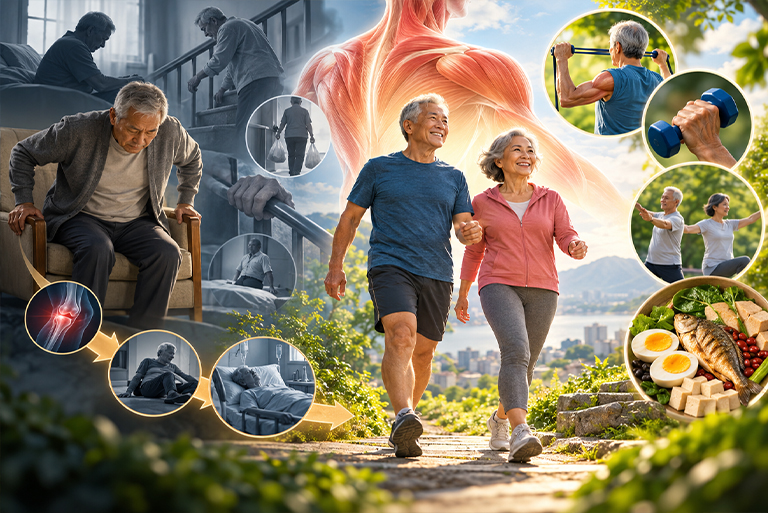
We worry about our heart, blood sugar and cholesterol—but are we forgetting one of the most important organs of healthy aging: our muscles?
By Rafael R. Castillo, MD
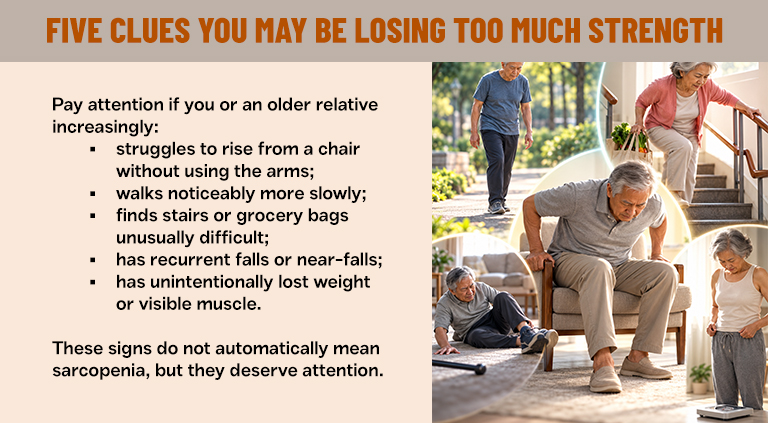
At 75, you may still have a sharp mind, controlled blood pressure and reassuring laboratory results. But can you rise from a chair without using your arms? Carry your groceries? Climb a flight of stairs? Catch yourself when you stumble? Walk briskly enough to cross the street safely? Open a stubborn jar? Lift your grandchild?
These seemingly ordinary abilities tell us something profound about health.
As we grow older, we can progressively lose muscle mass, strength and physical performance—a condition known as sarcopenia. Left unchecked, it can contribute to falls, fractures, disability, hospitalization and loss of independence.
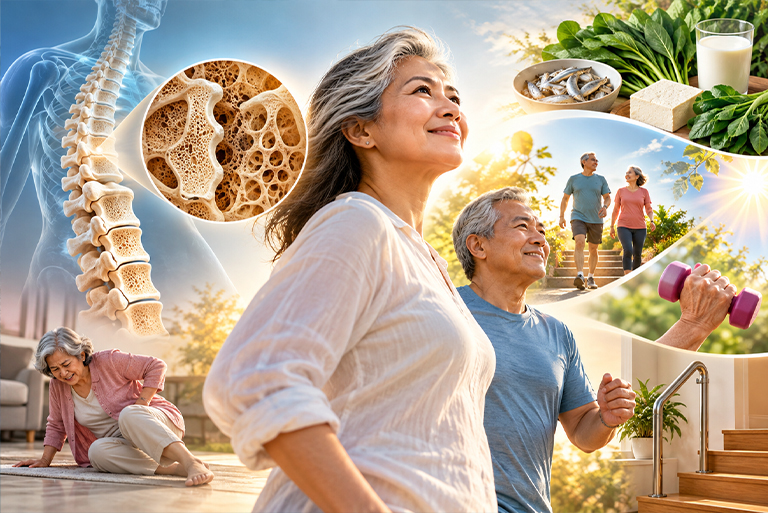
Yet there is an extraordinarily hopeful message: Growing older does not mean surrendering strength.
Muscle remains responsive to training and nutrition even in later life. We may not be able to stop aging, but we can influence how strongly we age.
“The goal of aging is not simply to remain alive. It is to remain strong enough to keep living your own life.”
The Morning the Chair Became Difficult
Imagine a 74-year-old man—we’ll call him Roberto. He considers himself healthy. He takes medication for hypertension. His cholesterol is controlled. He still drives, meets friends and occasionally walks around the mall.
Then one morning he notices something.
Getting out of his favorite chair requires a little push from both arms. Months later, climbing stairs becomes slower. His wife begins carrying the heavier grocery bags. He stops walking as far because his legs tire.
None of these changes seems dramatic enough to warrant a doctor’s appointment.
“I’m just getting old,” he says.
That sentence may be one of the greatest obstacles to healthy aging.
Roberto may indeed be aging. But he may also be losing muscle strength and function faster than he should. And something can be done about it.
What Is Sarcopenia?
Sarcopenia was once thought of primarily as age-related loss of muscle mass. We now understand it more broadly.
The European Working Group describes sarcopenia as a muscle disease or muscle failure, emphasizing that low muscle strength is particularly important. Low muscle quantity or quality helps confirm the diagnosis, while poor physical performance suggests greater severity.
For Asians, the Asian Working Group for Sarcopenia defines it through age-related loss of skeletal muscle mass accompanied by low muscle strength and/or impaired physical performance.
In everyday language: Your muscles are becoming smaller, weaker, less functional—or some combination of the three.
And strength may matter even more clinically than how muscular someone looks.
Sarcopenia Is Not the Same as Frailty
The terms are related but not interchangeable. Sarcopenia specifically concerns skeletal muscle—particularly loss of muscle mass, strength and function. Frailty is broader. It describes reduced physiological reserve and increased vulnerability to stressors.
A robust older adult develops pneumonia and recovers. A frail older adult develops the same infection and may lose mobility, become delirious, require prolonged hospitalization and never fully regain previous independence.
Sarcopenia can be an important contributor to frailty. But a person can have sarcopenia without meeting a broader definition of frailty, and frailty can arise through multiple pathways.
Why Do We Lose Muscle?
Some muscle decline accompanies aging. But age alone does not tell the whole story. Several forces may accelerate it.
Inactivity
Muscle follows a brutal biological rule: Use it or lose it.
Long hours sitting, reduced walking and abandoning physically demanding activities progressively remove the stimulus muscles need to remain strong.
Then comes a vicious cycle: weakness → less activity → further weakness → still less activity.
Illness and Hospitalization
A major illness can accelerate decline dramatically. An older adult develops pneumonia, undergoes surgery or spends days in bed. The acute disease improves. But the patient goes home weaker than before.
Suddenly the bathroom seems farther away. Stairs become intimidating. Falls become more likely. This is why hospitalization should not be viewed merely in terms of whether the disease was “cured.”
We must also ask: Did the patient leave the hospital still able to function?
Poor Nutrition
Older adults may eat less because of reduced appetite, dental problems, difficulty swallowing, loneliness, illness, financial constraints or simply because cooking for one person no longer feels worthwhile.
Protein intake may become inadequate precisely when maintaining muscle becomes increasingly important.
ESPEN recommends at least 1 gram of protein per kilogram of body weight daily for older people, individualized according to nutritional status, physical activity, disease and tolerance. Expert groups often suggest approximately 1.0–1.2 g/kg/day for healthy older adults, with potentially higher requirements during illness, although individual circumstances—including kidney disease—matter.
Chronic Disease and Inflammation
Heart failure, chronic lung disease, kidney disease, cancer, diabetes, inflammatory conditions and other illnesses can contribute to muscle loss through inactivity, altered metabolism, inflammation and poor nutrition.
This is why unexplained weakness or weight loss should never simply be attributed to age.
THE CONSEQUENCES GO FAR BEYOND MUSCLE
Losing muscle is not a cosmetic problem. Muscle is essential for movement, balance and metabolic health. Progressive sarcopenia can make everyday tasks increasingly difficult: bathing; dressing; getting out of bed; rising from the toilet; carrying groceries; climbing stairs; and walking independently.
Eventually, a person’s world can become smaller. First he stops taking long walks. Then he avoids stairs. Then outings become tiring. Then he stays home. Then he becomes still weaker. The ultimate consequence is not simply smaller muscles. It can be loss of independence.
“Sometimes the first sign of declining health is not an abnormal laboratory result. It is the moment an older person begins pushing himself out of a chair.”
THE FALLING DOMINOES
Sarcopenia can contribute to a dangerous sequence:
Weak muscles → impaired balance → fall → fracture → hospitalization → bed rest → more muscle loss → greater frailty → another fall
Breaking that chain early is far easier than rebuilding independence after it has been lost.
THE SIMPLE TEST THAT CAN TELL US A LOT
You don’t necessarily need a sophisticated scanner to suspect trouble.
Try the chair test.
Can an older adult rise from a chair repeatedly without using the arms?
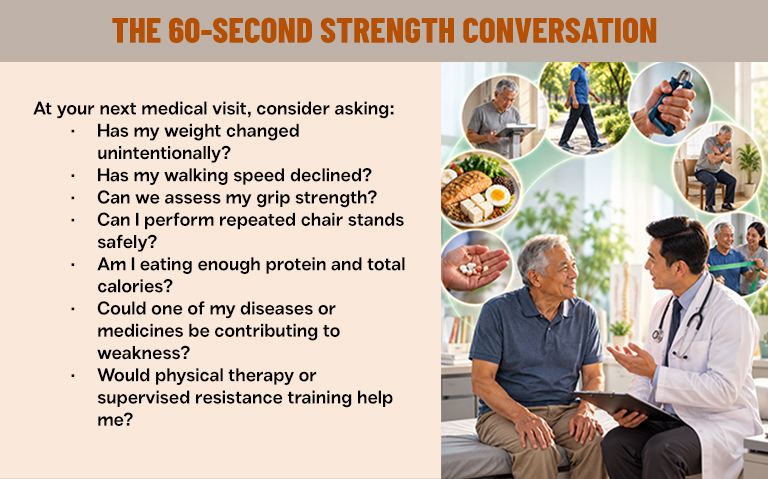
The Asian Working Group uses a five-time chair stand test of 12 seconds or longer as one marker of low physical performance. It also uses gait speed and grip strength in assessment.
For Asian adults, AWGS 2019 defines low handgrip strength as below 28 kg in men and 18 kg in women. A six-meter gait speed below 1.0 meter per second is another criterion for low physical performance.
These are screening/diagnostic thresholds, not do-it-yourself verdicts.
Body size, illness, pain and other factors influence performance.
But the principle is valuable:
Measure function, not merely weight.
THE GOOD NEWS: MUSCLE CAN FIGHT BACK
This is where the story becomes encouraging.
Unlike many consequences of aging that we cannot easily reverse, skeletal muscle retains considerable adaptability.
The central treatment for sarcopenia is remarkably inexpensive:
USE YOUR MUSCLES.
Not merely walking.
Walking is excellent.
But walking and strength training do different things.
The older body needs both.
WHO recommends muscle-strengthening activities involving the major muscle groups on at least two days each week, while older adults should also incorporate multicomponent activity emphasizing strength and functional balance to help maintain capacity and prevent falls.
Resistance Training: Medicine Without a Prescription Pad
Resistance training does not require becoming a bodybuilder.
It means asking muscles to work against resistance.
That can include:
chair squats;
wall push-ups;
resistance bands;
light dumbbells;
weight machines;
step-ups;
heel raises;
or appropriately supervised body-weight exercises.
The important principles are progressive overload, consistency and safety.
If an exercise never challenges the muscle, the muscle has little reason to become stronger.
But particularly for sedentary or frail older adults, progression should be gradual and individualized.
People with unstable cardiovascular disease, severe balance problems, recent surgery, significant orthopedic disease or other important medical conditions may need medical assessment and professional supervision before beginning a vigorous program.
DON’T FORGET BALANCE
Strength keeps us upright. Balance helps keep us from falling.
WHO recommends that older adults include multicomponent physical activity emphasizing functional balance and strength; this becomes especially important in those at increased risk of falling.
Exercises may include tandem standing, heel-to-toe walking, controlled single-leg stance when safe, tai chi and structured balance programs.
For someone already prone to falls, these should initially be performed with appropriate support or professional supervision.
WHAT ABOUT VITAMIN D?
Vitamin D is important for musculoskeletal health, and deficiency should be identified and treated when appropriate. But vitamin D should not be marketed as a stand-alone cure for sarcopenia.
Neither should testosterone, growth hormone or an ever-growing catalogue of “anti-aging” supplements be assumed to rebuild healthy muscle safely.
At present, exercise and adequate nutrition remain the foundations of prevention and management. The Asian consensus similarly identifies exercise and nutritional interventions as the mainstays of treatment.
WHAT SHOULD LOLO AND LOLA EAT?
Filipino diets can provide excellent protein without requiring expensive powders.
Think:
fish — bangus, tilapia, tuna, sardines;
eggs;
chicken and lean meat;
milk, yogurt and other dairy products if tolerated;
tofu and taho;
monggo and other legumes;
soy products;
and combinations of nutritious plant foods.
The objective is not simply “eat more protein.”
Older adults also need adequate total energy, vegetables, fruits, whole grains or other nutritious carbohydrate sources, healthy fats and micronutrients.
Someone eating too few calories may burn dietary protein for energy rather than use it optimally for tissue maintenance.
KEY REFERENCES
- Cruz-Jentoft AJ, Bahat G, Bauer J, et al. Sarcopenia: revised European consensus on definition and diagnosis. Age Ageing. 2019;48:16–31. The EWGSOP2 consensus emphasizes muscle strength for case identification, muscle quantity/quality for confirmation, and physical performance for severity.
- Chen LK, Woo J, Assantachai P, et al. Asian Working Group for Sarcopenia: 2019 Consensus Update on Sarcopenia Diagnosis and Treatment. J Am Med Dir Assoc. 2020;21:300–307.e2. Provides Asian-specific screening, grip-strength, gait-speed, chair-stand and muscle-mass criteria and emphasizes exercise and nutrition as treatment foundations.
- Volkert D, Beck AM, Cederholm T, et al. ESPEN practical guideline: Clinical nutrition and hydration in geriatrics. Clin Nutr. 2022;41:958–989. Recommends at least 1.0 g/kg/day protein in older adults, individualized according to health and nutritional circumstances.
- World Health Organization. WHO Guidelines on Physical Activity and Sedentary Behaviour. Geneva: WHO; 2020. Recommends aerobic activity, muscle strengthening and, for older adults, multicomponent activity emphasizing functional balance and strength.
- World Health Organization. Physical activity and sedentary behaviour: a brief to support older people. Geneva: WHO; 2022. Focuses on maintaining function and preventing falls and physical decline in older adults.
- World Health Organization. Promoting physical activity for older people: a toolkit for action. Geneva: WHO; 2023. Provides implementation approaches applicable to older people across different functional abilities and healthcare settings.








Leave a Reply