



Doctors are accustomed to looking at the chart hanging at the end of the patient’s bed.
Blood pressure. Pulse. Temperature. Laboratory results. Medications. Diagnosis.
But there is another document that eventually reaches almost every hospitalized Filipino family.
The bill.
And sometimes that document produces almost as much anxiety as the illness itself.
I have seen families confronted by serious disease ask not only: “Will my father survive?”
but almost immediately: “Doc, magkano kaya?”
How much will this cost?
That question tells us something important about our healthcare system.
Illness is frightening enough.
Families should not have to face the additional terror of wondering whether getting well will bankrupt them.
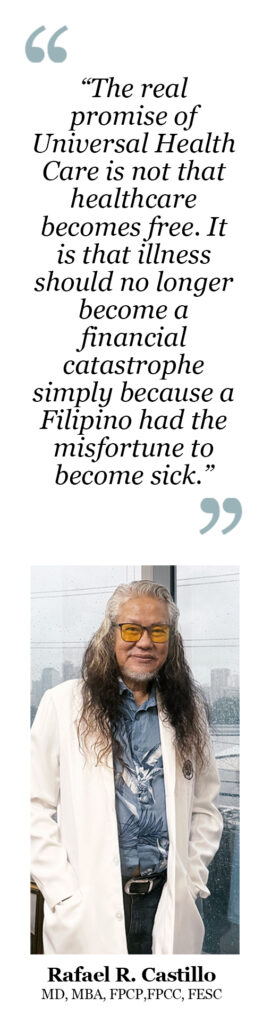
The Philippines enacted Universal Health Care precisely because access to healthcare should not depend entirely upon the thickness of one’s wallet.
There has been progress.
Government and compulsory schemes now finance a larger portion of healthcare spending, and household out-of-pocket expenditure has fallen over the past decade. But Filipino families still directly paid 41.2% of current health expenditure in 2025.
That remains a formidable burden.
This is why the debate over PhilHealth’s budget should not deteriorate into an argument over whose spreadsheet contains the larger number.
The question is bigger.
What kind of health system do we want?
We need a PhilHealth that is sufficiently funded—but also efficient, transparent and accountable.
We need hospitals adequately reimbursed—but also accountable for quality and appropriate care.
We need stronger benefits—but also clear information so patients know what those benefits actually cover.
We need Zero Balance Billing—but implementation must work at the bedside.
We need money to treat cancer, stroke, kidney failure and heart disease—but we should invest just as seriously in preventing them.
And if laws earmark particular public revenues for health, citizens deserve transparent accounting of how much was collected, how much was transferred, where it went and what health outcomes it purchased.
More money alone will not create Universal Health Care.
But neither can we promise universal healthcare indefinitely without adequately and sustainably financing it.
The UHC Act itself recognizes this. It created multiple financing streams—from premiums and national appropriations to sin taxes and designated PAGCOR and PCSO revenues.
The challenge now is turning those financial mechanisms into something a patient can actually feel.
A medicine she can afford.
A laboratory test she does not postpone.
A cancer treatment she can complete.
A hospital discharge that does not come with years of debt.
And perhaps someday, when the doctor says:
“You may go home tomorrow,”
the patient’s family will simply feel relief.
They will not have to whisper:
“But how are we going to pay?”
That, to me, is when Universal Health Care begins to live up to its name.








Leave a Reply