

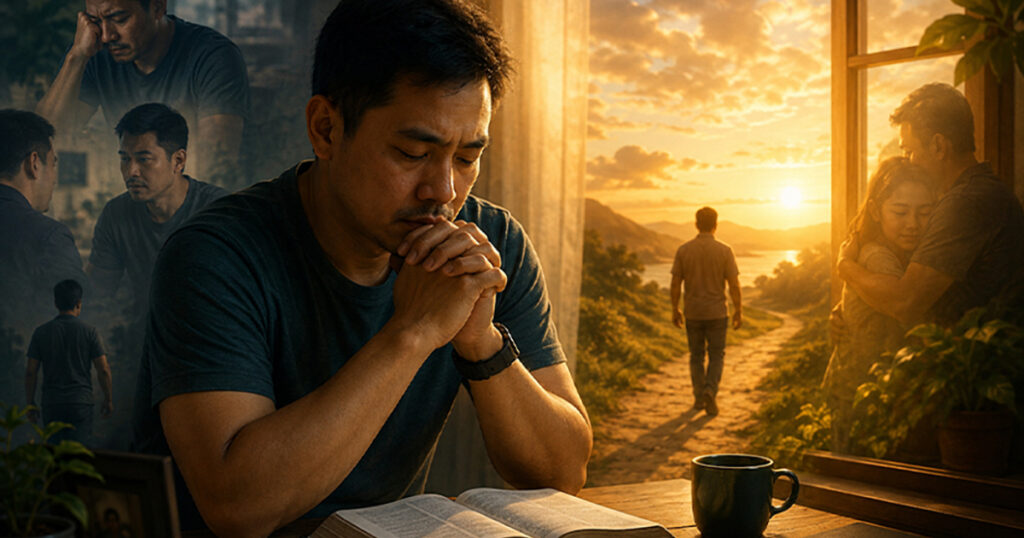

Many people enter a new day carrying an old burden. A mistake, a missed opportunity, a painful memory, a decision they wish they could undo. But this Sabbath story reminds us that God did not create us to live facing backward. The Sabbath is His weekly invitation to lay down yesterday and receive His grace for today.
By Raffy Castillo
For nearly a year, Benjamin carried a conversation inside his head. Not an actual conversation.
A replay.
Something he should have said. Something he should not have said. A moment he wished he could revisit.
The event itself had lasted less than ten minutes. But in his mind, it had lasted months.
The Weight of an Unchangeable Past
Benjamin rarely spoke about it. Outwardly, life continued.
He worked. He smiled. He attended church. He fulfilled responsibilities.
Yet beneath the surface, a part of him remained trapped in a room that no longer existed.
Every now and then, the memory would return. Usually late at night. Or during quiet moments when there was nothing else competing for his attention.
And every time it returned, so did the same question:
“What if I had done things differently?”
The Illusion of Rehearsing the Past
At first, Benjamin believed he was learning from the experience. But eventually he realized something painful. He was no longer learning. He was simply reliving.
The past had become a place he kept visiting, hoping somehow to rewrite it. But no matter how many times he replayed the scene, nothing changed.
The words remained spoken. The moment remained gone. And he remained tired.
The Sabbath Interruption
That Sabbath morning, Benjamin sat alone before everyone else had awakened. A Bible rested open on his lap. His eyes settled on familiar words:
“Forget the former things; do not dwell on the past. See, I am doing a new thing.”
(Isaiah 43:18–19)
He had read the passage many times before. But that morning it felt different. The verse did not deny the past. It simply refused to make the past the center of the story.
What God Was Trying to Show Him
Benjamin suddenly realized that regret often disguises itself as responsibility.
We convince ourselves that if we keep revisiting old wounds, we are honoring them.
If we keep carrying old failures, we are somehow paying for them. But God was offering something different. Not forgetfulness. Forgiveness. Not denial. Healing.
The Freedom of What Cannot Be Changed
As the Sabbath unfolded, Benjamin stopped arguing with yesterday. He stopped negotiating with memories. He stopped asking impossible questions. Instead, he prayed a simple prayer:
“Lord, I give You what I cannot undo.”
For the first time in a long while, the burden felt lighter. Not because the past had changed. But because he had finally placed it in stronger hands than his own.
What He Wrote Before Sunset
As evening approached, Benjamin opened his journal and wrote:
“Today, I stopped asking God to change yesterday and started asking Him to redeem it.”
And somehow, peace arrived where regret had lived for so long.
Sabbath Reflection
The Sabbath reminds us that God is the Lord of time.
He is present in our past, active in our present, and already waiting in our future.
There are mistakes we cannot undo. Words we cannot retrieve. Moments we cannot relive. But there is no wound beyond God’s ability to redeem.
This Saturday, June 6, may you release the burden of yesterday.
May you stop carrying what grace has already forgiven.
May you trust that God can bring beauty even from chapters you wish had been written differently.
And may the Sabbath gently remind you that while you cannot change the past,
God can still transform what it means.
“He finally discovered that God could heal what he could not change.”
-
An incredible message of grace. Stopping the endless replay in our minds is so hard but releasing it into ‘stronger hands’ brings such deep peace.











Leave a Reply