

A new American Heart Association late-breaking study suggests that a once-daily ‘polypill’ combining key heart-failure medications can dramatically improve heart function, symptoms, quality of life, and adherence among adults with heart failure with reduced ejection fraction (HFrEF). The findings open the door to a simpler, more accessible way of treating heart failure—especially for marginalized and high-risk populations.
By Dr. Rafael R. Castillo
A Simplified Regimen With Powerful Results
In one of the most anticipated presentations at the AHA Scientific Sessions 2025, researchers reported that adults with HFrEF who took a single combination polypill once daily for six months experienced better outcomes than those taking the same medications as separate pills.
The trial is the first ever to test a polypill strategy in heart failure—evaluated whether simplifying therapy could improve real-world medication adherence and, in turn, clinical outcomes.
The polypill contained three guideline-recommended medications:
- Metoprolol succinate – beta-blocker
- Spironolactone – MRA
- Empagliflozin – SGLT2 inhibitor
All participants also received sacubitril-valsartan (ARNI) separately, since it cannot be incorporated into a once-daily pill.
Lead investigator Ambarish Pandey, MD, MS, FAHA of UT Southwestern emphasized the importance of addressing adherence gaps: “Only about 15% of patients receive all guideline-recommended therapies after a hospitalization for heart failure. By simplifying treatment into one pill, we saw significant improvements—even in socially disadvantaged groups.”
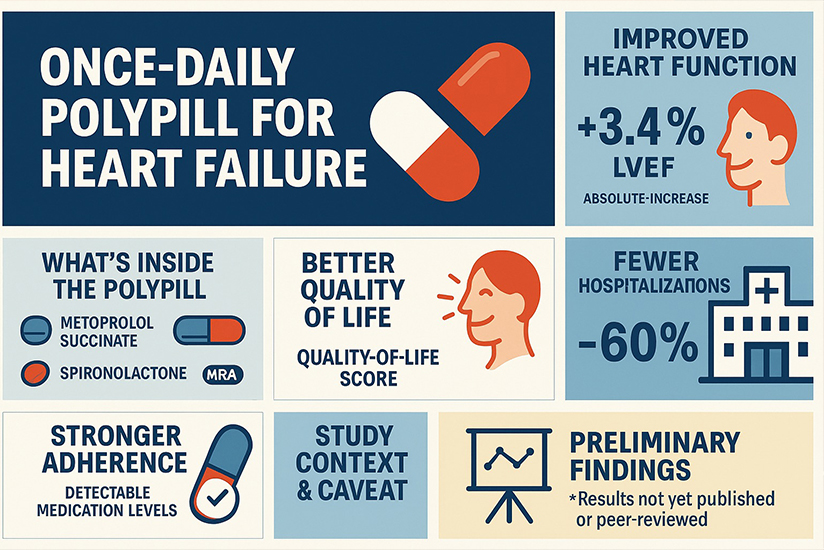
Key Findings: Better Function, Fewer Hospitalizations, Higher Quality of Life
Across 212 adults with HFrEF (median age 54), the advantages of the polypill approach were striking:
1. Improved Heart Function
Participants taking the polypill achieved:
- 3.4% higher absolute left ventricular ejection fraction (LVEF) compared with the standard-care group
- All participants improved, but polypill users improved more significantly
2. A 60% Reduction in Hospitalizations
The polypill group had less than half the rate of heart failure-related ER visits and hospitalizations—a major predictor of long-term outcomes and healthcare costs.
3. Markedly Better Quality of Life
Using the Kansas City Cardiomyopathy Questionnaire-12:
- Polypill group: 72 points
- Standard-care group: 63 points
This 9-point difference reflects tangible improvements in fatigue, breathlessness, daily activity, and overall well-being.
4. Stronger Medication Adherence
Therapeutic drug monitoring revealed:
- 79% of polypill users had detectable medication levels
- 54% in the multi-pill group
- 4-fold greater odds of taking all medicines correctly with the polypill
For heart failure—where survival relies heavily on consistent medication—this may be one of the most important findings.
Who Was Studied? A Real-World, High-Risk Population
The trial enrolled adults often excluded or underrepresented in cardiovascular trials:
- 68% had no insurance or relied on county-funded care
- 42% had food insecurity
- 32% experienced housing instability
- 54% were Black; 33% Hispanic
- Average baseline LVEF: 26%
Participants were enrolled from Parkland Health and UT Southwestern—the safety-net backbone of Dallas County—over more than three years.
All underwent cardiac MRI at baseline and six months, ensuring precise assessment of heart function.
Why This Matters: Simpler is Stronger
Heart failure remains a leading cause of hospitalization and disability. Despite proven medications, many patients do not receive or adhere to all four foundational therapies due to:
- Complex daily pill burden
- Cost and accessibility
- Lack of stable housing or food security
- Poor follow-up
- Side-effect fears or misunderstanding of medications
A once-daily polypill has the potential to transform real-world care by lowering barriers, simplifying regimens, and ensuring that the most effective therapies actually reach patients.
Dr. Pandey adds: “Our findings provide the first evidence that a polypill approach could be effective for our patients with heart failure. We are planning broader implementation studies moving forward.”
Important Caveat: Findings Are Preliminary
As with all Scientific Sessions presentations, these results were shared as a research abstract and have not yet undergone peer review.
They should be interpreted as promising but provisional until published in a peer-reviewed journal.
Heart Failure: A Growing Global Challenge
HFrEF (LVEF ≤ 40%) represents a major subset of heart failure, with outcomes strongly linked to adherence and timely initiation of four-pillar therapy.
If a polypill can address adherence at scale, it may represent one of the most practical, impactful innovations in heart-failure management.
A Step Toward More Equitable Heart-Failure Care
By focusing on socioeconomically vulnerable patients, this study highlights how structural barriers—not just clinical factors—shape outcomes.
This polypill approach may offer a path to:
- Improve population-level adherence
- Reduce preventable hospitalizations
- Lower healthcare costs
- Empower patients with simplified treatment
- Deliver equitable, guideline-directed care
AHA 2025’s message is clear: sometimes, innovation isn’t a new molecule—it’s making the right medicines easier to take.
“A single pill, once a day, led to better heart function, fewer hospitalizations, and higher quality of life.”