

How to protect your health — and your family’s — through what may be the hottest, driest months in memory
PLUS
• Sidebar: El Niño 2026–2027 at a Glance
• Sidebar: Reading the Heat Index
• Sidebar: Heat Stroke First Aid — Cool First, Then Go
• Heat Exhaustion or Heat Stroke? Knowing the Difference Can Save a Life
• Your Medicines and the Heat
• When the Taps Run Low: Water, Hygiene and the Diseases That Follow Drought
• Children, Elders and Outdoor Workers: Who Needs Protecting First
• Commentary: Treat Extreme Heat Like a Typhoon
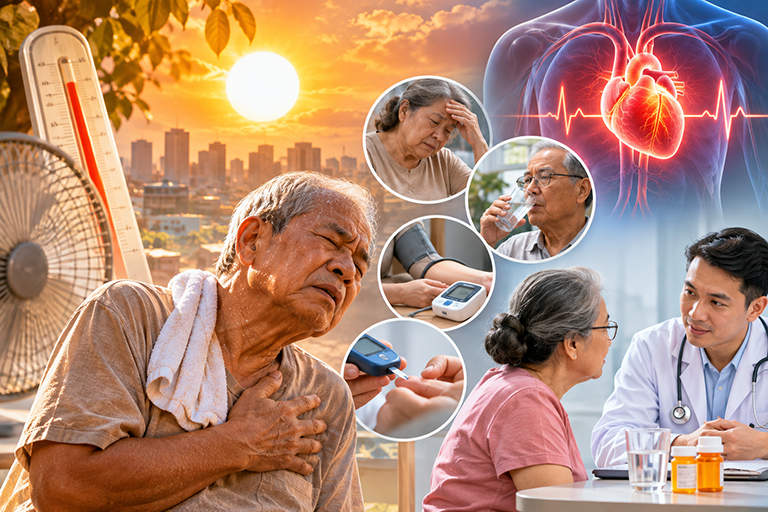
• Doctor’s Note: Heat Is a Heart Matter
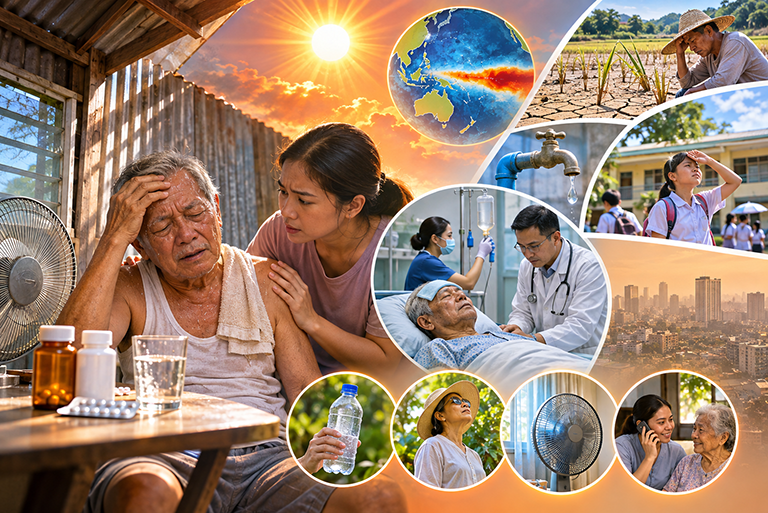
We usually think of November as the start of the cool months. Not this year. PAGASA says a strong to very strong El Niño is under way, likely to peak before the end of 2026 and to last well into the first half of 2027. Farms are already losing billions, more than a hundred towns have declared a state of calamity, Metro Manila’s water allocation has been cut, and DepEd has issued rules for suspending classes when the heat becomes dangerous. One research group estimates thousands of extra heat-related deaths in the Philippines over the coming months. Most of them can be prevented. Here is what every household needs to know — and do — now.
By Rafael R. Castillo, MD
The heat nobody noticed
He was 74, a retired jeepney driver living alone in a second-floor room in Tondo. Corrugated roof, one small window, an electric fan he used sparingly because of the bill. He took a water pill for his heart and another for his blood pressure.
During a stretch of hot, still days, his daughter called and found him unusually confused. He said he wasn’t thirsty. He hadn’t eaten much. When she arrived, his skin was hot and dry, and he couldn’t tell her what day it was.
At the hospital, his core temperature was over 40°C. The doctors cooled him down, gave him fluids, and watched his kidneys closely. He recovered, but only because his daughter happened to call.
This composite is drawn from the kind of cases that fill emergency rooms in every hot spell. What makes heat so dangerous is not just how high the temperature goes. It is how quietly it works. There is no crash, no flood, no wind. An older person simply grows weaker, more confused, less able to ask for help — often alone, often indoors.
What we’re facing
El Niño is a periodic warming of the central and eastern Pacific Ocean that shifts weather patterns worldwide. For the Philippines, it usually means less rain, hotter temperatures and fewer — though sometimes still powerful — typhoons.
This one is shaping up to be exceptional. In July, PAGASA put the probability of a “very strong” El Niño between October 2026 and January 2027 at 81 percent, and said there was a 97 percent chance that El Niño conditions would persist through the first half of 2027. Its October advisory confirmed that a strong to very strong El Niño is present, possibly peaking before the end of this year.
The effects are already showing:
• Agriculture. The Department of Agriculture reported damage and losses of ₱8.57 billion as of October 21, affecting more than 288,000 farmers and nearly 291,000 hectares, mostly corn and rice. More than a hundred cities and municipalities have declared their own states of calamity.
• Water. The National Water Resources Board cut Metro Manila’s water allocation from Angat Dam to 44 cubic meters per second starting in October, and slashed irrigation allocations, to stretch supply through the dry months ahead. The NWRB’s executive director warned that this could be “the hottest or most severe El Niño on record.”
• Schools. DepEd Memorandum 64, issued this month, sets out when schools should shorten hours, shift to home-based learning, or suspend classes entirely as heat rises.
• Hospitals. The DOH has told hospitals to prepare surge plans and emergency room fast lanes for heat-related illness.
And in September, the Climate Impact Lab — a research collaboration founded by economists and scientists from the University of Chicago, UC Berkeley, Rutgers and the Rhodium Group — estimated that this El Niño could cause about 6,500 additional heat-related deaths in the Philippines between September 2026 and February 2027, compared with a normal year.
Estimates like these carry uncertainty. But the direction is clear, and so is the opportunity: heat deaths are among the most preventable deaths there are.
What heat does to the body
The human body is built to stay at about 37°C. When it gets hot, we sweat, and blood vessels near the skin widen to release heat. This works well — up to a point.
When the air is very hot and humid, sweat doesn’t evaporate easily, so it stops cooling us. That’s why the heat index — what the temperature feels like when humidity is factored in — matters more than the thermometer alone. PAGASA classifies a heat index of 33°C to 41°C as “extreme caution,” 42°C to 51°C as “danger,” and 52°C and above as “extreme danger.”
As the body struggles to cool itself, the heart has to work harder, pumping more blood to the skin. Sweating drains water and salt. Blood thickens slightly, raising the risk of clots. The kidneys, short of fluid, can be injured. If the body’s temperature keeps rising, the brain begins to malfunction, and organs start to fail. That is heat stroke, and it can kill within hours.
This is why heat is not just a comfort issue. Studies have consistently found that cardiovascular deaths rise during hot weather — by roughly two percent for every degree of added heat in one large review — and that heat waves bring increases in heart attacks, strokes, kidney injury and hospital admissions among people with chronic illnesses.
Who is most at risk
Anyone can get sick from heat, but some people are far more vulnerable:
• Older adults, especially those over 65 who live alone. They feel thirst less, sweat less and often take medicines that affect how the body handles heat.
• People with heart disease, high blood pressure, diabetes, kidney disease, lung disease or obesity.
• People taking certain medicines, including water pills (diuretics), some blood pressure and heart drugs, some diabetes medicines, and medicines for mental health conditions. (See our supplemental article.)
• Infants and young children, who heat up faster and depend on others for water and shade.
• Pregnant women.
• Outdoor workers: construction workers, farmers, vendors, traffic enforcers, delivery riders, tricycle and jeepney drivers.
• People in hot housing: small rooms under metal roofs, upper floors with poor ventilation, informal settlements.
• People who are socially isolated, who may have no one to notice they are getting sick.
Recognizing heat illness
Heat illness usually progresses in stages:
• Heat cramps: painful muscle spasms, often in the legs or abdomen, after heavy sweating.
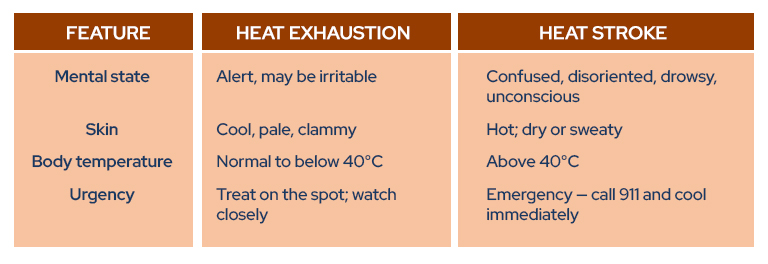
• Heat exhaustion: heavy sweating, weakness, dizziness, headache, nausea, cool and clammy skin, fast pulse. The person is still alert. Rest in a cool place, fluids and cooling usually bring recovery.
• Heat stroke: body temperature above 40°C with confusion, slurred speech, strange behavior, seizures or loss of consciousness. The skin may be hot and dry — or still sweaty. This is a medical emergency.
The key sign that separates heat stroke from heat exhaustion is a change in the brain: confusion, disorientation, unusual drowsiness. In an older person, this may be the only sign, and it is easily mistaken for “just getting old” or a stroke.
The most important rule: cool first, then go
If you suspect heat stroke, call 911 — and start cooling the person immediately, while waiting for help. Every minute the body stays overheated adds to the damage.
• Move them to shade or a cool room.
• Remove extra clothing.
• Wet the skin with cool water and fan them. If available, put ice packs or cold, wet towels on the neck, armpits and groin.
• If you can, immerse them in cool water up to the neck — this is the fastest method.
• Don’t give fluids by mouth if they are confused or drowsy.
• Don’t give paracetamol or aspirin. They don’t lower body temperature in heat stroke.
Prevention: what works
Heat illness is almost entirely preventable. The basics:
• Drink water regularly, even before you feel thirsty. Older adults should keep a water bottle within reach and drink on a schedule. People with heart failure or kidney disease who have been told to limit fluids should ask their doctor how to adjust during hot weather.
• Avoid sugary drinks, alcohol and too much coffee. They don’t hydrate as well and can worsen dehydration.
• Stay out of the sun from late morning to mid-afternoon, roughly 10 a.m. to 4 p.m.
• Dress light: loose, light-colored clothing, a hat or umbrella.
• Keep your home cool: open windows at night, close curtains during the day, use fans, and spend the hottest hours in the coolest part of the house or in an air-conditioned public space like a mall, church or library.
• Take cool showers or wipe down with a damp towel.
• Check on others. Call or visit elderly neighbors and relatives every day during hot spells. This simple act saves lives.
• Watch the heat index. PAGASA publishes daily forecasts. Plan outdoor work and errands around them.
• Don’t stop your maintenance medicines on your own. If you’re worried about how a medicine affects you in the heat, ask your doctor.
Beyond heat: the other health effects of El Niño
Heat is the most direct danger, but El Niño affects health in other ways too:
• Water shortages can make it harder to wash hands, prepare food safely and keep toilets clean, increasing the risk of diarrhea, typhoid and hepatitis A.
• Stored water in drums and pails can breed dengue mosquitoes if left uncovered. Studies in Southeast Asia have linked El Niño years to dengue surges.
• Crop losses and rising food prices can push poorer families toward cheaper, less nutritious food, with effects on children’s growth and on chronic diseases.
• Dust, smoke and dry air can worsen asthma and COPD — conditions the DOH has said it is monitoring alongside heat illness.
• Mental health can suffer as farmers lose harvests and families face financial strain.
A final word
El Niño will pass. By the second half of 2027, if forecasts hold, the rains will return. The question is how many lives we lose before then.
Unlike an earthquake or a typhoon, a heat emergency gives us warning. We know it’s coming. We know who is most at risk. We know what keeps people alive: water, shade, cooling, and someone checking in.
So this week, do three things. Learn the signs of heat stroke and the rule of cool first, then go. Make a plan for the oldest and most vulnerable person in your life. And put a reminder on your phone to call them every day when the heat index climbs.
That call may be the most important medicine they receive this season.
“A heat emergency gives us warning. We know it’s coming, we know who is most at risk, and we know what keeps people alive: water, shade, cooling — and someone who checks in.”
EL NIÑO 2026–2027 AT A GLANCE
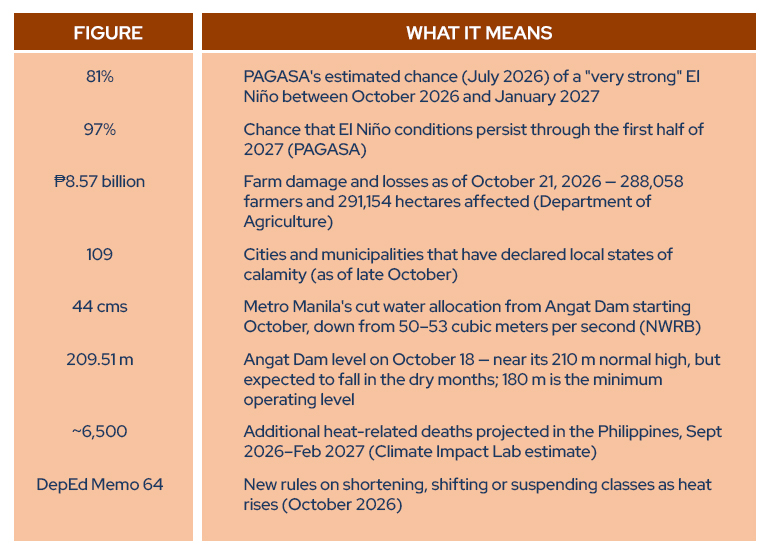
Sources: PAGASA climate outlooks as reported by GMA News (July 28, 2026) and Philstar (Oct. 18, 2026); Department of Agriculture bulletin as reported by Astig.ph (Oct. 22, 2026); NWRB as reported by Philstar (Sept. 30, 2026); Climate Impact Lab as reported by Khaleej Times (Sept. 25, 2026); DepEd as reported by Philstar (Oct. 27, 2026).
READING THE HEAT INDEX
The heat index is what the temperature feels like to your body once humidity is factored in. PAGASA publishes daily heat index forecasts for stations across the country.
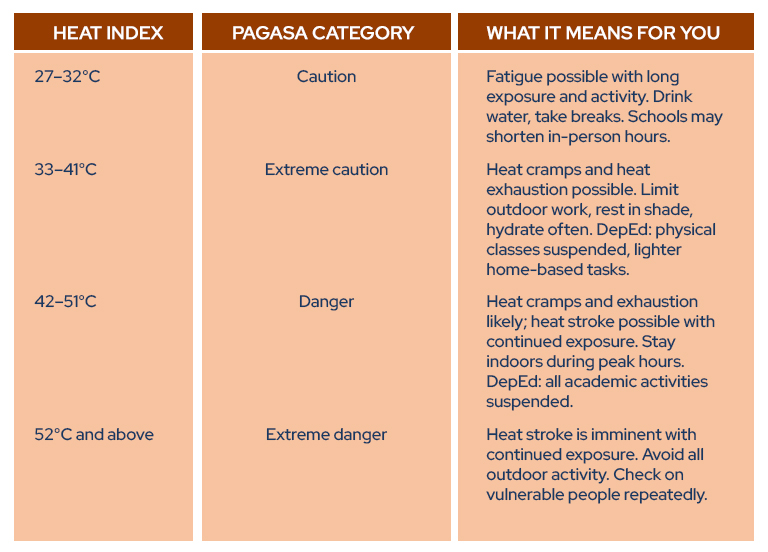
DepEd thresholds per DepEd Memorandum 64, s. 2026, as reported by The Philippine Star (Oct. 27, 2026). Check the memo itself for exact scope.
HEAT STROKE FIRST AID: COOL FIRST, THEN GO
Suspect heat stroke if someone in the heat becomes confused, disoriented, very drowsy, starts acting strangely, has a seizure or collapses, especially if their skin feels very hot.
• Call 911 or get someone to arrange transport to the nearest hospital.
• Start cooling immediately — don’t wait for the ambulance.
• Move them to shade or the coolest room available.
• Remove extra clothing.
• Wet the skin and fan them, or place ice packs or cold, wet towels on the neck, armpits and groin.
• If possible, immerse them in cool water up to the neck — the fastest way to bring temperature down.
• Lay them on their side if they are vomiting or drowsy.
• Do not give fluids if they are confused or unconscious.
• Do not give paracetamol or aspirin.
Remember: In heat stroke, cooling is the treatment. The sooner the body temperature comes down, the better the chance of survival without brain or organ damage.
KEY REFERENCES
1. PAGASA. Climate outlook, August 2026–January 2027, as reported in: Serquiña MC. “Very strong El Niño likely from October 2026 to January 2027 — PAGASA.” GMA News Online, July 28, 2026.
2. “Oct. 18: Angat Dam water level inches up amid strong El Niño.” The Philippine Star, October 18, 2026.
3. “Metro Manila water allocation cut as Super El Niño looms.” Philstar.com, September 30, 2026.
4. “El Niño farm damage jumps to P8.57 billion as PAGASA warns of a 2027 peak.” Astig.ph, October 22, 2026 (citing Department of Agriculture bulletin, October 21, 2026).
5. “Philippines faces 6,500 heat-related deaths as ‘super El Niño’ looms, US group warns.” Khaleej Times, September 25, 2026 (Climate Impact Lab estimates).
6. “DepEd: Complete suspension of classes if temperature hits 42 degrees Celsius.” The Philippine Star, October 27, 2026 (DepEd Memorandum 64, s. 2026).
7. Villanueva R. “DOH readies hospitals for El Niño patient surge.” The Philippine Star, October 18, 2026.
8. “Public warned vs heat stroke amid El Niño.” The Philippine Star, October 4, 2026.
9. PAGASA. Heat index classification and daily heat index forecasts. pagasa.dost.gov.ph.
10. World Health Organization. Heat and health fact sheet. Geneva: WHO; 2024.
11. Epstein Y, Yanovich R. Heatstroke. N Engl J Med. 2019;380(25):2449–2459.
12. Liu J, Varghese BM, Hansen A, et al. Heat exposure and cardiovascular health outcomes: a systematic review and meta-analysis. Lancet Planet Health. 2022;6(6):e484–e495.
13. Ebi KL, Capon A, Berry P, et al. Hot weather and heat extremes: health risks. Lancet. 2021;398(10301):698–708.
14. Jay O, Capon A, Berry P, et al. Reducing the health effects of hot weather and heat extremes: from personal cooling strategies to green cities. Lancet. 2021;398(10301):709–724.
15. Romanello M, et al. The 2024 report of the Lancet Countdown on health and climate change. Lancet. 2024;404(10465):1847–1896.
16. Hess JJ, Lm S, Knowlton K, et al. Building resilience to climate change: pilot evaluation of the impact of India’s first heat action plan on all-cause mortality. J Environ Public Health. 2018;2018:7973519.
17. Centers for Disease Control and Prevention. Heat and medications — guidance for clinicians. Updated 2024.
18. “DoH rolls out flu vaccines as seasonal cases rise.” Daily Tribune, October 25, 2026.
HEAT EXHAUSTION OR HEAT STROKE?
Knowing the difference — and what to do for each — can save a life
By the H&L Editorial Team
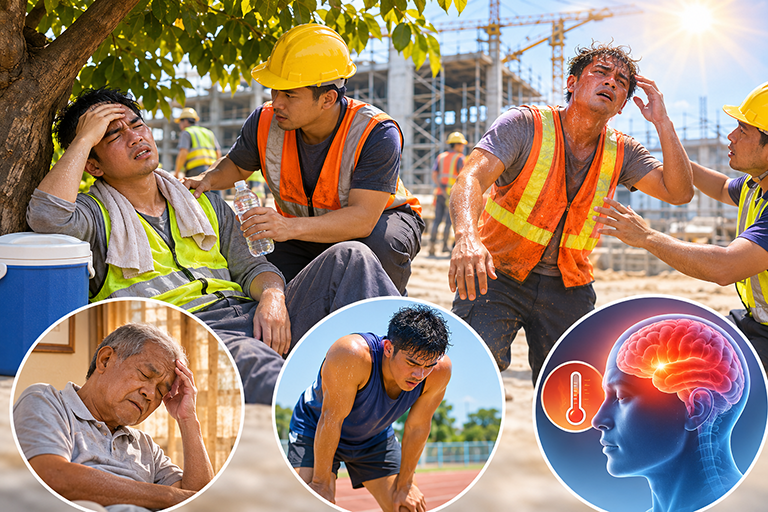
Picture a construction site at two in the afternoon. One worker sits down in the shade, drenched in sweat, pale and dizzy, complaining of a pounding headache. Another, a few meters away, is wandering in circles, mumbling, his skin flushed and hot. He doesn’t seem to know where he is.
Both are suffering from the heat. Only one of them is in immediate danger of dying.
Heat exhaustion: the warning stage
Heat exhaustion happens when the body loses too much water and salt through sweating and starts to struggle to keep cool.
Signs:
• Heavy sweating
• Cool, pale, clammy skin
• Weakness, tiredness, dizziness or fainting
• Headache, nausea or vomiting
• Muscle cramps
• Fast, weak pulse
• Body temperature normal or mildly raised
• Still alert and able to answer questions sensibly
What to do:
• Move to a cool, shaded place and lie down with legs slightly raised.
• Loosen or remove extra clothing.
• Sip water or an oral rehydration solution.
• Cool the skin with wet cloths and a fan.
• Rest for the remainder of the day — don’t go back to work in the heat.
When to get help: If symptoms don’t improve within an hour, if the person vomits repeatedly, or if they become confused at any point, take them to a hospital.
Heat stroke: the emergency
Heat stroke happens when the body’s cooling system fails entirely and core temperature climbs above 40°C. Brain cells and other organs begin to be damaged.
Signs:
• Confusion, disorientation, slurred speech, strange behavior or agitation
• Seizures or loss of consciousness
• Hot skin — which may be dry or still sweaty, especially in younger people who were exerting themselves
• Rapid, strong pulse
• Rapid breathing
What to do: Call 911 and start cooling immediately. (See our sidebar, “Cool First, Then Go.”)
The tricky cases
• In older adults, heat stroke often develops slowly over a few days of hot weather, without exercise. The first sign may simply be new confusion, unusual sleepiness or refusing to eat. Families may mistake it for a stroke, an infection or “just old age.”
• In young, active people, like athletes, soldiers or workers, heat stroke can develop quickly during exertion. They may still be sweating heavily, which fools people into thinking it’s only exhaustion.
• Stroke and heat stroke can look alike. Both may cause slurred speech and confusion. Either way, the answer is the same: get to a hospital immediately. If the person is clearly overheated, start cooling on the way.
YOUR MEDICINES AND THE HEAT
Some common medicines make the body more vulnerable to heat. Here’s what to know — and why you shouldn’t simply stop them.
By Marie Barrientos-Regala, MD
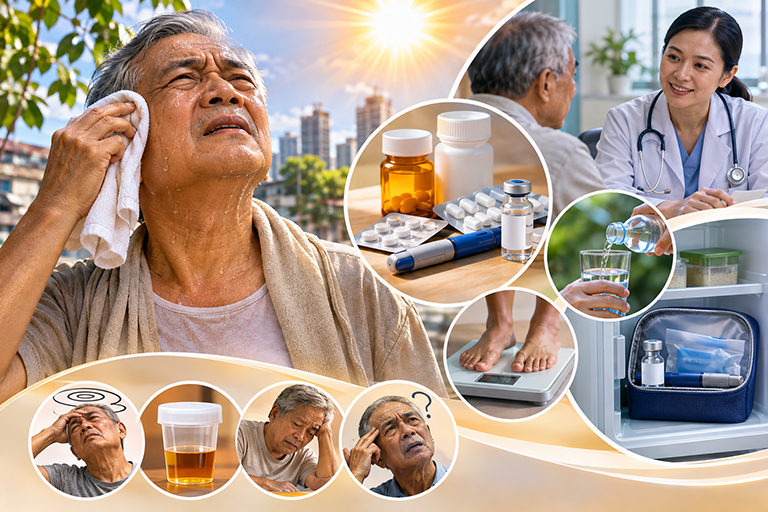
Millions of Filipinos take maintenance medicines every day. Most of these medicines are safe and life-saving. But some can change how the body handles heat, fluids and salt, and that matters in a season like this one.
Medicines that deserve extra attention in hot weather
Diuretics (“water pills”) such as furosemide and hydrochlorothiazide. They make the kidneys release more water and salt. In hot weather, combined with sweating, this can lead to dehydration, low blood pressure and kidney strain.
Blood pressure and heart medicines, including ACE inhibitors, ARBs and beta-blockers. Some can lower the body’s ability to adjust blood pressure when dehydrated, or reduce the heart’s ability to speed up to pump blood to the skin. Dizziness and fainting are more likely in the heat.
SGLT2 inhibitors (some newer diabetes and heart failure medicines, such as empagliflozin and dapagliflozin). They cause the body to lose sugar and water in the urine, so dehydration is a risk if fluid intake is low.
Insulin and other diabetes medicines. Heat can change how quickly insulin is absorbed, and dehydration affects blood sugar. Insulin itself can be damaged if stored in hot places.
Medicines for mental health, including some antipsychotics and antidepressants, and anticholinergic drugs used for bladder problems, allergies or Parkinson’s disease. These can reduce sweating or impair the brain’s temperature control.
Lithium. Dehydration can raise lithium levels to toxic ranges.
Some antihistamines and sleeping pills can reduce awareness of heat and thirst.
What to do
• Don’t stop your medicines on your own. Stopping blood pressure, heart or diabetes medicines suddenly can be far more dangerous than the heat.
• Ask your doctor whether any of your medicines need adjustment during hot spells, especially if you take a diuretic, have heart failure or kidney disease, or have been feeling dizzy.
• Know the warning signs: dizziness when standing, very dark urine, much less urine than usual, unusual fatigue, confusion. Call your doctor if they appear.
• If you’ve been told to restrict fluids, ask your doctor how much you should drink during very hot weather.
• Weigh yourself daily if you have heart failure. Sudden weight loss can mean dehydration; sudden gain can mean fluid buildup.
• Store medicines properly. Keep them away from direct sunlight and out of hot cars. Keep insulin in the refrigerator (not the freezer), or in a cool pouch when traveling.
Bring this list to your next check-up: “Doc, with El Niño coming, do any of my medicines need adjusting? How much water should I drink? What signs should make me call you?”
WHEN THE TAPS RUN LOW
Water, hygiene and the diseases that follow drought
By Rebecca Lorenzo-Castillo
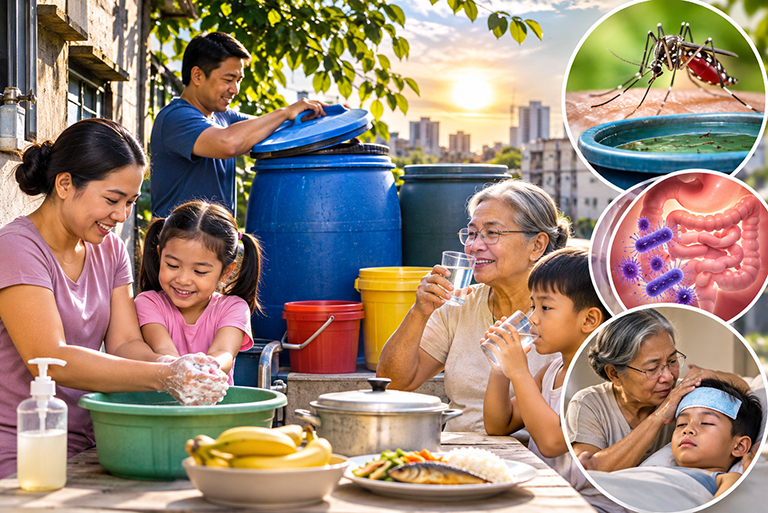
The rotating water interruptions of past El Niño years taught many Metro Manila families a set of survival habits: fill every pail and drum when the water comes, flush only when necessary, reuse washing water, bathe quickly.
These habits help families get through. But they also carry health risks that are easy to overlook.
Less water, more germs
When water is scarce, handwashing becomes less frequent. Dishes get a quick rinse. Toilets go unflushed. Food is prepared with less care. Each of these makes it easier for germs to spread, particularly the ones that cause diarrhea, typhoid fever and hepatitis A. Young children and older adults are especially vulnerable to dehydration from diarrhea — and in hot weather, dehydration happens faster.
The dengue paradox
It seems strange that a drought could raise dengue risk, since dengue is often thought of as a rainy-season disease. But the mosquitoes that carry dengue breed in clean, still water — exactly the kind stored in uncovered drums, pails and containers during water shortages. Studies in Southeast Asia have linked El Niño years with dengue surges.
Water safety habits for a dry season
• Cover every container of stored water tightly. If you can’t cover it, use it up within a few days and scrub the inside before refilling.
• Scrub drums and pails weekly to remove mosquito eggs stuck to the sides.
• Drink only safe water. If unsure, boil it at a rolling boil for at least one minute, or use chlorine tablets as directed.
• Keep drinking water separate from water for washing and flushing. Use a clean dipper, never your hands or a cup that’s been in someone’s mouth.
• Don’t skip handwashing. If water is limited, use a small basin and soap, or alcohol-based sanitizer when hands aren’t visibly dirty. Always wash before preparing food, before eating, after using the toilet and after changing diapers.
• Prioritize water for drinking, cooking and handwashing over washing cars or watering ornamental plants.
• Cook food thoroughly and eat it promptly. Food spoils faster in heat.
• Give oral rehydration solution early for diarrhea, especially in children and older adults, and seek medical care if there are signs of dehydration: sunken eyes, dry mouth, little urine, unusual drowsiness.
Did you know? Angat Dam supplies most of Metro Manila’s water. In mid-October it stood near its normal high of 210 meters, but water authorities have already cut allocations to stretch the supply through the dry months. Saving water now helps avoid harsher interruptions in early 2027.
CHILDREN, ELDERS AND OUTDOOR WORKERS
Who needs protecting first — and how
By the H&L Editorial Team
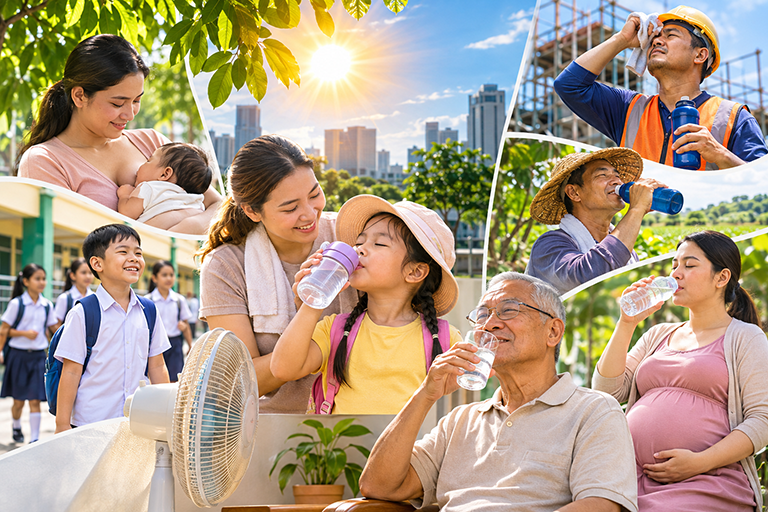
Heat doesn’t treat everyone equally. Some groups face higher risks because of their bodies, their jobs or their living conditions. Protecting them takes planning from families, schools, employers and local governments.
Children
Children heat up faster than adults, sweat less efficiently and often don’t recognize or report that they’re getting overheated. Infants depend entirely on adults to keep them cool and fed.
What helps:
• Offer water frequently, even if children don’t ask. Breastfed infants under six months generally don’t need extra water; nurse more often.
• Dress them in light, loose clothing.
• Never leave a child in a parked vehicle, even for a few minutes. Temperatures inside can rise to deadly levels very quickly.
• Schedule outdoor play for early morning or late afternoon.
At school: DepEd Memorandum 64 now ties school schedules to the heat. At a heat index of 27–32°C, school heads may shorten in-person hours or shift to flexible schedules. At 33–41°C, physical classes are suspended and students move to lighter home-based tasks. At 42°C and above, all academic activities, including home-based learning, are suspended. Parents should watch for school advisories and make sure children have water and shade on the way to and from school.
Older adults
Older people feel thirst less, sweat less, and are more likely to have chronic illnesses and to take medicines that affect heat tolerance. Many also live alone or are reluctant to use electric fans or air conditioning because of cost.
What helps:
• Call or visit at least once a day during hot spells — twice if they live alone.
• Set a water schedule: a glass every hour while awake, unless a doctor has said otherwise.
• Help them spend the hottest hours in a cooler place — a relative’s air-conditioned room, a mall, a church.
• Watch for new confusion, unusual sleepiness or loss of appetite — these may be early signs of heat illness.
Outdoor workers
Construction workers, farmers, fisherfolk, vendors, traffic enforcers, delivery riders and drivers are exposed to heat for hours every day, often while doing heavy physical work.
What helps:
• Water, rest and shade. Drink water every 15 to 20 minutes during heavy work, and take regular breaks in the shade.
• Adjust work hours. Shift heavy work to early morning and late afternoon whenever possible.
• Get used to the heat gradually. New workers or those returning after time off are at higher risk in their first days.
• Use the buddy system. Watch co-workers for signs of heat illness.
• Know your rights. According to the DOLE, workers who suffer heat-related injuries on duty may claim compensation through the Employees’ Compensation Commission.
Pregnant women
Pregnancy increases heat stress, and extreme heat has been linked to higher risks of preterm birth. Pregnant women should drink plenty of water, rest in cool places, avoid strenuous activity during the hottest hours, and seek care promptly for dizziness, fainting, decreased fetal movement or contractions.
A simple family plan: Write down who in your family is most at risk, who will check on them each day, where they can go to cool off, and the number of the nearest hospital. Put it on the refrigerator.
PUBLIC HEALTH COMMENTARY
TREAT EXTREME HEAT LIKE A TYPHOON
By the H&L Editorial Team
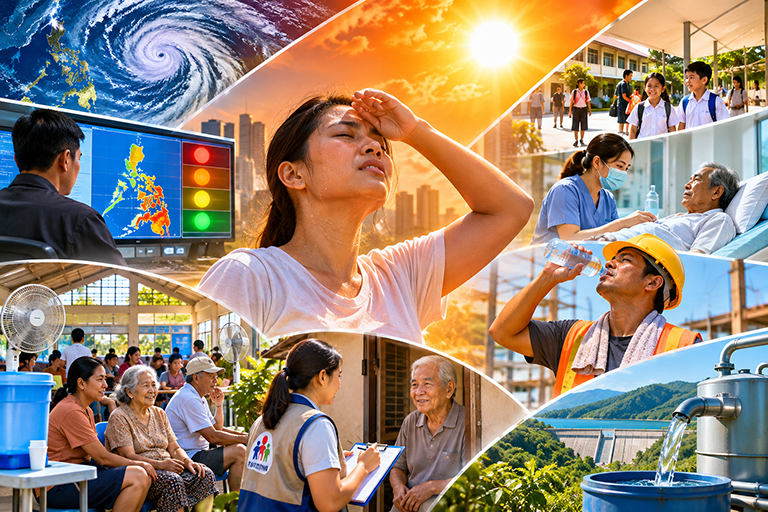
When a typhoon approaches the Philippines, the country knows what to do. Signal numbers go up. Classes are suspended. Evacuation centers open. Local officials go on the radio. Barangay workers go door to door. The whole system mobilizes, because we have learned, at terrible cost, what happens when we don’t.
Extreme heat kills more quietly. There are no dramatic images of flooded streets or roofs torn away. Its victims often die alone, indoors, and their deaths may be recorded as heart attacks, strokes or kidney failure rather than heat. That invisibility is precisely why heat is so often under-prepared for.
This El Niño is a chance to change that.
There are encouraging signs. DepEd’s new memorandum gives schools clear rules for adjusting classes to the heat. The DOH has told hospitals to prepare surge plans and fast lanes for heat-related illness. Water regulators are budgeting Angat’s supply months in advance. These are the beginnings of a heat response system.
What would a full system look like?
• Heat-health warnings that trigger action. PAGASA’s heat index forecasts should feed into a clear warning system — like typhoon signals — that tells local governments, hospitals, schools and employers exactly what to do at each level.
• Local heat action plans. Cities like Ahmedabad in India have shown that coordinated heat action plans — early warnings, public messaging, cooling centers, adjusted work hours and hospital preparedness — can reduce heat-related deaths. Philippine cities can adapt the model.
• Cooling centers. Barangay halls, churches, schools and malls can open as places where people without cool homes can spend the hottest hours.
• Registries of the vulnerable. Barangay health workers already know who lives alone, who is bedridden, who has heart disease. A simple list and a daily visit schedule during heat alerts could save many lives.
• Worker protections. Clear rules on rest breaks, water, shade and adjusted hours for outdoor workers, with enforcement.
• Water security. Investment in alternative water sources, reduced leakage and fair rationing that protects hygiene in poor communities.
• Better data. Counting heat-related illnesses and deaths properly, so we can see the problem and measure our response.
None of this is expensive compared with the cost of inaction. A cooling center is a hall with fans and water. A daily phone call costs almost nothing. A heat warning system can be built on forecasts PAGASA already produces.
We have months, not days, to prepare. Let’s use them as wisely as we would if a typhoon were on the horizon. Because in a sense, one is.







Leave a Reply