

Why Singing Is Good for the Mind, Body, and Soul

In a world increasingly burdened by stress, anxiety, and emotional exhaustion, one of the simplest forms of therapy may already be within us: the human voice. Whether in the shower, inside the car, during worship, or while singing along to a favorite old song, singing has quietly served as a natural stress reliever for generations. Science now confirms what many have long instinctively felt—singing is not merely entertainment; it is medicine for the mind and spirit.
By Katrina Juanite
There is a reason people sing during celebrations, worship services, reunions, heartbreaks, and even difficult times. Singing helps us process emotions in ways ordinary conversation sometimes cannot.
We hardly realize that one of the most affordable forms of therapy is already inside us—our breath, our voice, and a song that helps us feel human again.
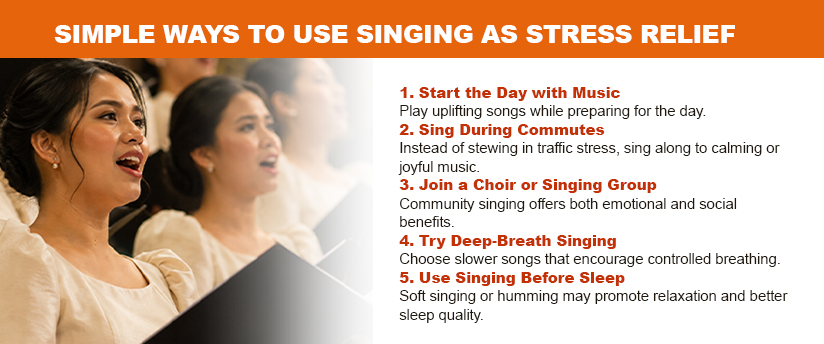
Modern research increasingly supports the therapeutic effects of singing. Studies have shown that singing may help reduce stress hormones such as cortisol while stimulating the release of endorphins—the body’s natural “feel-good” chemicals. Many individuals report feeling calmer, lighter, and emotionally refreshed after singing, even for just a few minutes.
In practical terms, singing functions almost like a form of controlled breathing exercise. Deep inhalation and prolonged exhalation during singing improve oxygenation and encourage slower, more rhythmic breathing patterns. This can activate the parasympathetic nervous system—the body’s natural calming mechanism.
For this reason, singing is increasingly incorporated into wellness programs, pulmonary rehabilitation exercises, dementia care, and mental health interventions.
More Than Just Relaxation
Singing does more than improve mood.
It may also:
- Reduce feelings of loneliness
- Improve social connection
- Enhance memory and concentration
- Promote better breathing control
- Encourage emotional release
- Improve overall sense of well-being
This is especially relevant today, when many people quietly struggle with emotional fatigue, digital overload, and chronic stress.
Interestingly, one does not need to be a professional singer to experience these benefits. The therapeutic value lies less in vocal perfection and more in emotional expression and breathing rhythm.
In other words, the body does not care whether you sound like a concert performer or a bathroom karaoke champion.
Why Group Singing Feels So Good
I have been a church choir singer for quite sometime now and have been joining our Thursday karaoke sessions with our office mates; and anyone who has sung in a choir, prayer gathering, videoke session, or family reunion knows there is something uniquely uplifting about singing with others.
Scientists believe group singing promotes social bonding by synchronizing breathing, heart rhythms, and emotional experience. This may partly explain why communal singing often creates feelings of warmth, connection, and belonging.
In a society where many people feel increasingly isolated despite constant online connectivity, shared music can become a powerful antidote to loneliness.
Singing and Emotional Healing
Music has long accompanied grief, healing, and hope.
A familiar song can evoke memories, comfort painful emotions, and create a sense of continuity during uncertain times. For some people, singing becomes a form of prayer. For others, it becomes emotional release.
Many individuals notice that after singing:
- their chest feels lighter
- their thoughts slow down
- tension decreases
- sleep improves
These effects are not imaginary. They reflect real physiologic and psychological changes.
A Final Note
Life today can feel relentlessly noisy—yet emotionally empty. Singing offers something rare: a moment of emotional release, physical relaxation, and human connection.
You do not need expensive equipment, a gym membership, or special training.
Sometimes all it takes is a familiar melody, a willing heart, and the courage to let your voice be heard.
And perhaps that is the deeper lesson of singing itself: healing does not always arrive in silence. Sometimes, it arrives in song.
“Sometimes the most affordable form of therapy is already inside us—our breath, our voice, and a song that helps us feel human again.”











Leave a Reply