

Why every minute matters when the brain begins to die
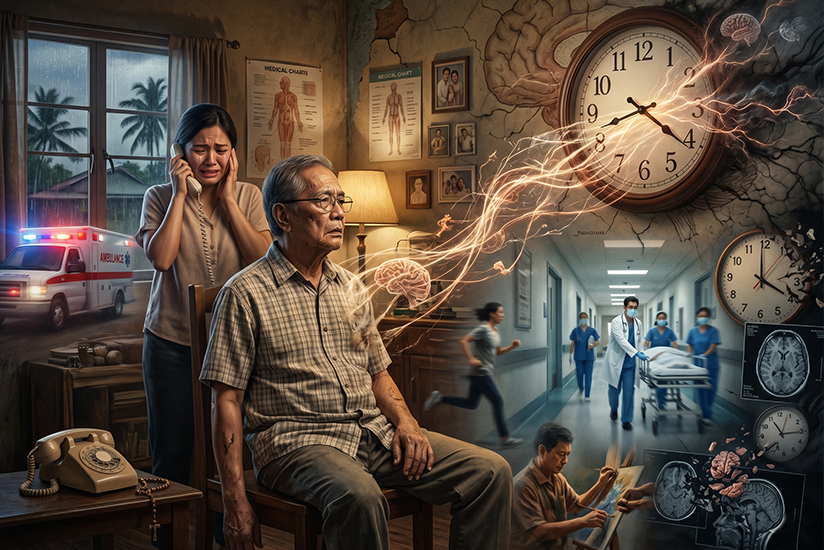
Stroke remains one of the leading causes of death and long-term disability among Filipinos. Yet despite modern advances in emergency treatment, many patients still arrive at hospitals too late—after critical brain tissue has already been permanently damaged. Some dismiss symptoms as fatigue, high blood pressure, or “naipit na ugat.” Others seek massage, herbal remedies, or rest instead of emergency care. The tragedy is that stroke is one of the few neurological emergencies where rapid action can dramatically change outcomes. In stroke care, time is not merely important—it is brain tissue, memory, speech, movement, and independence itself.
By Rafael R. Castillo, MD
The Morning That Changed Everything
A 52-year-old father sits down for breakfast before work.
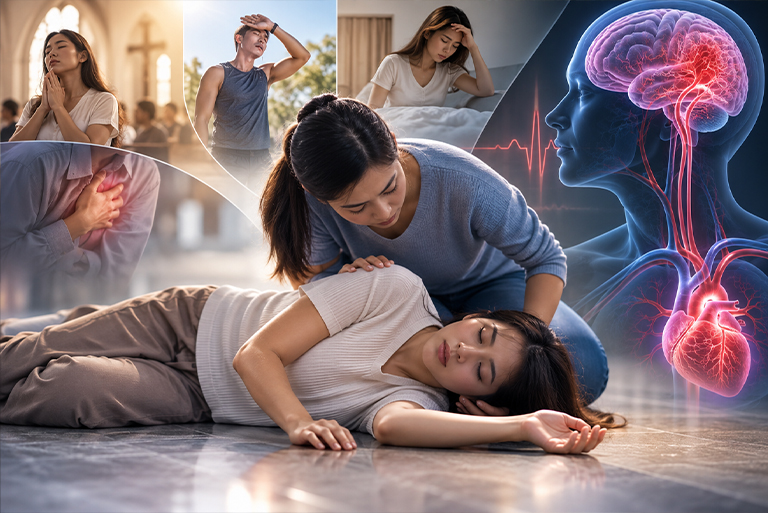
Mid-sentence, his wife notices something strange. His speech suddenly becomes slurred. The spoon slips from his hand. The right side of his face droops slightly.
He tries to stand but stumbles.
The family hesitates.
“Baka napagod lang.” (He might be just tires)
“Baka high blood lang.” (The blood pressure might be high.)
“Pahinga muna.” (He just needs rest.)
An hour passes. Then another.
By the time he reaches the hospital, precious brain cells have already died.
This scene repeats itself every day in the Philippines.
Not because stroke is untreatable—but because too many people fail to recognize that stroke is a true medical emergency.
What Exactly Is a Stroke?
A stroke occurs when blood flow to part of the brain is interrupted.
Without oxygen and nutrients, brain cells begin dying within minutes.
There are two major types:
1. Ischemic Stroke (Most Common)
Caused by blockage of a blood vessel supplying the brain.
Usually linked to:
- hypertension
- diabetes
- smoking
- cholesterol buildup
- irregular heartbeat (atrial fibrillation)
2. Hemorrhagic Stroke
Caused by rupture of a blood vessel inside the brain.
Often associated with:
- uncontrolled hypertension
- aneurysm
- vascular abnormalities
This form can be rapidly fatal.
“In stroke, every minute matters. The longer the brain is deprived of blood flow, the more permanent the damage becomes.”
Why Stroke Is a Major Filipino Health Crisis
Stroke remains among the leading causes of:
–death
–paralysis
–long-term disability in the Philippines.
Several factors fuel this burden:
- widespread hypertension
- diabetes
- smoking
- obesity
- sedentary lifestyles
- delayed emergency consultation
Many Filipinos also underestimate symptoms or initially seek non-medical remedies.
Unfortunately, delay is dangerous.
The Warning Signs Everyone Must Know
The most important message about stroke is this: Symptoms often appear suddenly.
Remember “FAST”
F – Face Drooping
One side of the face appears uneven.
A – Arm Weakness
One arm becomes weak or numb.
S – Speech Difficulty
Speech becomes slurred or confused.
T – Time to Call Emergency Services
Immediate hospital care is critical.
Other Possible Symptoms
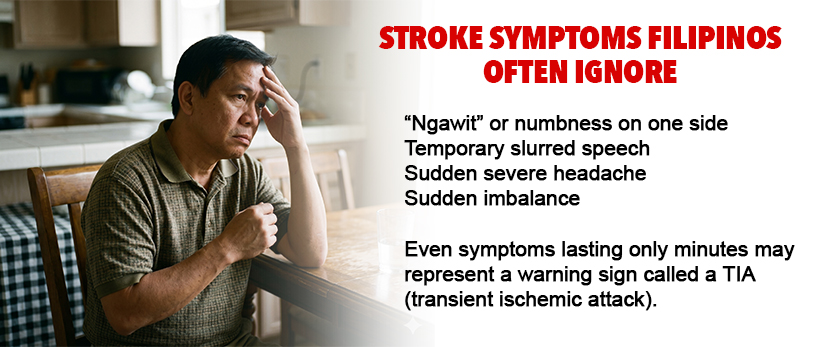
- Sudden severe headache
- Vision loss
- Dizziness or imbalance
- Sudden confusion
- Difficulty walking
Why the First Few Hours Are Critical
Modern stroke treatment has transformed outcomes—but timing is everything.
- Certain patients with ischemic stroke may benefit from: clot-busting medication (thrombolysis)
- mechanical clot retrieval (thrombectomy)
However, these treatments work best within strict time windows.
The earlier blood flow is restored, the greater the chance of:
- survival
- recovery
- preserved independence
Delayed consultation often means lost opportunity.
The Conditions Quietly Driving Stroke
Stroke rarely appears without warning risk factors.
Hypertension
The single most important modifiable risk factor.
Many Filipinos have high blood pressure without symptoms.
Diabetes
Damages blood vessels over time.
Smoking
Accelerates vascular injury and clot formation.
Obesity and Sedentary Lifestyle
Increase risk of hypertension, diabetes, and vascular disease.
Atrial Fibrillation
An irregular heartbeat that may generate blood clots.
How Is Stroke Diagnosed?
Emergency evaluation usually includes:
✔ Neurological examination
✔ CT scan or MRI
✔ Blood tests
✔ Heart rhythm evaluation
Brain imaging is essential because treatment differs dramatically between ischemic and hemorrhagic stroke.
Treatment: A Race Against Time
Ischemic Stroke
May involve:
- thrombolytic drugs
- thrombectomy
- blood thinners
- risk factor control
Hemorrhagic Stroke
May require:
- blood pressure control
- neurosurgical intervention
- intensive care
Life After Stroke
Survival is only the beginning.
Many stroke survivors face:
- paralysis
- speech difficulty
- swallowing problems
- memory impairment
- depression
Rehabilitation becomes crucial.
Rehabilitation Matters
Physical therapy, occupational therapy, and speech therapy can significantly improve recovery.
The brain possesses remarkable adaptability, especially with early rehabilitation.
“A stroke does not only threaten life—it can steal speech, memory, movement, livelihood, and independence.”
The Emotional Burden on Families
Stroke affects entire households.
Family members often become:
- caregivers
- financial providers
- emotional support systems
The cost includes:
✔ hospitalization
✔ rehabilitation
✔ lost income
✔ emotional exhaustion
This is why prevention remains far more powerful than treatment alone.
The Filipino Delay Problem
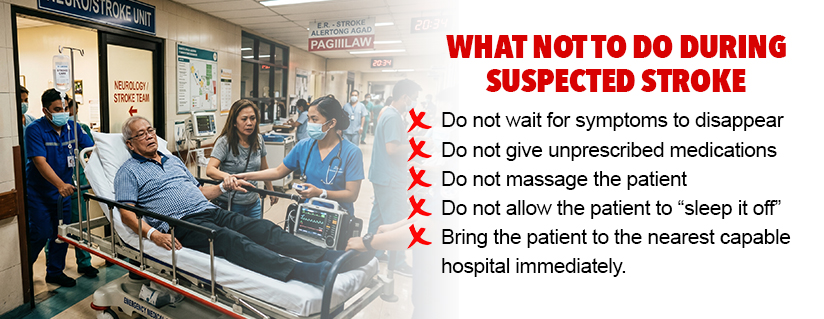
One of the greatest challenges in the Philippines is delayed hospital arrival.
Reasons include:
- poor symptom recognition
- traffic and transport barriers
- financial concerns
- reliance on home remedies
- seeking massage first
Unfortunately, every hour of delay increases the likelihood of permanent disability.
Can Stroke Be Prevented?
The encouraging reality is this:
Most strokes are preventable.
Key Prevention Habits
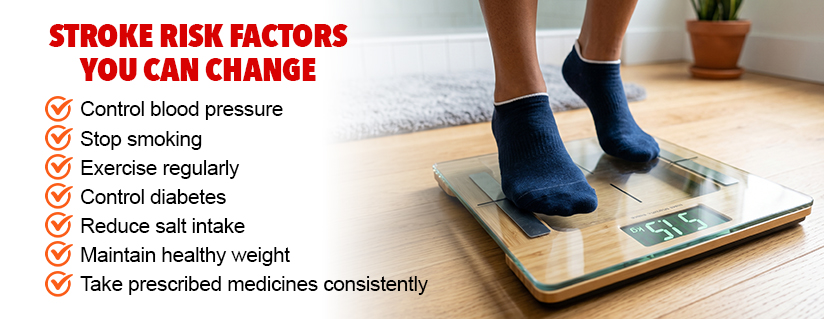
- Monitor blood pressure regularly
- Reduce dietary salt
- Exercise consistently
- Stop smoking
- Control diabetes and cholesterol
- Sleep adequately
- Maintain healthy weight
The Bigger Lesson
Stroke reminds us that chronic disease often develops quietly for years before catastrophe occurs.
The stroke itself may appear sudden.
But the vascular damage began long before:
- uncontrolled hypertension
- poor diet
- smoking
- inactivity
- neglected check-ups
In many ways, stroke is not merely a neurological emergency.
It is the final consequence of long-standing vascular neglect.
Final Lesson
The brain is extraordinary.
It stores memories, language, identity, personality, and the ability to move through the world independently.
Yet it is also fragile.
A single blocked vessel can permanently alter a life within minutes.
That is why stroke awareness matters—not only in hospitals, but in homes, workplaces, schools, and communities.
Because recognizing stroke early may mean the difference between:
- recovery and disability
- speech and silence
- independence and dependence
- life and death
And perhaps the most important lesson is this:
When it comes to stroke, hesitation can be irreversible.
References
- World Stroke Organization. Global Stroke Fact Sheet 2025.
- American Stroke Association. Stroke warning signs and emergency treatment guidelines.
- Department of Health (Philippines). National Stroke Prevention and Control advisories.
- Philippine Heart Association and Philippine Neurological Association stroke education materials.
- Powers WJ, et al. 2023 Guidelines for the Early Management of Acute Ischemic Stroke. Stroke. American Heart Association.
- Feigin VL, et al. Global burden of stroke and risk factors. Lancet Neurology. 2021.
- Centers for Disease Control and Prevention (CDC). Stroke prevention and FAST campaign resources.
- World Health Organization. Cardiovascular disease and stroke prevention fact sheets.
- Philippine Statistics Authority. Leading causes of mortality in the Philippines.
- Donkor ES. Stroke in low- and middle-income countries. Cardiovasc Diagn Ther. 2018.





Leave a Reply