
Climate Change Is Now a Health Policy Issue


For many years, climate change was viewed primarily through an environmental lens. That perspective is no longer sufficient.

The growing health consequences of climate change demand a public health response equal to the scale of the challenge.

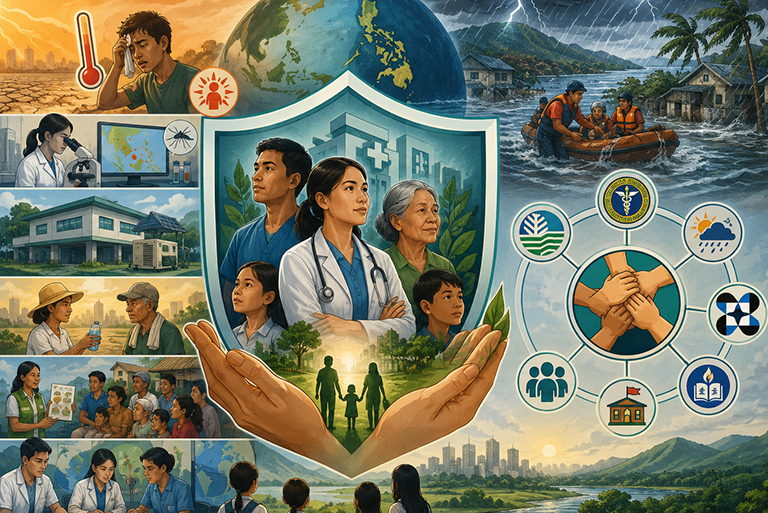
The Department of Health has already recognized climate-sensitive diseases as an emerging concern. However, future planning must go beyond disaster response and incorporate climate resilience into routine healthcare delivery.

Key priorities should include:


Strengthening Disease Surveillance

Monitoring dengue, leptospirosis, diarrheal diseases, and heat-related illnesses should become increasingly sophisticated as environmental conditions evolve.


Climate-Resilient Healthcare Facilities

Hospitals and health centers must remain operational during floods, typhoons, heat waves, and power disruptions.


Heat Action Plans

Local governments should develop protocols to protect vulnerable populations during extreme heat events.


Community-Based Preparedness

Barangay-level education can reduce preventable illness and death during disasters.


Integrating Climate Into Health Professional Education

Medical, nursing, and public health curricula should include climate-health competencies.


Strengthening Interagency Collaboration

The health impacts of climate change require cooperation among the DOH, DENR, PAGASA, DOST, DepEd, local governments, and civil society.

Climate change is no longer merely an environmental concern.

It is increasingly a determinant of health.

The sooner health systems adapt, the better prepared the Philippines will be to protect future generations.



Leave a Reply

Your email address will not be published. Required fields are marked *

Share this Article
Facebook
X
LinkedIn
WhatsApp
Email

More News

banner-SS-copy-7
Climate Change Is Now a Health Policy Issue
For many years, climate change was viewed primarily through an environmental lens. That perspective is...
banner-SS-copy-10
The Rubicon Principle
By Dr. Tony Leachon  A past president of the PHIlippine College of Physicians once asked...
banner-SS-copy-6
10 Ways Filipino Families Can Protect Their Health From Climate Change
By the H&L Editorial Team 1. Stay Ahead of Heat Waves Drink water regularly, even before feeling...
banner-SS-copy-5
THE FEVERED PLANET
How Climate Change Is Making Us Sick For decades, climate change was discussed largely in terms...
banner-SS-copy-4
THE DOCTOR WHO CAME HOME
How Dr. Rollin P. Tabuena turned a childhood dream into a lifetime of healing, leadership, and service Where...
banner-SS-copy-2
The Day He Stopped Looking Over the Fence
It is easier than ever to compare our lives with those of others. Their successes. Their families. Their...
banner-SS-copy-1
Patience: The Waiting Game
By Henrylito D. Tacio  “Patience asks us to live the moment to the fullest, to be completely...
High Falls from a distance
High Falls: The other waterfall shared by the United States and Canada
High Falls from a distance. Words and Photos by Henrylito D. Tacio When Filipinos talk about a waterfall...
banner-copy4-copy-3
What To Do—and Not Do—When Severe Abdominal Pain Strikes
✔ DO Stay Hydrated Small sips of water may help prevent dehydration if vomiting is mild. Observe...
banner-copy4-copy-1
When Waiting Can Be Dangerous
One of the most common statements physicians hear in emergency rooms is: “Akala ko mawawala lang.” (I...