

What the Latest Evidence Tells Us—and Why Calm, Evidence-Based Vigilance Still Matters
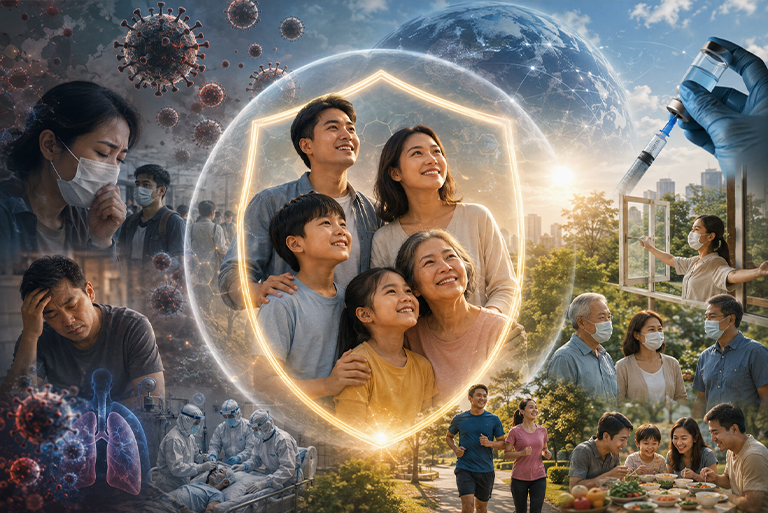
For many people, COVID-19 feels like a chapter that has finally closed. Schools are open, travel has resumed, restaurants are full, and masks have largely disappeared from daily life. Yet reports of increasing COVID-19 activity in parts of Asia and elsewhere have prompted a familiar question: Is the virus making a comeback? The answer is both reassuring and cautionary. COVID-19 never truly disappeared, but neither has it returned to the devastating reality of 2020. Thanks to widespread immunity, vaccines, improved treatments, and years of scientific experience, we are entering a new phase—one that calls not for fear or complacency, but for informed vigilance grounded in evidence.
By Rebecca Lorenzo-Castillo, MD
“The challenge today is not choosing between fear and denial. It is choosing informed vigilance.”
The Pandemic We Thought Was Over
For many people, COVID-19 ended not because the virus disappeared, but because life demanded that it continue. Children returned to school, offices reopened, airports became busy once again, and families reunited after years of disruption. Gradually, masks came off, and COVID-19 slipped from the front pages of newspapers.
Yet viruses do not read headlines.
While the world moved forward, SARS-CoV-2 quietly continued to circulate. Like influenza and other respiratory viruses, it has become part of our environment, producing periodic increases in infections as immunity changes, people travel more, and new viral variants emerge.
Recent reports of increasing COVID-19 activity in several countries have understandably raised concerns. Social media has amplified these reports, often with alarming claims that another devastating pandemic is imminent. At the opposite extreme are those who dismiss COVID-19 as “just another cold.”
Neither position reflects the current scientific evidence.
COVID-19 has not disappeared. Neither has it returned to the crisis of 2020.
The truth lies between panic and complacency.
COVID Has Entered a New Phase

The World Health Organization (WHO) ended the Public Health Emergency of International Concern in 2023, but it did not declare COVID-19 eradicated. Instead, the disease has entered what many experts describe as an endemic phase, characterized by continuing transmission with periodic waves.
Respiratory viruses rarely disappear completely. Influenza, respiratory syncytial virus (RSV), and the common cold coronaviruses continue to circulate every year. SARS-CoV-2 has joined this group.
Today’s increases in cases are therefore not unexpected. They reflect the natural interaction between viral evolution, waning immunity, seasonal behavior, and human mobility.
Importantly, an increase in reported infections does not necessarily translate into proportional increases in severe illness or deaths. Because of widespread immunity from vaccination and previous infection, the relationship between case numbers and hospitalizations has changed dramatically compared with the first years of the pandemic.
Are the New Variants More Dangerous?
Viruses constantly evolve.
Every time SARS-CoV-2 infects a person, small genetic changes occur as it replicates. Most mutations have little or no biological significance. Occasionally, however, a combination of mutations allows a variant to spread more efficiently or partially evade existing immunity.
Current circulating variants remain descendants of the Omicron lineage.
Available evidence indicates that these variants are generally more transmissible but not inherently more virulent than recent Omicron strains. In other words, they may infect more people, but they have not consistently demonstrated greater disease severity.
This distinction is critically important.
More infections do not automatically mean a more dangerous virus.
The continued surveillance of variants through global genomic monitoring remains essential, but at present there is no convincing evidence that currently circulating variants have fundamentally altered the overall risk profile of COVID-19.
Who Remains Most Vulnerable?
Although many healthy younger adults recover uneventfully, COVID-19 can still cause severe disease in vulnerable populations.
Higher-risk groups include:
- Adults aged 65 years and older
- Individuals with cardiovascular disease
- People with hypertension or diabetes
- Patients with chronic kidney disease
- Those with chronic lung disease, including COPD
- Individuals with obesity
- Cancer patients receiving chemotherapy
- Organ transplant recipients
- People with weakened immune systems
- Some pregnant women with significant underlying risk factors
For these groups, preventing infection remains worthwhile because the consequences of illness may still be substantial.
This is why many national and international health authorities continue to recommend updated vaccination for older adults and other high-risk individuals.
Long COVID: The Story That Continues
Perhaps the most important legacy of the pandemic is not the acute infection itself but what follows for some patients.
Long COVID, also known as post-COVID condition, refers to persistent symptoms that continue or develop after the initial infection and cannot be explained by another diagnosis.
Common symptoms include:
- Persistent fatigue
- Reduced exercise tolerance
- Difficulty concentrating (“brain fog”)
- Sleep disturbances
- Shortness of breath
- Loss or alteration of smell and taste
- Palpitations
- Mood changes
The severity varies considerably. Some individuals recover within weeks, while others require prolonged rehabilitation.
Although vaccination appears to reduce the risk of Long COVID, it does not eliminate it completely.
Preventing infection therefore remains valuable not only to avoid hospitalization but also to reduce the risk of prolonged health problems.
What Should Filipino Families Do Today?

The encouraging news is that the measures that reduce COVID-19 risk are largely the same measures that promote overall health.
Practical recommendations include:
- Stay home if you develop symptoms of a respiratory infection.
- Practice good hand hygiene.
- Improve ventilation whenever possible by opening windows or increasing airflow.
- Consider wearing a well-fitting mask in crowded indoor settings during periods of increased transmission, particularly if you are at high risk or are visiting medically vulnerable individuals.
- Stay up to date with recommended COVID-19 vaccination if you belong to a group for whom it is advised.
- Seek medical attention promptly if you are at high risk and develop symptoms, since early treatment may be beneficial.
- Maintain healthy habits, including regular exercise, adequate sleep, balanced nutrition, smoking cessation, and good control of chronic medical conditions.
These measures are practical, evidence-based, and beneficial far beyond COVID-19.
Choosing Wisdom Over Fear
One of the greatest lessons of the pandemic is that public health depends upon trust.
Fear may gain attention, but it rarely sustains good decisions.
Likewise, complacency invites unnecessary risk.
The wiser path is informed vigilance.
Science has equipped us with vaccines, better treatments, improved diagnostic tests, and a much deeper understanding of the virus.
Healthcare systems are better prepared.
Physicians have years of clinical experience.
Communities know far more about preventing respiratory infections than they did in 2020.
These are genuine reasons for confidence.
At the same time, COVID-19 reminds us that infectious diseases continue to evolve and that protecting older adults, people with chronic illnesses, and other vulnerable individuals remains a shared responsibility.

Looking Ahead
Will COVID-19 disappear?
Probably not.
Like influenza, it is likely to remain part of our lives for the foreseeable future, producing periodic waves of varying intensity.
Our response, however, has changed.
We are no longer facing an unknown virus with no vaccines, no effective treatments, and little understanding of its behavior.
We now possess knowledge, experience, and effective tools.
The challenge before us is to use them wisely.
COVID-19 has become part of our world.
It need not dominate our lives.
If there is one enduring lesson from the pandemic, it is this:
The greatest strength of humanity has never been the absence of disease.
It has always been our ability to learn, adapt, care for one another, and move forward together.
That remains our greatest protection—not only against COVID-19, but against whatever public health challenges the future may bring.







Leave a Reply