

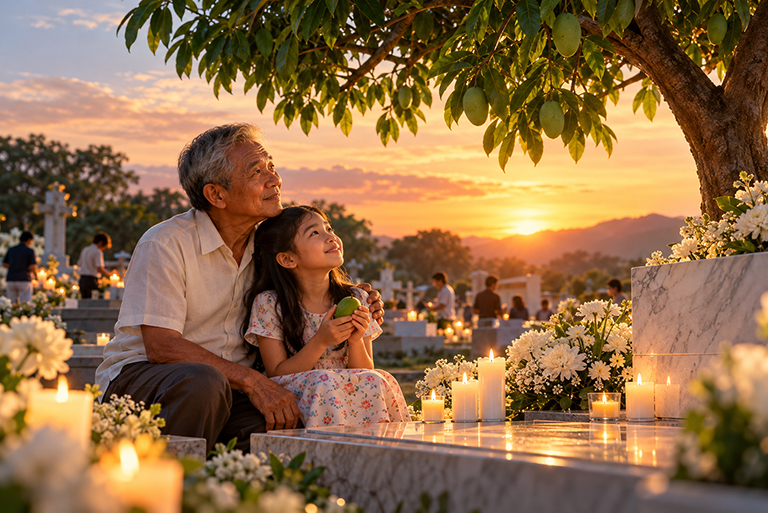
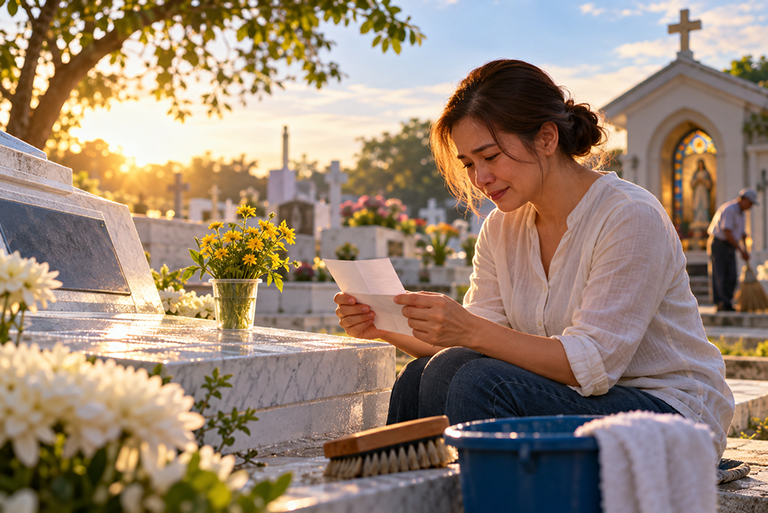
Every November, we return to the graves of the people we love. We light candles, pray, and tell stories. But beneath the flowers and the familiar rituals lies a question as old as grief itself: Is this the end? This Sabbath story is about an old carpenter, his granddaughter, a mango tree, and the hope that has carried believers through every cemetery visit for two thousand years — that the grave does not have the final word.
“It looked dead, Lolo said. Dry and hard as a stone. That’s what makes a seed so stubborn. It has to be buried before it can live.”
By Raffy Castillo
The tree was taller than Lolo Lucas now.
When he first planted it, six years ago, it was only a mango seed, flat and fibrous, from the last carabao mango Lola Remedios had eaten. She had shared it with him the week before she died, slowly, one small slice at a time, because by then she could not eat much. When she finished, she handed him the seed and smiled. “Itanim mo, para may lilim ka.” (Plant it, so you’ll have shade.)
He had thought she was joking. He planted it anyway, in the strip of earth beside her tomb, the week after the funeral. The caretaker had shrugged. Nobody expected it to grow.
All Souls’ Day
This year, his granddaughter Bea came with him. She was nine, full of questions, and she had insisted on carrying the candles herself.
They cleaned the marble together. Lucas wiped her grandmother’s name with a damp cloth: Remedios Santos Villareal, 1950–2020. Bea arranged the white candles in a neat row and watched the flames bend in the warm November wind.
Then she sat on the low ledge and looked up at the tree.
“Lolo,” she said, “is Lola still in there?”
The Question Under All the Questions
Lucas had been asked a lot of hard questions in his life. Customers wanting a cabinet by Friday. His children asking for tuition money he didn’t have. Doctors asking whether he wanted them to keep trying.
But no one had asked him this one so plainly.
He sat down beside her and was quiet for a while.
“Her body is there,” he said finally. “But Lola herself — the part of her that laughed and scolded me and prayed the rosary every night — she’s with God now.”
Bea thought about this. “Will we see her again?”
He wanted to say yes immediately, the way adults do to comfort children. But he found he wanted to tell her the truth, and the truth deserved a better answer than a quick yes.
The Seed
He pointed up at the mango tree.
“Do you know where that tree came from?”
Bea shook her head.
“From a seed. Lola’s seed. From the last mango she ate.” He held up his hand, finger and thumb a few centimeters apart. “It was this big. Dry. Hard as a stone. It looked dead. If you’d seen it, you would have thrown it away.”
“But you planted it.”
“I planted it. And it had to stay in the ground, in the dark, for a long time before anything happened. That’s what makes a seed so stubborn. It has to be buried before it can live.”
He looked at the tree, at its dark green leaves moving in the breeze, at the shade it now cast over his wife’s name.
“Jesus said something like that once. ‘Except a corn of wheat fall into the ground and die, it abideth alone: but if it die, it bringeth forth much fruit.’ He was talking about Himself. He was buried too. And then, on the third day, He rose.”
What Lola Believed
“Lola believed that,” Lucas went on. “Not just for Jesus. For herself. For all of us.”
He told Bea about the last days in the hospital. How Remedios had asked him to read to her from the small Bible she kept in her bag, the one with the cracked leather cover. How she always asked for the same passage, from Saint Paul’s letter to the Thessalonians, and how he had read it so many times that he still knew it by heart.
He recited it now, slowly, the way she had liked it:
“‘I would not have you to be ignorant, brethren, concerning them which are asleep, that ye sorrow not, even as others which have no hope. For if we believe that Jesus died and rose again, even so them also which sleep in Jesus will God bring with him.'”
Bea frowned. “Asleep?”
“That’s how Saint Paul talks about people who have died believing in God. Like they’re sleeping, waiting to be woken up.”
“Who wakes them up?”
“Jesus does. When He comes back.” Lucas smiled. “Saint Paul says the dead in Christ will rise first. And then those of us who are still alive will be gathered up together with them. All at once. Nobody left behind.”
“Then You’ll Be There Too”
Bea was quiet for a long moment, watching the candles.
“So Lola will wake up,” she said slowly, “and if you’re still alive, you’ll go with her. And if you’re—” She stopped.
“And if I’m already asleep by then,” Lucas finished gently, “then I’ll wake up too. Next to her, probably. She’d scold me if I were late.”
Bea laughed, then grew serious again. “And me?”
He put his arm around her. “You too, anak. That’s the whole point. Not just Lola. Not just me. Everyone who belongs to Him. The ones who died, and the ones still living. All together again.”
Before They Left
The sun was dropping behind the rows of tombs. Families were packing up their mats and folding tables. Someone nearby was singing softly.
Before they left, Bea stood up and picked a small, unripe mango that had fallen from the tree. She turned it over in her hands.
“Lolo, can I plant this one at home?”
He looked at the little green fruit, then at his granddaughter, and something in his chest loosened that had been tight for six years.
“Of course,” he said. “But you’ll have to be patient. It has to be buried first.”
She nodded seriously, as if she understood exactly what he meant.
Maybe she did.
SABBATH REFLECTION
This season, millions of Filipinos visit the graves of their loved ones. Some go with hearts full of sweet memories. Others go carrying grief that still feels raw, or regrets that have never been resolved.
Remembering the departed is an act of love. But for people of faith, it is also an act of hope.
The Christian hope is not merely that our loved ones live on in our memories, or that their spirits are somehow at peace. It is something bolder: that because Christ rose from the dead, those who belong to Him will rise too. That one day, the faithful who have died and the faithful who are still living will be gathered together, made whole, and never parted again.
Saint Paul does not tell us not to grieve. He tells us not to grieve “as others which have no hope.” Grief and hope can live in the same heart. We can miss someone terribly and still believe, with quiet confidence, that the goodbye is not forever.
This Sabbath, as you remember those you have lost, consider what you are planting in the meantime. The faith they passed on to you. The love they showed. The prayers they prayed. These, too, are seeds — buried for now, but waiting.
And ask yourself: Am I living in a way that makes that reunion something to look forward to?
CLOSING PRAYER
Lord of life and Conqueror of death,
We remember before You today those we love who have gone before us.
Thank You for the years we shared, the lessons they taught, the faith they handed down.
Comfort us where grief still aches.
Heal us where regret still lingers.
And strengthen in us the hope You have promised:
that the dead in Christ shall rise,
that we who remain shall be gathered with them,
and that we shall all be together with You forever.
Until that morning comes, help us to live faithfully,
to love generously, and to plant seeds of faith in those who will come after us.
We ask this through Jesus Christ, the Resurrection and the Life.
Amen.





Leave a Reply