


By Eugene F. Ramos, MD

What becomes of us as the years pass? Do we become what we always wanted, or do we fall short and end up just wanting what we’ve become?
A life that exceeds 80 years is likely a celebration of fulfilled expectations; a life cut short at 30, a tragedy of wasted possibilities.
Taking a good look at our individual lives, we see a panorama of snapshots when we look back, and a row of milestones as we move forward. Like train-stops that serve to remind us of where we are in a journey, these milestones keep us aware of both time and distance, specifically what is left to hope for.
Stephen Covey has an excellent way of summing this up in a phrase: To learn, to love, to leave a legacy. With so many things to aspire for and too little time to cover them, how we balance the various elements in a life dream ultimately determines where to find ourselves – and how people look at us – when the journey ends.
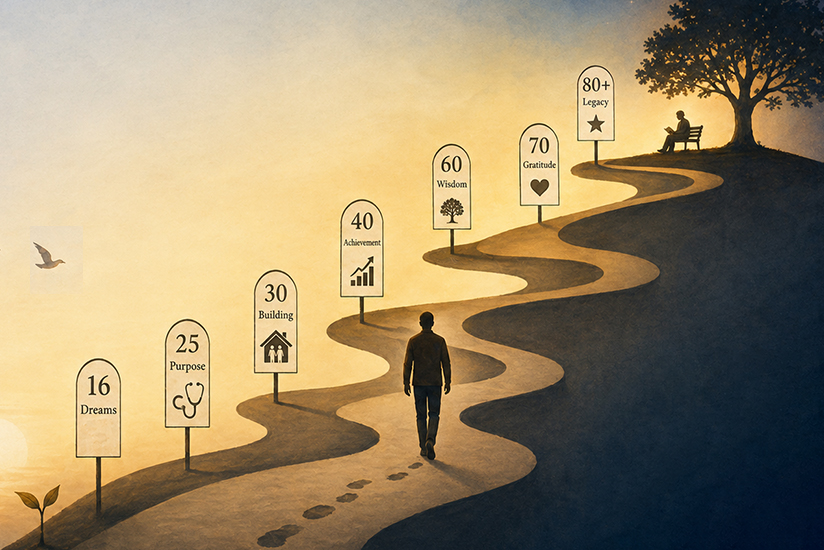
Milestones were embedded in our minds when we entered college or, among us doctors, medical school. Things that had to happen must happen at certain time frames. We were one thing at 16 but were something else—or better—by the time we turned 21.
When we finished med school at 25, a whole new set of goalposts took shape after we decided to choose one path over another. It was a big deal when we finished medical specialty training in our 30s as we started imagining, with anxious optimism, the perks of a promising practice in the years ahead.
By the time we turn 40, life begins to put on a new face. We start to rise, both in stature and confidence, and acquire respectability in the community where we settle and build a family.
Many assume bigger roles in the organizations that are honored to have them; some become their movers and shakers. Here, ego-boosting opportunities and options for upward mobility multiply and diverge. We go through the so-called midlife crisis at around this decade, when we perceive a mismatch between our dreams for ourselves and our achievements so far—between flourishing possibilities outside and a floundering energy inside.
Dilemmas and decisions on a career change are happy problems to talk about, with both unease and masked pride. Here, the drive to succeed becomes complicated because success starts to embrace new meanings—some of them incoherent, some, unreasonable.
As we get past 50, we become more aware of our shortcomings and the reality of our ordinariness. We notice a world that will go on with or without us; we are compelled to reexamine our trajectory and habits—to curb our wants for things that are fleeting, to indulge less and contribute more.
This, too, is a function of time – the number of years it takes us to discover and confront who we are and how we are to others. It can be a tough call to those who have been up in the clouds for so long, afloat in their hard-earned successes, and do not have the motivation to share their luck with the many down below. But everything evens out and self-corrects in time, as time is the ultimate equalizer.
Past 50, we seek to simplify things by realigning what success means with what truly makes us happy. Happiness becomes more personal, closer to in here than out there. Slowing down the metaphorical hedonic treadmill smoothly, getting off safely and gracefully, and finding a shady tree to sit under, undisturbed, with a good book—this vision of a humbler future can be magical when we learn to give in and let go. Despite physical decline, wisdom and equanimity animate our presence as we transcend 60, then 70, 80, through 90.
A hundred years is, perhaps, too much to aim for, but as the years add up, we learn to appreciate in a much grander way what the years strip away and build upon. Numbers influence the decisions that we make – both the major and minor ones. We celebrate life depending on the number that dates it. Our 1st birthday—and the 1st birthdays of our children—are painted in our minds with balloons, clowns, gifts and a birthday cake with a single lighted candle at the center, recorded for posterity by a very busy but ever-present father, and orchestrated by a mother who throws herself at the impermanence of the moment as the all-in-one planner, producer, director, and actor.
The first year of marriage is bliss, with adjustments and difficulties overpowered by love, if not passion. The first wedding anniversary is an exclusive romantic occasion that every wife looks forward to and every husband who values peace and order never forgets. The first anniversary of an achievement – and even the first death anniversary of a loved one or a respected individual – never passes unplanned, unacknowledged, or uncelebrated.
People always remember the first; the second seldom comes close. The first of anything is almost always imbued with passion, commitment and great promise for the years to come; the second that follows is easily overlooked.
Ten years of marriage, happy or otherwise, is a milestone for couples who learn to put up with each other’s idiosyncrasies. A decade at work calls for an award or recognition, if not for excellence at least for tenacity and loyalty. A lot of things go into 10 years of any endeavor.
We come out of it whole or broken but are expected to come out of it wiser either way. Time changes us; we learn to adapt. When we can’t, we suffer.
We expect certain changes – progress, if you may – as we move through the numbers, because we like to believe that time confers on us wisdom or even just recurrent opportunities for redemption. At 18, we become legal; at 21, we go mainstream; at 25, we think of work and survival; by 30, we start a family; at 40, we look forward to comfort and achievements; at 50, we aim for things greater than ourselves; by 60, we look forward to peace, quiet and security; at 75, we count our blessings.
We bracket the numbers in our lives with the sparkle of our hopes and aspirations. Twenty-five years is silver; 50 is gold; 75, diamond.
In time, 100 will become the norm as medical science and technology accelerate the ‘evergreening’ of the human species. As we regain dominance over squeaky joints, flabby muscles, droopy wrinkles, sagging breasts and unresponsive penises, and revive ourselves with new energy sources—internal and external, we may see a new world order evolving in the way we drill the numbers. When 60 becomes the new 40, and adolescence extends up to 30, joie d’ vivre could put our world at risk of being crowded with aging people who love life but only for themselves!
As the number of our years rolls down a red carpet, we must not allow ourselves to be found doing more of the same things that we have done so far, mindful of the fact that a lot of time is wasted on things of no consequence. If all that science manages to provide is more years to people with overstretched faces and overblown egos, 100 will be to plastic what 75 was to diamond.
What becomes of us as time passes? We acquire the patina of the years – the waves of changes – that shape our existence. Everything else depends on whether we can count on ourselves to choose what counts the most.