

Why the pills meant to heal may sometimes make us sick

In modern medicine, prescriptions have become symbols of care—evidence that something is being done. Yet for many patients, especially older adults, the growing list of medications can quietly become a burden rather than a benefit. Polypharmacy—the use of multiple medications at the same time—is increasingly common, and with it comes a hidden danger: drug interactions, side effects, and unintended harm. In a healthcare system that often rewards adding rather than simplifying, a critical question must be asked—are we treating disease, or overwhelming the patient?
By Rafael R. Castillo, MD
An elderly patient walks in, carefully opening a plastic bag filled with medicines. “Doc, ito po lahat iniinom ko.” (These are all the medicines I’m taking.)
Inside are tablets of different shapes and colors—some for blood pressure, others for diabetes, cholesterol, pain, sleep, vitamins, and more. Some prescribed by different doctors. Some continued out of habit. Some no longer necessary.
The patient feels tired, dizzy, and forgetful. And yet, the answer is not always to add another pill. Sometimes, the answer is to take one away.
What Is Polypharmacy?
Polypharmacy is commonly defined as the use of five or more medications simultaneously.
While often necessary—especially for patients with multiple conditions—it becomes problematic when:
- Medications are duplicated
- Drugs interact negatively
- Side effects are misinterpreted as new illnesses
- Prescriptions are continued without reassessment
In short, polypharmacy becomes harmful when quantity overtakes clarity.
Why Polypharmacy Is Increasing
Aging Population
As Filipinos live longer, they accumulate more chronic conditions:
- Hypertension
- Diabetes
- Heart disease
- Arthritis
Each condition often comes with its own set of medications.
Multiple Doctors, Fragmented Care
Patients may consult several specialists—each focused on one condition, but not always on the whole patient.
Guideline-Driven Medicine
Clinical guidelines often recommend multiple drugs for optimal control of disease—sometimes without full consideration of cumulative burden.
The ‘Add, Don’t Subtract’ Culture
It is easier to prescribe a new medication than to reassess existing ones.
The Hidden Risks
Polypharmacy is not just inconvenient—it can be dangerous.
Drug Interactions
Some medications alter the effects of others, leading to toxicity or reduced efficacy.
Side Effects That Mimic Disease
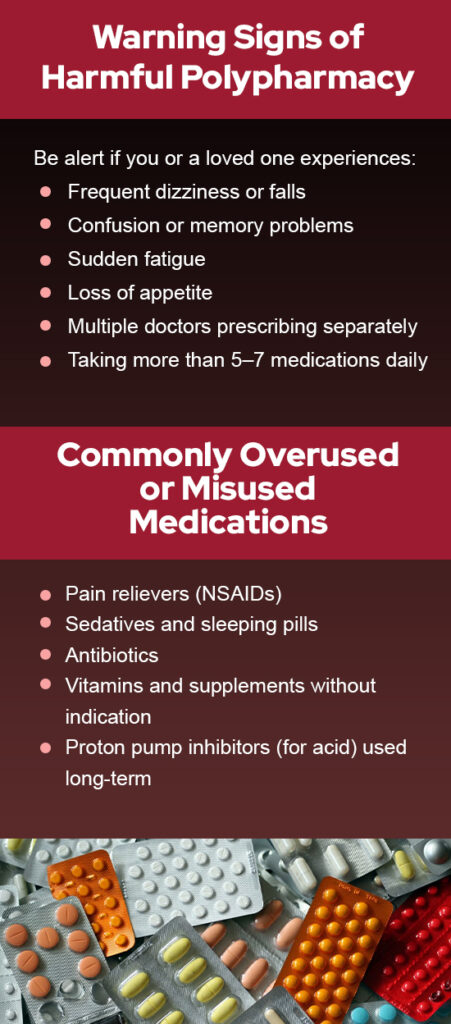
Dizziness, confusion, falls, fatigue—these may be mistaken for aging rather than medication-related.
Increased Risk of Falls
Sedatives, blood pressure medications, and certain pain relievers can increase fall risk, especially in older adults.
Hospitalizations
Adverse drug reactions are a leading cause of hospital admission among elderly patients.
Medication Non-Adherence
The more complex the regimen, the more likely patients are to skip doses or take medications
When More Becomes Less
One of the paradoxes of medicine is this:
More treatment does not always mean better outcomes.
In fact, excessive medication can reduce quality of life—leaving patients:
- Overmedicated
- Overwhelmed
- Undernourished
- Less functional
The goal is not just to treat disease—but to preserve function, clarity, and dignity.
Deprescribing: The Other Side of Care
A growing movement in medicine is deprescribing—the careful reduction or discontinuation of medications that are no longer necessary.
This involves:
- Reviewing all medications regularly
- Identifying those with limited benefit
- Assessing risk vs. benefit
- Simplifying regimens
Deprescribing is not neglect.
It is thoughtful, patient-centered care.
The Filipino Context
Polypharmacy is particularly relevant in the Philippines due to:
- Easy access to over-the-counter drugs
- Self-medication practices
- Multiple healthcare providers
- Limited continuity of care
Many patients add supplements, herbal products, and vitamins—often without informing their physician.
These, too, can interact with prescribed medications.
The Role of Doctors and Families
For Physicians:
- Conduct regular medication reviews
- Avoid unnecessary duplication
- Prioritize simplicity
For Families:
- Keep an updated medication list
- Bring all medicines to clinic visits
- Observe for changes in behavior or function
A More Human Approach to Treatment
Medicine is not just about numbers.
It is about people.
A patient with controlled blood pressure but constant dizziness is not truly well.
A patient with perfect lab results but poor quality of life is not fully cared for.
The goal is not perfection on paper—but balance in life.
Final Reflection
Polypharmacy reminds us of a simple but profound truth:
Healing is not always about adding.
Sometimes, it is about letting go.
Letting go of unnecessary medicines.
Letting go of complexity.
Letting go of the idea that more is always better.
Because in medicine—as in life—
clarity often heals more than excess.
“Your medicines may be making you sick—not because they are wrong, but because there are simply too many of them.”
References
- Maher RL, et al. Clinical consequences of polypharmacy. Expert Opin Drug Saf. 2014. doi:10.1517/14740338.2013.827660
- Gnjidic D, et al. Polypharmacy and health outcomes. J Am Geriatr Soc. 2012. doi:10.1111/j.1532-5415.2012.03923.x
- World Health Organization. Medication safety in polypharmacy. 2019.
- American Geriatrics Society. Beers Criteria for potentially inappropriate medication use. 2023
- Scott IA, et al. Deprescribing in older adults. JAMA Intern Med. 2015. doi:10.1001/jamainternmed.2015.0324
- CDC. Adverse drug events in older adults. 2022
- Philippine Department of Health. Rational drug use guidelines
Patient Medication Checklist Card
“Bring This to Every Clinic Visit”
My Current Medications
Medication names?
Doses?
Time taken?
Prescribed by whom?
Purpose?
Quick Self-Check
Do I know what each medicine is for?
Am I taking more than 5 medications daily?
Have any new symptoms started after a new medicine?
Am I taking vitamins or supplements not prescribed?
Do I have medicines from different doctors?
Important Questions to Ask My Doctor
- Do I still need all these medicines?
- Can any of these be reduced or stopped?
- Are there any interactions I should worry about?
- What side effects should I watch for?
- Is there a simpler regimen?
Warning Signs to Report Immediately
- Dizziness or frequent falls
- Confusion or memory changes
- Severe fatigue
- Loss of appetite
- Palpitations or unusual symptoms
Golden Rule
“More medicines do not always mean better care.”
Emergency Information
Name: __________________________
Contact Person: __________________
Contact Number: _________________
Primary Doctor: _________________
Final Note for Patients
Bring all your medicines—even vitamins and supplements—to every clinic visit.
Your doctor can only help you fully
if they see the complete picture.