

How Climate Change Is Making Us Sick
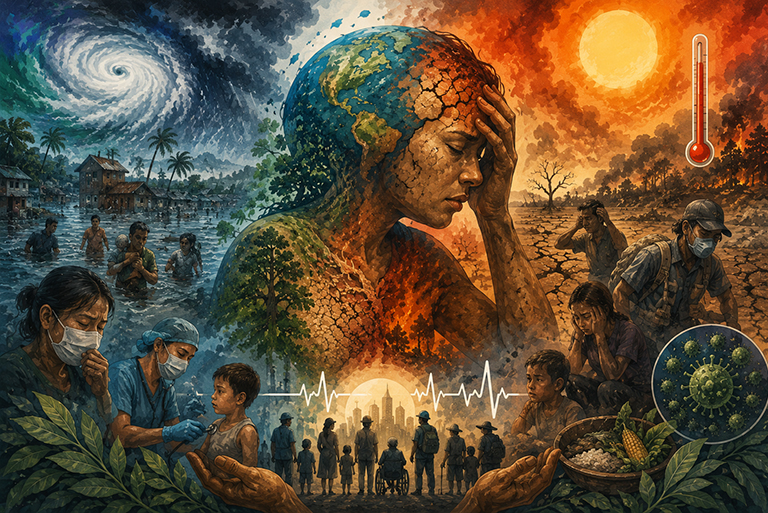
For decades, climate change was discussed largely in terms of melting glaciers, rising sea levels, disappearing forests, and endangered species. Today, a more urgent reality has emerged: climate change is increasingly becoming a public health emergency.
Around the world—and especially in climate-vulnerable countries such as the Philippines—rising temperatures, stronger typhoons, worsening air pollution, floods, droughts, infectious disease outbreaks, food insecurity, and psychological stress are already affecting human health. Children, older adults, pregnant women, outdoor workers, and vulnerable communities bear the greatest burden.
The question is no longer whether climate change affects health.
The question is how quickly we can adapt before its health consequences become even more severe.
By Rafael R. Castillo, MD
WHEN THE ENVIRONMENT BECOMES A PATIENT
For generations, physicians have treated illnesses one patient at a time. A child with asthma. A farmer with heat exhaustion. A grandmother hospitalized with dengue. A laborer suffering from dehydration.
Increasingly, however, doctors are recognizing that many of these illnesses share a common denominator: The changing environment.
Climate change is no longer an abstract scientific concept discussed only in international conferences.
It is now showing up in clinics, emergency rooms, intensive care units, and communities across the Philippines.
In a very real sense, the planet itself has become a patient—and its fever is affecting us all.
“Climate change is no longer simply an environmental issue. It is a health emergency affecting the air we breathe, the food we eat, the water we drink, and the diseases we face.”
THE PHILIPPINES: GROUND ZERO FOR CLIMATE VULNERABILITY
The Philippines consistently ranks among the countries most vulnerable to climate-related disasters.
Its geographic location exposes it to:
- Typhoons
- Floods
- Storm surges
- Droughts
- Extreme heat events
Each year, communities experience disruptions that affect not only infrastructure and livelihoods but also physical and mental health.
Climate change acts as a threat multiplier.
It worsens existing vulnerabilities and amplifies health risks that already challenge the country.
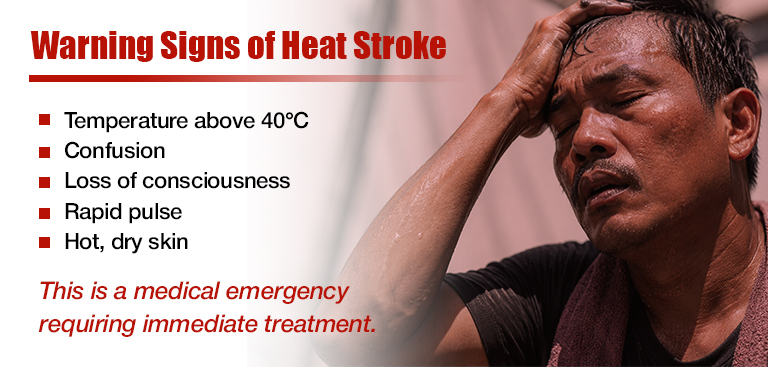
HEAT: THE INVISIBLE KILLER
Heat-related illness is among the most direct health effects of climate change.
When temperatures rise beyond the body’s ability to cool itself, dangerous conditions can develop:
Heat Cramps
Painful muscle contractions.
Heat Exhaustion
Symptoms include:
- Symptoms include:
- Dizziness
- Nausea
- Fatigue
- headache
Heat Stroke
A life-threatening emergency.
Body temperature rises dangerously high, potentially leading to:
- organ failure
- brain injury
- death
Who Is Most Vulnerable?
✔ Older adults
✔ Infants
✔ Outdoor workers
✔ Farmers
✔ Construction workers
✔ People with heart disease
✔ People with kidney disease
DENGUE AND THE EXPANDING THREAT OF VECTOR-BORNE DISEASES
Mosquitoes thrive in warm environments.
Climate change may influence:
- mosquito breeding patterns
- mosquito survival
- geographic spread
This has important implications for diseases such as:
✔ Dengue
✔ Chikungunya
✔ Zika
✔ Malaria in some regions
Longer rainy seasons, flooding, and changing temperatures may create favorable conditions for mosquito proliferation.
For a country that already battles dengue outbreaks regularly, this is a significant concern.
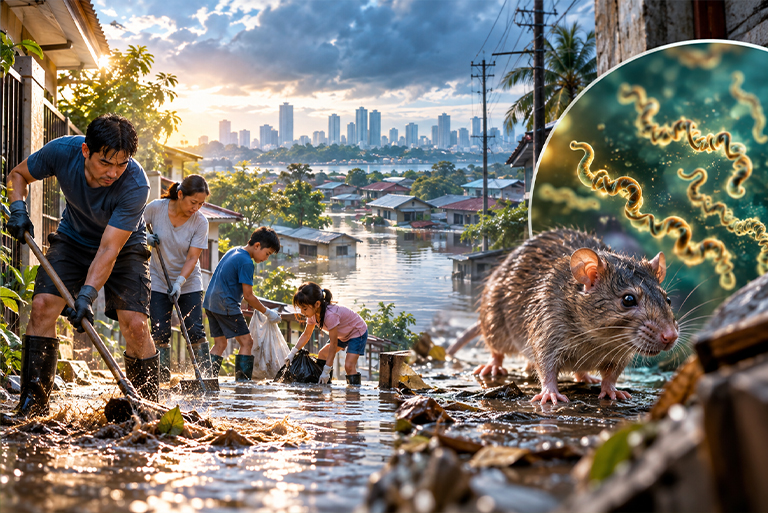
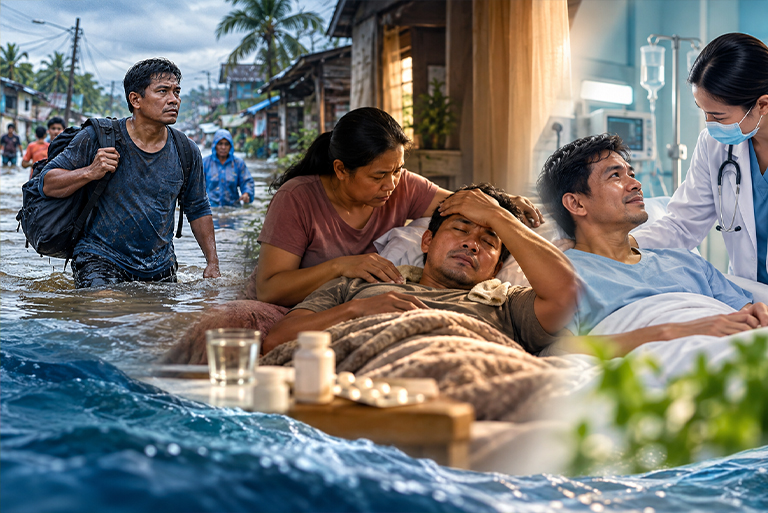
FLOODS, WATER, AND INFECTIOUS DISEASES
Floods are not simply natural disasters.
They are public health events.
After flooding comes increased risk of:
✔ Leptospirosis
✔ Diarrheal disease
✔ Skin infections
✔ Water contamination
✔ Respiratory illness
The Philippines has repeatedly experienced these consequences after major storms and floods.
“The health impact of a typhoon does not end when the winds stop. For many communities, the medical consequences continue for weeks or months.”
AIR POLLUTION: THE CLIMATE CONNECTION
Fossil fuel combustion contributes both to climate change and air pollution.
Air pollution increases the risk of:
- asthma
- COPD
- heart attack
- stroke
- lung cancer
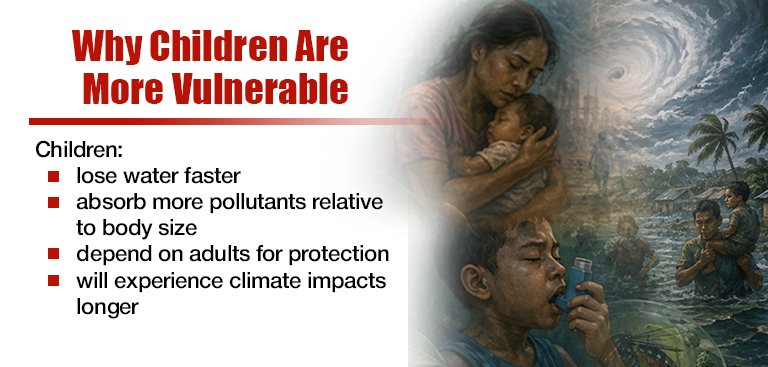
Children are especially vulnerable.
Their lungs are still developing, making them more susceptible to long-term damage.
CHILDREN: THE MOST VULNERABLE GENERATION
Perhaps no group will experience the consequences of climate change more profoundly than today’s children.
Children face increased risks from:
✔ Heat stress
✔ Malnutrition
✔ Infectious diseases
✔ Air pollution
✔ Mental health effects
Unlike adults, children have little control over the environment they inherit.
The decisions society makes today will shape their future health for decades.
FOOD SECURITY AND NUTRITION
Climate change threatens agriculture through:
- droughts
- floods
- changing rainfall patterns
- crop losses
These disruptions may affect:
✔ food availability
✔ food prices
✔ nutritional quality
For low-income families, rising food insecurity can worsen:
- malnutrition
- stunting
- micronutrient deficiencies
THE MENTAL HEALTH DIMENSION
One of the least appreciated consequences of climate change is psychological distress.
After disasters, many individuals experience:
- anxiety
- depression
- grief
- post-traumatic stress
Repeated exposure to climate-related disasters can have lasting emotional effects, particularly among children and displaced communities.
CLIMATE CHANGE AND HEART DISEASE
Heat places additional stress on the cardiovascular system.
Studies have linked extreme temperatures to increased risk of:
✔ Heart attacks
✔ Stroke
✔ Heart failure exacerbations
Individuals with existing cardiovascular disease may be particularly vulnerable during heat waves.
CLIMATE CHANGE AND KIDNEY DISEASE
Emerging evidence suggests chronic heat exposure may contribute to kidney injury.
This is particularly concerning for:
- agricultural workers
- construction workers
- outdoor laborers
Dehydration and repeated heat stress can damage kidney function over time.
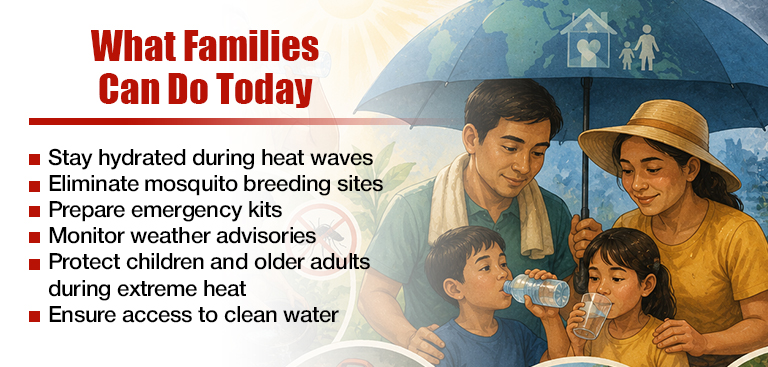
DISASTER RESILIENCE IS HEALTH PROTECTION
Preparing for climate change is not only about infrastructure.
It is also about health resilience.
Communities benefit from:
✔ Early warning systems
✔ Emergency preparedness
✔ Reliable healthcare access
✔ Safe water supplies
✔ Disease surveillance
✔ Community education
IS CLIMATE CHANGE THE BIGGEST HEALTH THREAT OF OUR GENERATION?
Reasonable people may debate whether climate change is the single greatest health threat.
However, few experts dispute that it is among the most important.
Unlike many diseases, climate change affects multiple systems simultaneously:
- infectious diseases
- cardiovascular disease
- respiratory disease
- nutrition
- mental health
- injury risk
Its reach extends beyond hospitals into homes, schools, workplaces, farms, and entire communities.
FINAL REFLECTION
The climate crisis is often described using environmental terms:
carbon emissions, global temperatures, sea levels, and weather patterns.
Yet ultimately, its most profound consequences may be measured not in degrees Celsius but in human lives.
The child hospitalized with severe dengue.
The elderly man suffering heat stroke.
The family displaced by flooding.
The farmer facing crop failure.
The community struggling with contaminated water.
These are not future scenarios.
They are already happening.
The health effects of climate change are no longer distant warnings.
They are today’s realities.
And perhaps the most important lesson is this:
Protecting the planet is increasingly inseparable from protecting human health.
REFERENCES
- World Health Organization. Climate Change and Health Fact Sheet. Updated 2025.
- Intergovernmental Panel on Climate Change (IPCC). Sixth Assessment Report.
- Lancet Countdown on Health and Climate Change. 2024 Report.
- World Health Organization. Protecting Health from Climate Change.
- United Nations Children’s Fund (UNICEF). The Climate Crisis Is a Child Rights Crisis.
- Department of Health (Philippines). Climate Change and Health Strategic Framework.
- World Meteorological Organization. State of the Global Climate 2024.
- Romanello M, et al. The Lancet Countdown on Health and Climate Change. Lancet. 2024.
- Centers for Disease Control and Prevention. Climate Effects on Health.
- Intergovernmental Panel on Climate Change. Climate Change 2023 Synthesis Report.






Leave a Reply