
When Treatment Becomes Too Much


In medicine, we are trained to act—to diagnose, to treat, to prescribe. Every symptom calls for a response, every abnormal result invites intervention. And yet, over time, something subtle can happen.

The list grows.

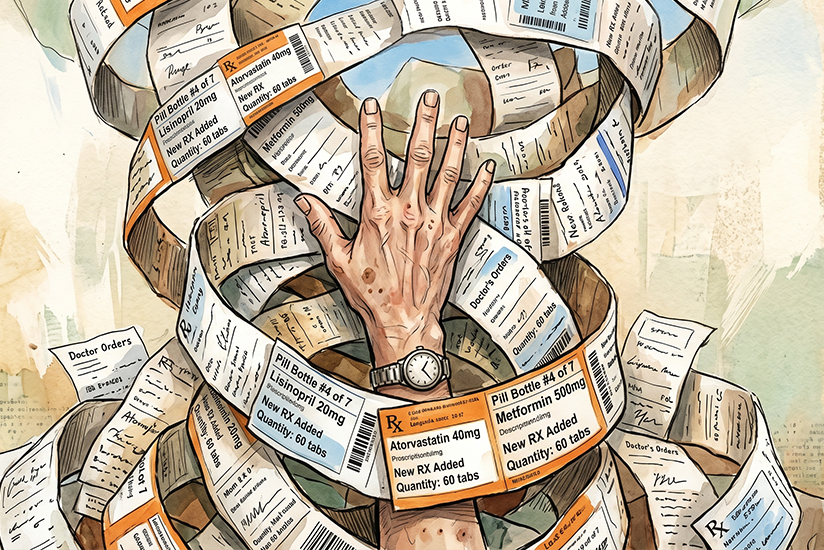
One medicine becomes two. Two becomes five. Five becomes a daily ritual of pills—taken faithfully, often unquestioned.

Then the patient returns.

Doc, nahihilo po ako.” (I feel dizzy.)
Parang nanghihina ako.” (I feel weak.)
Hindi na ako makatulog.” (I have difficulty sleeping.)

We begin to search for a new diagnosis. But sometimes, the answer is already in front of us.

It is in the medicines themselves.

Polypharmacy is not always the result of error. More often, it is the unintended consequence of good intentions—multiple doctors trying to help, guidelines trying to optimize care, patients trying to follow instructions. But when these efforts are not integrated, the result can be excess.

And excess, in medicine, can harm.

The challenge for us as physicians is to remember that prescribing is only half of our responsibility. The other half is reassessing—asking whether a medication is still necessary, still beneficial, still aligned with the patient’s goals.

Deprescribing is not withdrawal of care. It is refinement of care.

For patients and families, the message is equally important: do not hesitate to ask questions. Medicines are not meant to be carried indefinitely without purpose. They should serve you—not burden you.

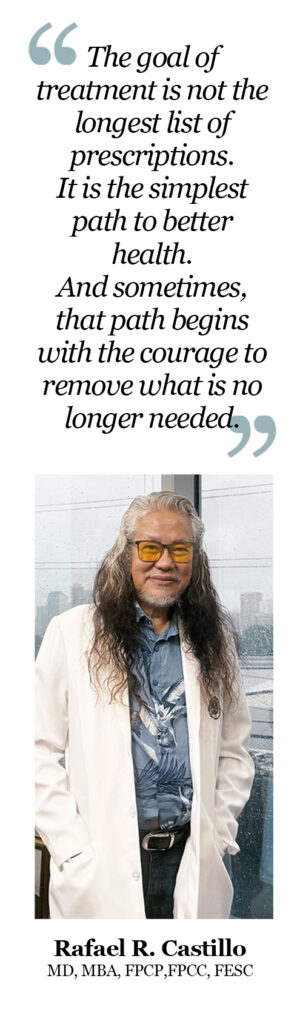
The goal of treatment is not the longest list of prescriptions.

It is the simplest path to better health.

And sometimes, that path begins with the courage to remove what is no longer needed.

Share this Article
Facebook
X
LinkedIn
WhatsApp
Email

More News

banner-copy5-10
Polypharmacy: When Too Many Medicines Harm
Why the pills meant to heal may sometimes make us sick In modern medicine, prescriptions have become...
banner-copy4-copy-28
When Treatment Becomes Too Much
In medicine, we are trained to act—to diagnose, to treat, to prescribe. Every symptom calls for a response,...
banner-copy5-9
The Meeting He Didn’t Attend
There are days when saying yes feels responsible—and saying no feels like failure. But this Sabbath story,...
banner-copy5-8
Holy Week at Serene Mountain Crest Homecare 🤍
By Princess Lhean Yape-Arriola  From Lunes Santo all the way to Easter Sunday, our home was filled...
banner-copy4-copy-25
A Crisis of Vision: Healthcare and Energy at the Brink
By Dr. Tony Leachon  The Filipino people are now bearing the brunt of decisions made without...
banner-copy9-copy
Forgiveness: The deliberate act of letting go
By Henrylito D. Tacio  “I had a brother once, and I betrayed him.” That sentence seemed...
banner-copy4-copy-23
The Liver You Don’t Feel—Until It’s Too Late
In clinical practice, the most dangerous diseases are often the quietest. Fatty liver disease is one...
banner-copy10
The Silent Epidemic: Fatty Liver Disease in Filipinos
Why even non-drinkers are at risk—and what we can do about it For many Filipinos, liver disease...
banner-copy4-copy-22
What A Joy My 105-Yr Old Patient Vicky Brings!
By Eugene F. Ramos, MD Her clinic visits were occasions for good conversation, starting from the...
banner-copy5-7
The Day He Turned It Off
In a world that never stops notifying, updating, and demanding attention, silence can feel almost unnatural....