
Health Advocates Press Supreme Court Action on Alleged Defunding of Universal Health Care
By Reuben Ricallo
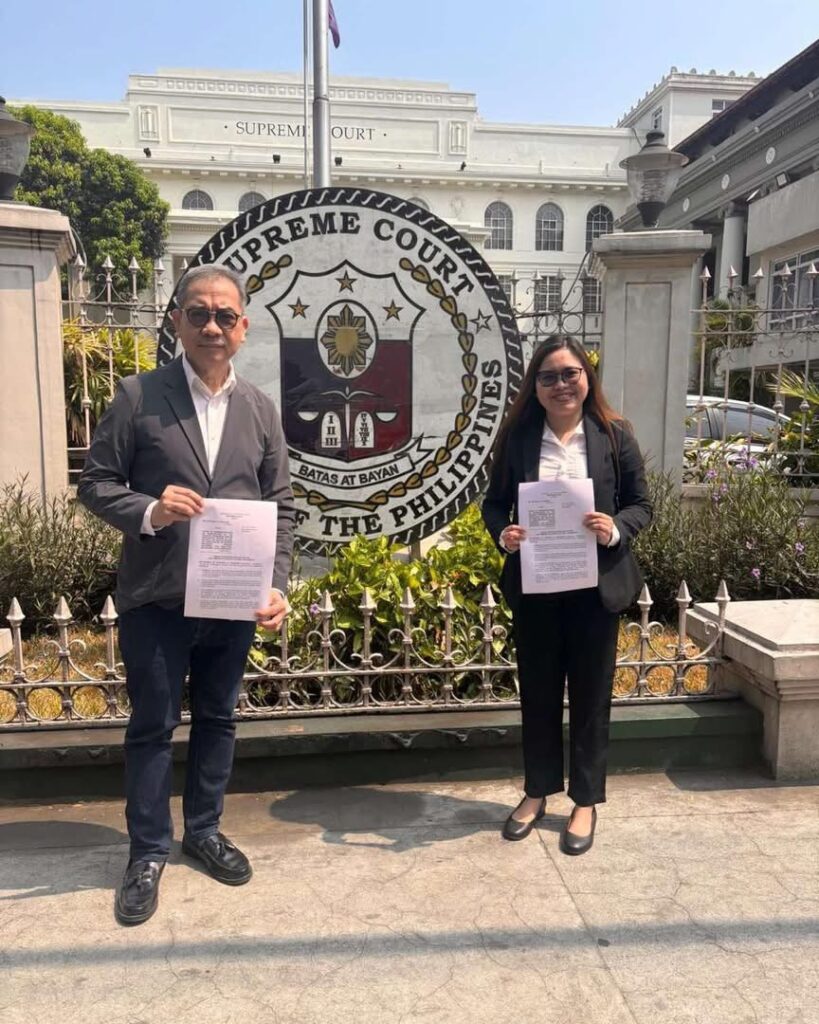
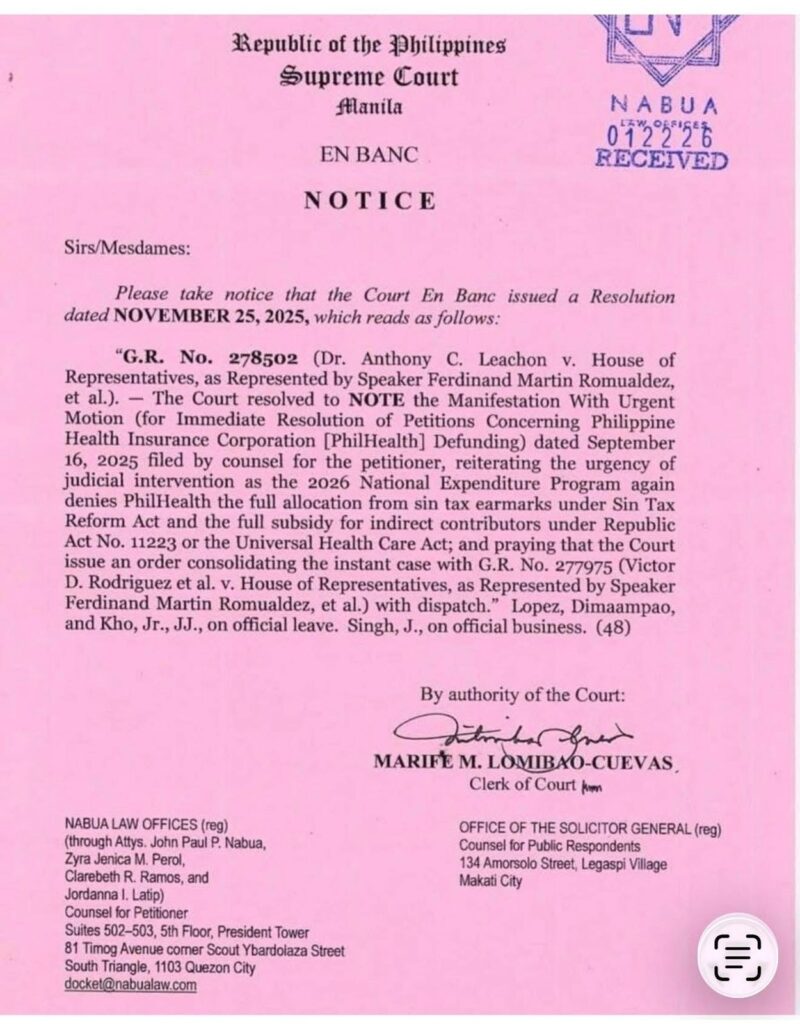
The battle over the financing of the country’s national health insurance program took a new turn on May 14, 2026, when independent health reform advocate Dr. Anthony C. Leachon, through Nabua Law Offices, filed an Urgent Manifestation and Motion to Admit Supervening Events and for Immediate Calendar of Oral Arguments before the Supreme Court.
The filing seeks to bring renewed attention to what health advocates describe as one of the most consequential healthcare controversies in recent years: the absence of a direct national government subsidy for PhilHealth under the 2025 General Appropriations Act (RA 12116).
For reform advocates, the issue extends far beyond budgeting. It raises fundamental questions about the government’s constitutional obligation to ensure access to healthcare for millions of Filipinos, particularly the poor, elderly, and medically vulnerable.
A Continuing Constitutional Debate
The controversy traces its roots to the transfer of a substantial portion of PhilHealth’s reserve funds to the National Treasury. Critics argued that the move undermined the financial stability of the state insurer and potentially compromised its ability to fulfill its obligations under the Universal Health Care (UHC) Act.
On December 5, 2025, the Supreme Court ruled that the diversion of ₱60 billion from PhilHealth’s reserve funds was unconstitutional, a decision widely viewed as a landmark victory for health advocates.
However, questions persisted regarding how and when the funds would be restored.
According to Dr. Leachon’s latest filing, the eventual restoration of the funds through appropriations under the 2026 national budget effectively shifted the burden back to taxpayers, despite the funds originally belonging to PhilHealth and its members.
Advocates argue that this sequence of events created a troubling precedent: government actions deemed unconstitutional were corrected only after significant delays, while the consequences were borne by both PhilHealth beneficiaries and the general public.
The Human Cost Behind the Numbers
While budget debates often revolve around figures and fiscal policy, health advocates emphasize that the true impact is measured in human lives.
They point to reports of delayed reimbursements, strained healthcare facilities, and continuing financial pressures on both public and private hospitals.
Healthcare providers have long argued that stable and predictable PhilHealth funding is essential to maintaining services, especially in underserved areas where patients depend heavily on government-supported healthcare.
For ordinary Filipinos, the consequences may be even more immediate.
Delayed claims can translate into postponed procedures, higher out-of-pocket expenses, and difficult choices between seeking medical care and meeting other household needs.
“Every peso removed from healthcare financing ultimately affects patients,” one health policy observer noted. “The consequences may not always be visible immediately, but they are felt in hospitals, clinics, and households across the country.”
Universal Health Care at Stake
The dispute also touches on the broader promise of the Universal Health Care Act, one of the most ambitious health reforms enacted in the Philippines.
The law envisioned a healthcare system where all Filipinos could access needed services without suffering financial hardship. Central to that vision was a financially stable PhilHealth capable of supporting expanded healthcare coverage.
Health reform advocates contend that insufficient government support threatens to undermine the gains envisioned under UHC.
They further argue that revenues generated from tobacco and alcohol excise taxes—long promoted as funding sources for healthcare expansion—were intended to strengthen public health programs rather than leave them vulnerable to budgetary uncertainties.
Many of the same reformers who championed the Sin Tax Law more than a decade ago have expressed concern that the original vision of using these revenues to improve healthcare access is being weakened.
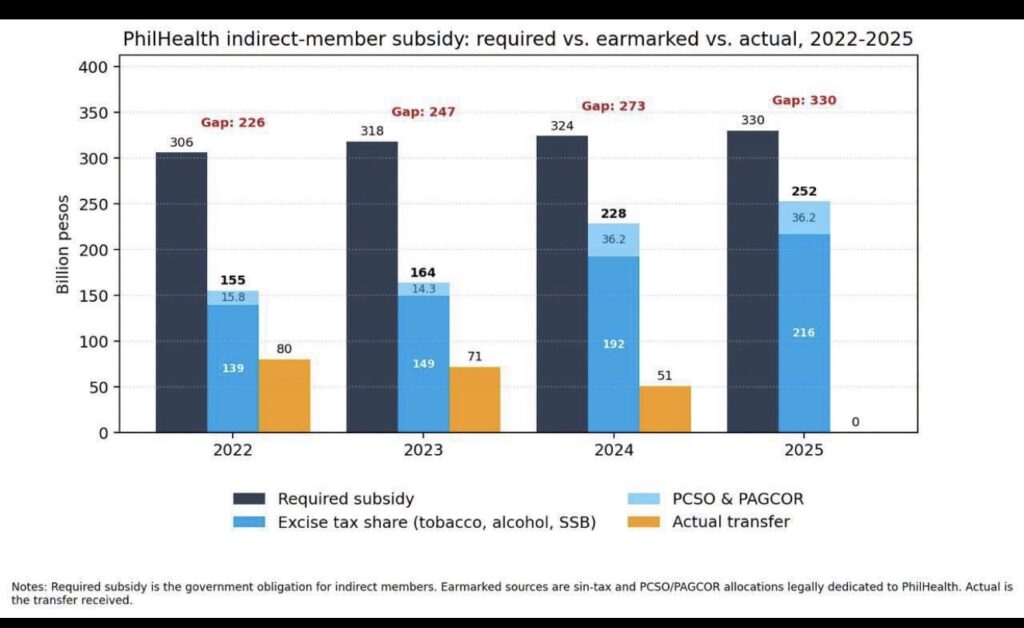
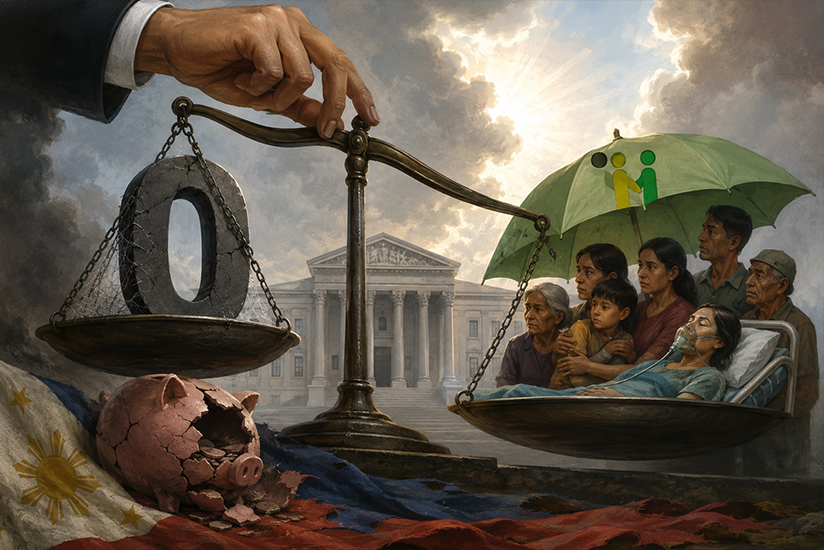
This chart, shared by Prof. Cielo Magno, exposes the precipitous defunding of PhilHealth — a moral and fiscal collapse under this administration.
From 2022 to 2025, the government’s required subsidy for indirect members soared from ₱306 billion to ₱330 billion, yet actual transfers plunged to zero.
Despite legally earmarked sin‑tax and gaming revenues, the widening gaps — ₱226 billion in 2022 to ₱330 billion in 2025 — reveal a systemic betrayal of public trust.
Each missing peso translates to dialysis sessions denied, cancer treatments deferred, and hospitals driven to insolvency.
Accountability is not optional; it is the only path to restore integrity and justice in health governance.
#RelentlessForChange
Calls for Accountability
In his motion before the Supreme Court, Dr. Leachon argues that the controversy remains a live and active issue of transcendental public importance despite previous court rulings.
The filing calls attention to what advocates characterize as continuing injury to PhilHealth members and healthcare providers, warranting further judicial review and public scrutiny.
Among the reforms being advocated are:
- Greater accountability for officials responsible for actions that may have adversely affected PhilHealth’s finances;
- Full restoration and protection of funds intended for healthcare services;
- Faster settlement of legitimate hospital claims;
- Structural safeguards that would shield PhilHealth financing from future political or fiscal interference.
A Test of National Priorities
At its core, the controversy is about more than budgets, appropriations, or legal technicalities. It is about how a nation chooses to prioritize the health and welfare of its people.
Healthcare economists often note that investments in health are not merely expenditures but commitments to human development, productivity, and social stability.
As the Supreme Court considers the latest developments, many observers believe the outcome could influence healthcare financing policy for years to come.
For millions of Filipinos who rely on PhilHealth for access to medical care, the stakes could not be higher.
Whether viewed as a constitutional issue, a fiscal controversy, or a moral question, the debate ultimately asks a simple but profound question: When it comes to healthcare, what obligations does a government owe its people—and how should those obligations be protected?
The answer may help define the future of Universal Health Care in the Philippines.










Leave a Reply