

DENGUE ISN’T DONE
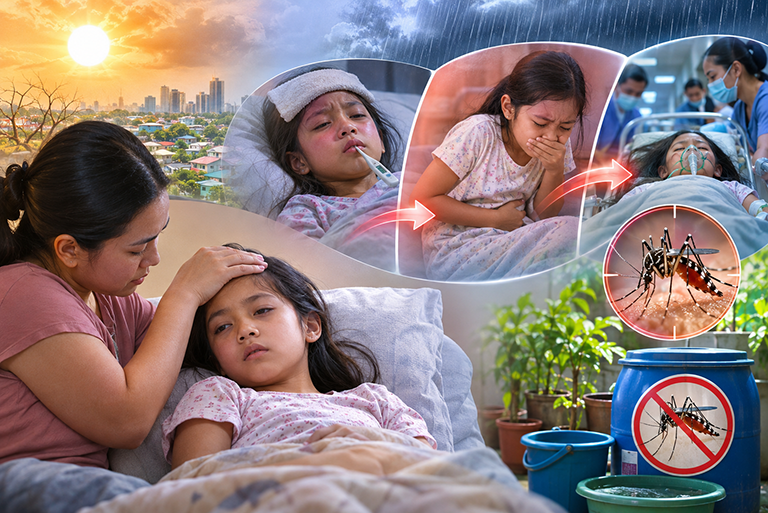
The national numbers look better this year. Tell that to Central Visayas, where dengue deaths are five times higher than last year — and El Niño may be stretching the season.
PLUS
- Sidebar: Dengue 2026 at a Glance
- Sidebar: The Most Dangerous Day Is When the Fever Breaks
- Sidebar: 4S and 4T — Your Household Battle Plan
- Platelets, Tawa-Tawa and Other Dengue Myths
- Dengue Is Not Just a Children’s Disease
- The Water Drum Problem: How El Niño Feeds the Mosquito
- Where Is the Dengue Vaccine?
- Commentary: When the Hospital Is Full, the Barangay Must Be Ready
- Doctor’s Note: When the Fever Breaks
On paper, 2026 has been a gentler dengue year. National cases are running about a fifth lower than in 2025. But averages hide hot spots. In Central Visayas, 119 people have died of dengue so far this year — more than five times the toll for all of 2025 — and Cebu’s hospitals are over capacity. Two children died in a single Mandaue barangay. Quezon City has passed 7,000 cases. And with El Niño pushing households to store water in drums and pails, the mosquito may not take its usual year-end break. Here is what every family needs to know to keep a fever from becoming a funeral.
By Rebecca L. Lorenzo-Castillo, MD
“Bumaba na ang lagnat, okay na siya”
She was nine, in Grade 4, the kind of child who sang while doing her homework. For three days she had a high fever, headache and body pains. Her mother gave her paracetamol, sponged her, and kept her home from school.
On the fourth morning, the fever was gone. Her mother was relieved. “Bumaba na ang lagnat. Okay na siya.”
By afternoon, the girl was quiet and pale. She complained of stomach pain and vomited twice. Her hands felt cold. Her mother thought she was just tired from being sick.
That night, she was rushed to the hospital in shock.
This is a composite story, but it describes the most dangerous misunderstanding in dengue — the one that doctors in Cebu, Bohol and Quezon City have been trying to correct all year. In dengue, the day the fever breaks is not the day the danger ends. It is often the day it begins.
A “good year” with a deadly exception
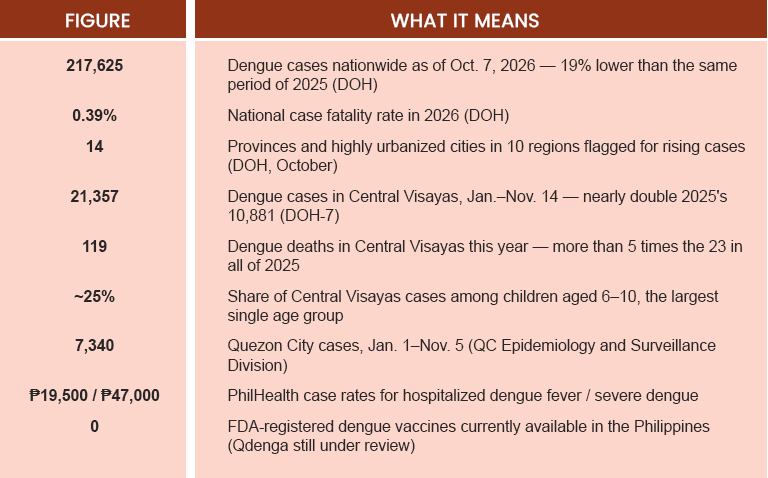
Nationally, the DOH’s figures for 2026 are encouraging. As of early October, the country had recorded 217,625 dengue cases, about 19 percent fewer than the same period in 2025, with a case fatality rate of 0.39 percent. Cases stayed below national alert and epidemic thresholds for most of the year.
But national averages can hide local emergencies.
• Central Visayas logged 21,357 cases and 119 deaths from January to November 14 — nearly double the 10,881 cases of 2025, and more than five times the 23 deaths recorded in all of last year. Bohol, which declared a dengue outbreak in July, has the most deaths (42). Cebu Province (40 deaths), Cebu City (22), Lapu-Lapu (8) and Mandaue (7) followed.
• Cebu’s provincial hospitals are over capacity, the provincial health officer confirmed, as they treat dengue, flu and other illnesses at the same time. Mandaue City is adding beds and hiring more doctors and nurses.
• Children are bearing the brunt. In Central Visayas, children aged 6 to 10 made up the largest share of cases, about a quarter. Two children died of dengue in a single Mandaue barangay.
• Metro Manila is not spared. Quezon City recorded more than 7,000 cases from January to early November, and Manila more than 5,100. The DOH flagged 14 provinces and highly urbanized cities across 10 regions for rising cases in its October report.
And the season may not be over. Dengue usually peaks in the rainy months, then fades. This year, two things could prolong it.
El Niño and the water drum
It sounds backwards: how can a drought feed a disease spread by mosquitoes that breed in water?
The answer is in our homes. The Aedes mosquito that spreads dengue doesn’t need floods. It breeds in small amounts of clean, still water — exactly the kind stored in drums, pails, basins and jars when households fear water shortages. With PAGASA expecting a strong El Niño through the first half of 2027, and water allocations already being cut, more families are storing water. Uncovered, every container becomes a nursery.
DOH Central Visayas officials also point out that warmer, more humid conditions speed up mosquito development, while bursts of rain still leave pools of stagnant water.
There’s a second complication: flu season. Influenza-like illnesses have been rising nationwide since September. Because both flu and dengue begin with fever, headache and body aches, families — and sometimes clinics — may mistake one for the other, or a patient may have both. Delayed recognition costs lives.
What dengue does
Dengue is caused by a virus with four types, or serotypes. It’s transmitted by the bite of infected Aedes mosquitoes, which bite mainly during the day, especially in the early morning and late afternoon.
Most infections are mild, and many cause no symptoms at all. But dengue can turn severe, and it does so in a predictable pattern:
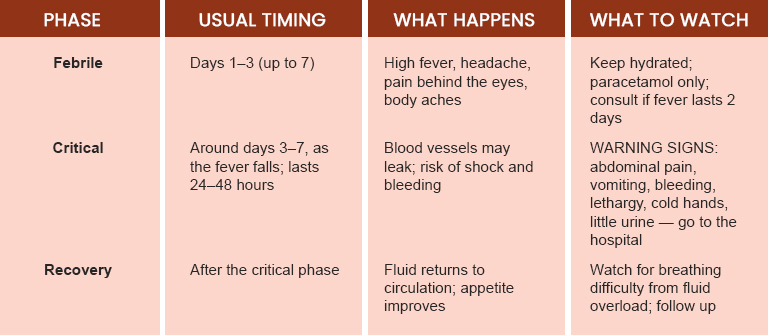
• The fever phase (about days 1 to 3, sometimes up to 7). Sudden high fever, severe headache, pain behind the eyes, muscle and joint pains, nausea, sometimes a rash.
• The critical phase (usually around days 3 to 7, as the fever falls). In some patients, the blood vessels become leaky. Fluid seeps out of the bloodstream into the tissues and body cavities. Blood pressure can drop, leading to shock. Bleeding can occur. This phase usually lasts 24 to 48 hours, and it’s when most deaths happen.
• The recovery phase. Leaked fluid returns to the bloodstream, appetite returns, and the patient improves.
A second dengue infection with a different serotype carries a higher risk of severe disease. And adults — especially those with diabetes, heart disease, kidney disease or obesity, as well as pregnant women and older people — can become seriously ill too. (See our supplemental article.)
The warning signs every parent must know
Seek urgent care — go to the hospital, not just the botika — if someone with dengue or suspected dengue has any of the following, especially as the fever falls:
• Severe or persistent abdominal pain
• Persistent vomiting
• Bleeding from the gums or nose, blood in vomit or stool, or black stools
• Lethargy, restlessness or irritability
• Cold, clammy hands and feet
• Little or no urine for 4 to 6 hours
• Difficulty breathing
In children, a child who suddenly becomes quiet, sleepy or “matamlay” after the fever goes away should be checked immediately.
What to do — and what not to do
Do:
• Consult early. For any fever lasting two days or more, especially during dengue season, see a doctor or health center. A complete blood count, and in the first days an NS1 test, can help confirm dengue and track the illness.
• Give paracetamol for fever, at the right dose.
• Keep the patient drinking. Water, oral rehydration solution, soups, juice. Watch urine output.
• Follow up daily if the doctor sends the patient home. The PhilHealth dengue standards call for daily blood count monitoring in outpatients.
• Go to the hospital immediately at the first warning sign.
Don’t:
• Don’t give ibuprofen, mefenamic acid or aspirin. These can worsen bleeding. Paracetamol is the safer choice.
• Don’t rely on herbal remedies such as tawa-tawa to “raise the platelets” instead of medical care. PhilHealth’s dengue quality standards specifically tell doctors to advise patients against herbal medicines, steroids and NSAIDs.
• Don’t relax when the fever drops. That’s when to watch most closely.
• Don’t self-medicate with antibiotics. Dengue is a virus.
What PhilHealth covers
PhilHealth’s dengue benefit for hospitalized patients is P19,500 for dengue fever and P47,000 for severe dengue. Emergency room visits that don’t require admission may be covered under the Outpatient Emergency Care Benefit, and primary care consultations are available through PhilHealth YAKAP providers. In 2025, PhilHealth paid more than 236,000 dengue claims, worth about P3.9 billion.
Stopping the mosquito
There’s still no widely available dengue vaccine in the Philippines (see our supplemental article), so prevention depends on mosquito control — and that happens mostly at home.
The DOH’s 4S strategy:
• Search and destroy breeding sites.
• Self-protection: repellents, long sleeves, screens and mosquito nets, especially for children and the sick.
• Seek early consultation for fever.
• Support fogging or spraying only in hotspot areas where cases are rising.
And the daily 4 o’clock habit, in its newer Filipino form, the 4T: Taob, Taktak, Tuyo, Takip. Turn over containers, tap out the water, dry them, and cover the ones you need.
Misting and fogging kill adult mosquitoes. They don’t kill the eggs and larvae waiting in your water drum. That part is up to us.
A final word
Dengue doesn’t make headlines the way typhoons do. It kills quietly, one child at a time, often on the day the family thought the worst was over.
This year, the national numbers gave us a reason to relax. Central Visayas reminds us why we shouldn’t. With El Niño, flu season and Christmas travel ahead, let’s keep our guard up: cover the drum, take the fever seriously, and watch most closely when the fever breaks.
“In dengue, the day the fever breaks is not the day the danger ends. It is often the day it begins.”
DENGUE 2026 AT A GLANCE
THE MOST DANGEROUS DAY IS WHEN THE FEVER BREAKS
4S AND 4T: YOUR HOUSEHOLD BATTLE PLAN
The DOH’s 4S:
• Search and destroy mosquito breeding sites
• Self-protection measures: repellent, long sleeves, nets, screens
• Seek early consultation for fever
• Support fogging or spraying in hotspot areas only
The 4T, every day at 4 p.m.:
• Taob — turn over containers that can hold water
• Taktak — tap out the water and any larvae
• Tuyo — let containers dry
• Takip — cover water drums, pails and jars you need to keep
Check these hidden breeding spots: flower-vase water, plant saucers, the tray under the refrigerator, roof gutters, old tires, discarded cups and bottles, bamboo stumps, aircon drip trays, pet water bowls, and unused toilets and drains.
KEY REFERENCES
1. “DOH flags 14 areas amid rise in dengue cases.” Daily Tribune, October 28, 2026.
2. “Philippines logs 205,347 dengue cases from January to October 2026.” Manila Bulletin, October 20, 2026.
3. “Dengue deaths surge.” SunStar Cebu, November 23, 2026 (DOH-7 data).
4. “Central Visayas dengue deaths hit 119, more than five times the 2025 toll.” Astig.ph, November 24, 2026.
5. “QC records over 7k dengue cases.” Daily Tribune, November 7, 2026.
6. “Manila dengue cases reach 5,164.” Daily Tribune, November 23, 2026.
7. “Flu-like illnesses rise as DOH records over 15,000 cases.” Daily Tribune, November 10, 2026.
8. Philippine Health Insurance Corporation. PhilHealth Circular No. 2026-0009: Quality Standards on the Diagnosis and Management of Dengue (Adult and Children).
9. Philippine Health Insurance Corporation. “193% increase in PhilHealth coverage for severe dengue; patients may claim up to Php 47,000.” February 2025.
10. “PhilHealth dengue claims” (236,232 claims, ₱3.9 billion in 2025). Inquirer Plus, 2026.
11. Food and Drug Administration Philippines. FDA Advisory No. 2026-0700: Public health warning against counterfeit Qdenga. July 2026.
12. “Palace says dengue vaccine under FDA review.” Daily Tribune, June 2, 2026.
13. World Health Organization. Dengue: guidelines for diagnosis, treatment, prevention and control. New edition. Geneva: WHO; 2009.
14. World Health Organization. Dengue and severe dengue fact sheet. Geneva: WHO; 2024.
15. Bhatt S, Gething PW, Brady OJ, et al. The global distribution and burden of dengue. Nature. 2013;496(7446):504–507.
16. World Health Organization. Dengue vaccines: WHO position paper — May 2024. Wkly Epidemiol Rec. 2024;99(18):203–224.
17. “Very strong El Niño likely from October 2026 to January 2027 — PAGASA.” GMA News Online, July 28, 2026.
PLATELETS, TAWA-TAWA AND OTHER DENGUE MYTHS
What families get wrong about dengue — and what actually keeps patients alive
By the H&L Editorial Team
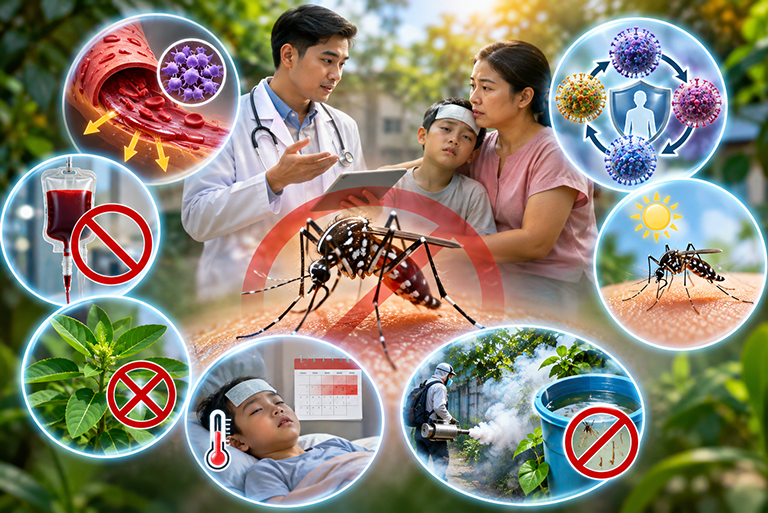
Every dengue season brings its own wave of misinformation, passed along in group chats and hospital corridors. Some of it is harmless. Some of it delays care at the worst possible moment.
Myth 1: “The platelet count is the most important number.”
Platelets matter, and doctors do track them. But the biggest danger in dengue isn’t low platelets — it’s plasma leakage, when fluid seeps out of the blood vessels and the patient slides into shock. That’s why doctors also watch the hematocrit (how concentrated the blood is), blood pressure, pulse, and urine output. A patient with a “not so low” platelet count can still be in danger, and one with a very low count may recover without a transfusion.
Myth 2: “Low platelets mean you need a platelet transfusion.”
Not usually. Routine platelet transfusions don’t prevent severe dengue. PhilHealth’s dengue quality standards reserve transfusion for significant bleeding or when a patient doesn’t respond to fluid treatment. Most patients’ platelets recover on their own as they enter the recovery phase.
Myth 3: “Tawa-tawa will cure dengue.”
Tawa-tawa (Euphorbia hirta) has long been used as a folk remedy for dengue, and some small studies have looked at whether it affects platelet counts. But there’s no good evidence that it prevents severe dengue or reduces deaths, and PhilHealth’s dengue standards tell doctors to advise patients against herbal medicines. The real risk is that families rely on it at home instead of bringing the patient to a doctor when warning signs appear.
Myth 4: “When the fever goes down, the patient is out of danger.”
This is the deadliest myth of all. The critical phase of dengue usually comes around the time the fever falls, typically between days 3 and 7. That’s when warning signs must be watched most closely.
Myth 5: “Fogging the neighborhood will stop dengue.”
Fogging kills adult mosquitoes that it reaches, but it doesn’t kill eggs and larvae waiting in water containers. Within days, a new generation emerges. The DOH supports fogging only in hotspot areas with rising cases, alongside clean-up drives. Removing breeding sites is what makes the lasting difference.
Myth 6: “You can only get dengue once.”
There are four dengue virus types. Infection with one gives lasting protection only against that type. A person can get dengue up to four times, and a second infection with a different type carries a higher risk of severe disease.
Myth 7: “Dengue mosquitoes bite only at night.”
Aedes mosquitoes bite mainly during the day, especially in the early morning and late afternoon. Children napping in the afternoon and students in classrooms need protection too.
What actually helps: early consultation, paracetamol for fever, plenty of fluids, daily follow-up, close watching for warning signs — especially when the fever drops — and getting to a hospital promptly when they appear.
DENGUE IS NOT JUST A CHILDREN’S DISEASE
Why adults, pregnant women and people with chronic illness need extra care
By Marie Barrientos-Regala, MD

Most dengue cases in the Philippines are in children and teenagers, and much of the public messaging is aimed at parents. But adults get dengue too. In Central Visayas this year, about one in four cases was aged 21 or older. And adults with other health problems can become seriously ill.
Who needs extra caution
PhilHealth’s dengue quality standards list several groups who should be admitted to the hospital if they have dengue with warning signs, rather than observed at home:
• Pregnant women
• Infants
• Older adults
• People with obesity
• People with diabetes
• People with kidney or respiratory disease
• People who live alone or far from a hospital
Doctors also take extra care with patients who have heart disease, liver disease or blood disorders, and those taking blood thinners.
Why these groups are at higher risk
• Diabetes can make it harder to judge fluid needs and may increase the risk of complications.
• Heart and kidney disease make fluid management tricky: patients need enough fluid to prevent shock, but too much can cause fluid to build up in the lungs.
• Blood thinners and antiplatelet medicines, such as aspirin, clopidogrel and anticoagulants, raise the risk of bleeding. Don’t stop them on your own — some patients have stents or heart valves that make stopping dangerous — but tell your doctor right away that you’re taking them.
• Pregnancy changes how the body handles fluid and can make dengue harder to recognize. Dengue in late pregnancy can also affect the baby.
• Older adults may not have a high fever and may present with confusion or weakness instead.
Adults delay too
Adults often keep working through a fever, assuming it’s the flu. They may come in late, already in the critical phase. Anyone with fever for two days or more during dengue season should get checked, whatever their age.
If you’re an adult with a chronic illness and develop a fever: Tell your doctor about all your conditions and medicines. Ask whether you need a blood count. Don’t take ibuprofen, mefenamic acid or extra aspirin for fever. And don’t wait to see if it passes.
THE WATER DRUM PROBLEM
How El Niño — and our habit of storing water — feeds the dengue mosquito
By the H&L Editorial Team
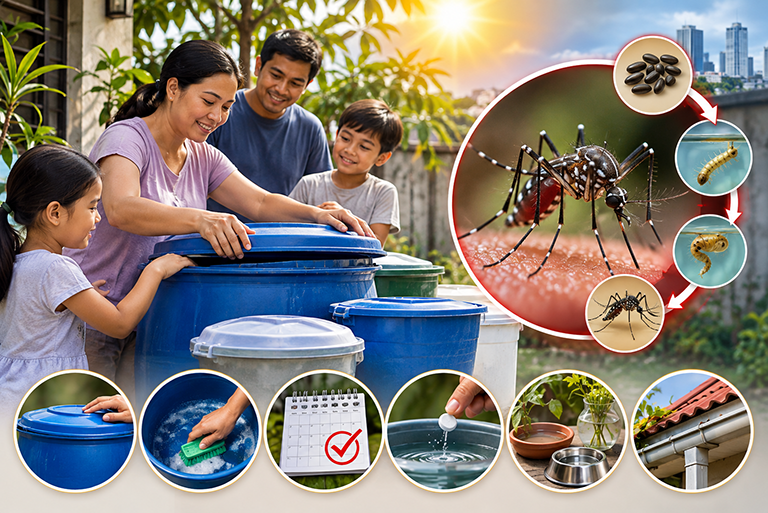
During water shortages, Filipino families know exactly what to do: fill every drum, pail, basin and bottle while the water’s running. It’s a smart survival habit. It’s also exactly what the dengue mosquito is waiting for.
Why stored water is perfect for mosquitoes
The Aedes aegypti mosquito prefers clean, still water close to people — not murky canals or floodwater. A female lays her eggs on the inside walls of containers just above the waterline. The eggs can survive dry for months, then hatch when water touches them again. In warm weather, an egg can become an adult mosquito in about a week.
A single uncovered drum can produce hundreds of mosquitoes.
El Niño’s double effect
PAGASA expects a strong El Niño to persist into the first half of 2027. Metro Manila’s water allocation has already been reduced. That means:
• More stored water, often in containers without proper lids.
• Warmer temperatures, which speed up the mosquito’s development and the virus’s multiplication inside the mosquito.
• Intermittent rains, which still leave pockets of stagnant water.
Studies in several countries have linked El Niño years to larger dengue outbreaks, and DOH officials in Central Visayas have cited these same factors this year.
How to store water safely
• Cover every container tightly. Use fitted lids. If there’s no lid, use a cloth or fine mesh tied securely.
• Scrub the inside walls weekly, not just empty and refill. Eggs stick to the sides.
• Use stored water within a week when possible, and rotate containers.
• Ask your health center about larvicides for water you can’t cover or empty. DOH-7 has distributed larvicides to local governments.
• Don’t forget small containers: plant saucers, vases, pet bowls and the tray under the refrigerator.
• Check gutters and roof drains after any rain.
A simple weekly ritual: Every Saturday afternoon, walk around your house and yard with your family. Taob, taktak, tuyo, takip. Make it a habit the children lead.
WHERE IS THE DENGUE VACCINE?
The story of Qdenga, the memory of Dengvaxia, and what families should know now
By Rebecca L. Lorenzo-Castillo, MD

Many parents ask: if there’s a dengue vaccine available in other countries, why can’t my child get one here?
The shadow of Dengvaxia
The Philippines was among the first countries to roll out a dengue vaccine, Dengvaxia, in a school-based program in 2016. In 2017, its manufacturer disclosed that the vaccine could increase the risk of severe dengue in people who had never had dengue before. The program was suspended, and the controversy that followed badly damaged public trust in vaccines — contributing to declines in childhood immunization and later outbreaks of measles and polio.
That history is why Philippine regulators are being especially careful with any new dengue vaccine.
Qdenga: under review since 2023
Qdenga (TAK-003), developed by Takeda, has been approved in a number of countries and received WHO prequalification. WHO has recommended its use in children aged 6 to 16 in settings with high dengue transmission.
In the Philippines, Takeda applied for registration in April 2023. As of mid-2026, the Food and Drug Administration was still reviewing it. In June, Malacañang said regulators were scrutinizing its efficacy and safety, particularly a possible risk of more severe disease from dengue type 3 — one of the common types circulating here — in vaccinated people who had never had dengue before. Health officials have also said that, if approved, it would not be used for mass immunization but given in clinics after individual assessment.
Beware of fake vaccines
In July, the FDA warned the public against a counterfeit version of Qdenga being offered for sale. Because Qdenga is not yet registered in the Philippines, any product sold locally is unauthorized and may pose serious health risks. Don’t buy vaccines online or from unlicensed sellers.
What protects your family now
Until a vaccine is approved and available, dengue prevention depends on:
• Eliminating breeding sites (4S and 4T)
• Personal protection — repellents, long sleeves, nets, screens
• Early consultation for fever
• Knowing the warning signs and acting fast
The bottom line: A safe, effective dengue vaccine would be a welcome tool. But even in countries that use one, mosquito control and early care remain the foundation of dengue prevention.
PUBLIC HEALTH COMMENTARY
WHEN THE HOSPITAL IS FULL, THE BARANGAY MUST BE READY
By Rafael R. Castillo, MD
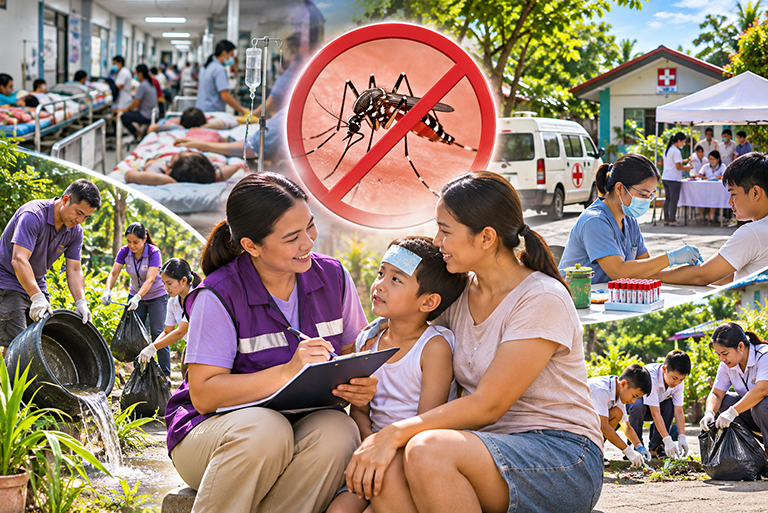
When Cebu’s provincial health officer confirmed this month that her hospitals were over capacity, she was describing a familiar pattern. Every dengue surge eventually becomes a hospital crisis: patients on stretchers in hallways, children sharing beds, exhausted staff.
But by the time a dengue patient reaches a crowded emergency room, the system has often already failed them. The real battle is fought earlier — in the barangay, where the mosquito breeds and where the fever first appears.
Central Visayas offers both the warning and some of the answers. Local officials have called for stronger community-level action: barangay health workers monitoring and reporting clusters of fever; weekly clean-up drives coordinated with schools; free blood counts and NS1 tests at city health offices; barangay vehicles on standby to bring patients to the hospital; and weekend triage at health centers to keep mild cases out of overcrowded hospitals.
These measures make sense, and they should be standard practice wherever dengue is rising — not emergency improvisations.
A barangay-first dengue response would include:
• Fever surveillance at the barangay level. Health workers who know their communities can spot clusters early and trigger clean-ups before cases multiply.
• Testing close to home. Blood counts and NS1 tests at health centers allow early diagnosis and daily monitoring without a trip to the hospital.
• Clear triage. Patients without warning signs can be followed up at home or at health centers, while those with warning signs or high-risk conditions are referred promptly.
• Transport. No family should have to wait for a tricycle at midnight with a child in shock.
• Sustained vector control. Larvicides, clean-ups and community education every week — not just during outbreaks.
• Adequate supplies. DOH-7 officials have said their allocations this year are lower than in 2024 and 2025, and urged local governments to buy supplemental supplies. National and local budgets should plan for dengue every year, not react to it.
• Timely outbreak declarations. Under current rules, local governments decide when to declare an outbreak. That decision should be driven by data and the strain on local health services, not by politics or fear of bad publicity.
Dengue is predictable. It comes every year, peaks in familiar months, and kills mostly children and the vulnerable. A predictable threat deserves a planned response.
The hospital is the last line of defense. Let’s make sure the barangay is the first.








Leave a Reply