

THE LAST PAROL
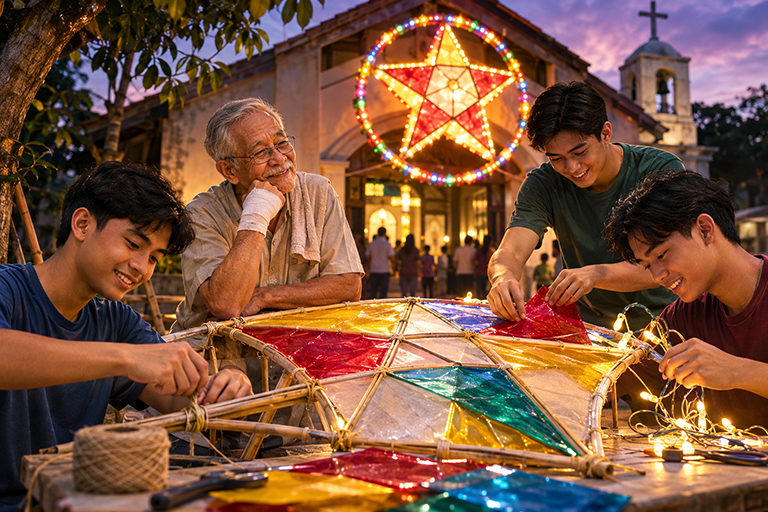
On the eve of the First Sunday of Advent, the season of waiting for the Light, an old parol-maker discovers that his hands can no longer do what they once did. This Sabbath story is about pride and humility, about the children we teach without realizing it, and about the hope that the light we kindle doesn’t go out when we can no longer carry it — it passes on.
“For fifty years he had made the light. This year, for the first time, he would have to let others carry it.”
By Raffy Castillo
Every year, on the Saturday before Advent, Mang Andoy made the parol.
Not just any parol. The big one, two meters across, that hung over the entrance of the barangay chapel from the first Sunday of Advent to the Feast of the Three Kings. Five points of bamboo, framed in capiz and colored papel de Hapon, with a ring of small bulbs that blinked in a pattern only he knew how to wire.
He had made it for fifty-one years. He started at nineteen, the year he married Lourdes, because the old man who used to make it had died and no one else knew how. He learned by taking the old parol apart and putting it back together.
Lourdes had been gone for six years now. He was seventy, and he still made the parol.
The Hands That Would Not Hold Still
This year, something was wrong.
It had started months before: a tremor in his right hand that came and went. His doctor had a name for it and a prescription that helped a little. But when he sat down that Saturday morning to cut the bamboo strips, his hand shook so badly that the bolo slipped. He tried again. The strip came out crooked.
He tried to tie the frame. The abaca twine kept slipping from his fingers.
By noon, he had one lopsided star point and a bandaged thumb.
He sat on the bench outside his house, looking at the mess, and felt something he hadn’t felt since Lourdes died. Not sadness exactly. Uselessness.
The Boys at the Gate
Around two o’clock, three teenagers stopped at his gate. Jun-jun, Paolo and Kiko. He knew them — or he had known them as boys. Ten years ago, they had followed him around every November, begging to help with the parol. He had let them hold the bamboo, pass the glue, sort the colored paper. Mostly, they had been in the way.
Now they were taller than he was, with deep voices and cellphones in their pockets.
“Lolo Andoy,” Jun-jun said, “kailan po namin makikita ang parol? Bukas na po ang unang Linggo ng Advent.”
When will we see the parol? Tomorrow is the first Sunday of Advent.
He looked at his bandaged thumb and the crooked star point.
“Baka wala munang parol ngayong taon, mga iho,” he said. “Hindi na kaya ng kamay ko.”
Maybe no parol this year. My hands can’t do it anymore.
The Thing He Couldn’t Say
The boys looked at each other.
Kiko spoke first. “Lolo, kami na lang po. Turuan n’yo po kami.”
We’ll do it. Teach us.
Mang Andoy almost said no. The parol was his. It had always been his. Fifty-one years. Every bulb, every knot, every point. People in the barangay called it “ang parol ni Mang Andoy.” What would it mean if someone else made it?
And what if they made it badly?
He looked at the boys. He saw, for a moment, the little ones they had been, getting glue all over their hands, asking a hundred questions, so proud when he let them hold the bamboo straight.
He had been teaching them all along. He just hadn’t known what for.
The Long Afternoon
They worked until dark.
Mang Andoy sat on the bench and talked them through it. How to split the bamboo so it bent without breaking. How to tie the joints tight with abaca. How to lay the papel de Hapon so the light glowed without tearing. Paolo, it turned out, was studying electronics in senior high school, and he understood the old wiring faster than Mang Andoy expected.
The boys made mistakes. One point came out shorter than the others. A capiz panel cracked. Kiko burned his finger on the soldering iron and laughed about it.
Mang Andoy didn’t correct every flaw. He found he didn’t want to.
The Light
At seven o’clock, they carried the parol to the chapel and hung it over the entrance. Paolo connected the wires.
For a moment, nothing.
Then the bulbs came on, one ring after another, in the old blinking pattern Mang Andoy had designed decades ago — the pattern Lourdes used to say looked like a heartbeat.
Neighbors came out of their houses. Children ran to see. Someone started singing “Ang Pasko ay Sumapit,” a little off-key, and others joined in.
Mang Andoy stood at the back of the small crowd, his trembling hand in his pocket, and looked up at the light.
It was not the most perfect parol he had ever seen. One point was a little short. One capiz panel had a crack.
It was the most beautiful.
What He Wrote Before Sunset
That night, Mang Andoy took out the old notebook where he used to sketch his parol designs, the pages yellowed and soft. On a blank page, in handwriting shakier than it used to be, he wrote:
“For fifty-one years, I made the light. Tonight, I watched the boys carry it.”
And beneath it, a line from the Gospel of John that Lourdes had once embroidered on a pillow for him:
“The light shineth in darkness; and the darkness comprehended it not.”
He added one more sentence before closing the notebook: “Maybe the light was never mine. I was only holding it until someone else could.”
SABBATH REFLECTION
Tomorrow, the Church begins the season of Advent, the four weeks of waiting and preparation for Christmas. Its central image is light: a single candle on the Advent wreath, then two, then three, then four — light growing in the darkness, pointing to the One who called Himself the Light of the world.
Advent is also a season of humility. We prepare for a God who came not in strength but as a vulnerable child, who depended on others to carry Him.
Many of us, as we grow older or face illness, struggle to let go of the things we once did well. We fear becoming useless. But the light we carried in our strength doesn’t go out when our hands weaken. If we have taught, loved and shared well, it passes on — sometimes to people we didn’t realize were watching.
This Sabbath, as Advent begins, consider: What light have you been carrying? Who might be ready to help you carry it, or to carry it after you? And is there someone whose hands are weakening who needs you to say, “Turuan n’yo po kami”?
CLOSING PRAYER
Lord Jesus, Light of the world,
As we begin this season of Advent, kindle in us a new hope.
Thank You for the people who carried Your light to us —
our parents and grandparents, teachers and neighbors,
those who taught us faith with patient, ordinary hands.
When our own strength fails, give us the humility to let others help us,
and the joy of seeing the light pass on.
When others grow weak, make us willing to learn and ready to serve.
Let our homes and communities shine with Your love this season,
not perfectly, but faithfully.
Come, Lord Jesus. Come and be our light.
Amen.







Leave a Reply