


Move every day. Prolonged sitting is the enemy of functional aging.
Strength-train at least twice weekly. Work the major muscle groups.
Practice getting up. The chair stand is both an assessment and, when appropriate, an exercise.
Train balance. Especially after 65 or if you have fallen before.
Walk—but don’t only walk. Aerobic fitness and muscle strength complement one another.
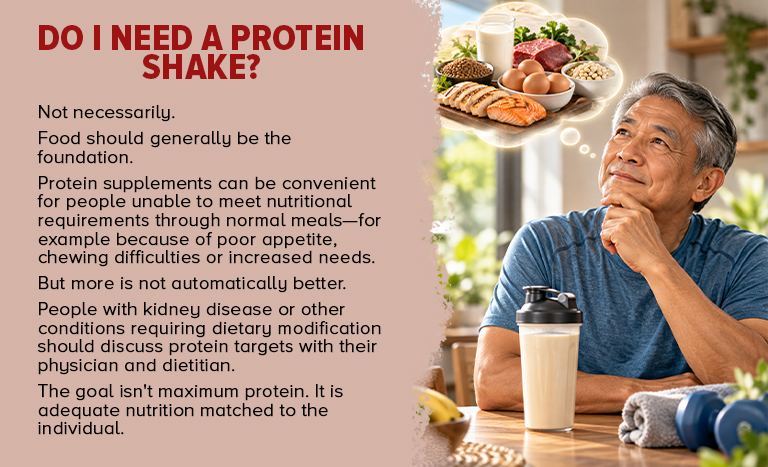
Eat enough protein. Spread protein-containing foods through the day rather than leaving nearly all of it for one meal.
Recover after illness. Ask not only, “Is the infection gone?” but “Have I regained my previous strength?”
Don’t ignore weight loss. Unintentional weight loss deserves evaluation.
Make your home fall-resistant. Good lighting, secure rugs, handrails and appropriate footwear matter.
Start where you are. A frail 85-year-old and a fit 65-year-old should not receive identical exercise prescriptions.
THE DANGEROUS WEEK IN BED
Why hospitalization can change an older person’s life

For a young adult, several days in bed may be an inconvenience.
For a frail older adult, they can become a turning point.
Acute illness brings together many enemies of muscle simultaneously:
inflammation;
reduced food intake;
bed rest;
weakness;
poor sleep;
medications;
and fear of falling.
Then comes discharge.
The laboratory tests look better. But the patient who entered hospital walking independently leaves needing assistance.
Modern geriatric care therefore needs a broader definition of recovery.
We should ask:
Can the patient walk?
Can she transfer from bed to chair?
Can she use the bathroom safely?
Can she eat adequately?
Has rehabilitation begun early enough?
The best time to restore mobility is not weeks after discharge.
When medically safe, it begins during recovery itself.
THE WEIGHT-SCALE TRAP
Why normal weight doesn’t necessarily mean healthy muscle

Two people can weigh exactly 70 kilograms and have very different bodies.
One may carry more skeletal muscle.
The other may have relatively little muscle and considerably more fat.
This is why the bathroom scale alone cannot diagnose sarcopenia.
A person can even have excess body fat while simultaneously having low muscle mass and strength—sometimes termed sarcopenic obesity.
So when assessing healthy aging, don’t ask only:
“How much do I weigh?”
Also ask:
“How strong am I?”
MUSCLE IS AN ORGAN OF LONGEVITY

We usually think of muscle as machinery that moves bones. It is much more.
Skeletal muscle is metabolically active tissue involved in glucose disposal and whole-body metabolism. It allows us to exercise, maintain balance, recover from illness and preserve independence.
Perhaps the most useful way to think about muscle in later life is as a reserve account. Build more reserve while you can. Because illness, surgery and inactivity may eventually make withdrawals.
The person entering a major illness with greater strength and functional reserve may be better positioned for recovery than someone already near the threshold of disability.
THE PHILIPPINE FAMILY ANGLE

Filipino families are wonderfully protective of their elders.
But sometimes love becomes overprotection.
“Ma, huwag ka nang tumayo.”
“Dad, kami na.”
“Lola, don’t carry that.”
Of course, an older person at high risk of falling needs protection. But doing everything for a capable older adult can unintentionally remove precisely the activities that preserve capability.
The better question is: “What can you still safely do for yourself?”
Help where help is needed. But preserve independence wherever independence remains possible.
A parent who still folds clothes, waters plants, walks to the dining table, prepares simple food or goes shopping with supervision is not merely doing chores. He or she is practicing function.
“Sometimes loving our aging parents means helping them. Sometimes it means resisting the urge to do everything for them.”
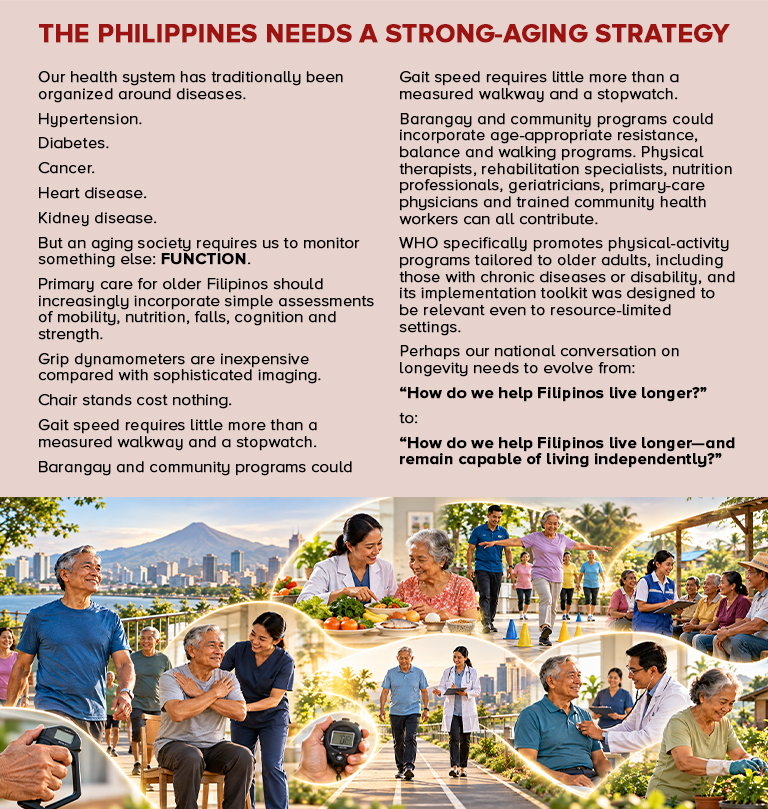
PHILIPPINE HEALTH POLICY
H&L PATIENT HANDOUT
ARE YOU AGING STRONG?

Once every few months, think about five everyday abilities:
CHAIR: Can I rise without increasing difficulty?
WALK: Am I walking as confidently and briskly as before?
STAIRS: Can I still manage stairs appropriate to my health?
LOAD: Can I carry ordinary household objects safely?
BALANCE: Have I fallen or nearly fallen recently?
A decline does not prove sarcopenia. But deterioration deserves attention—particularly after hospitalization or illness.
Don’t wait until weakness becomes disability before asking for help.









Leave a Reply