

By Henrylito D. Tacio
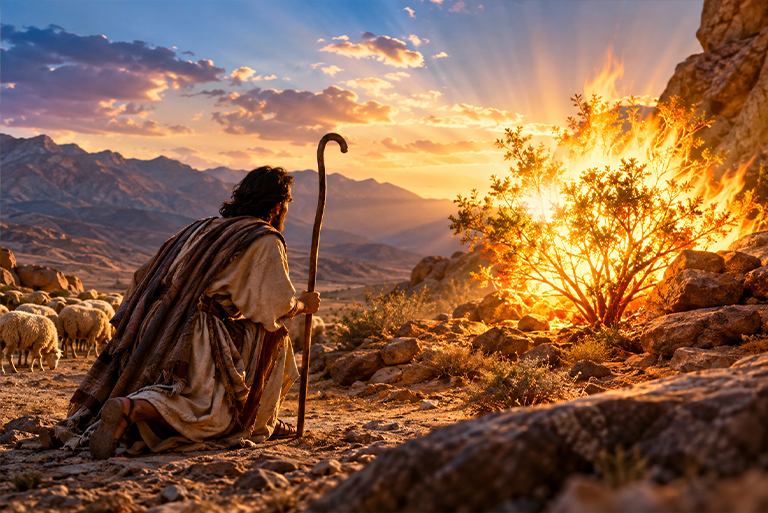
On a quiet afternoon in the foothills of Sinai, a shepherd stood alone with his thoughts. The desert wind brushed against his face as he watched over a flock that wasn’t even his. Moses had long left Egypt, choosing obscurity over conflict, silence over struggle.
Yet on that day, something happened that would alter the course of history. A burning bush that did not burn called his name. And from within the flame came a command that shook him to the core: “I am sending you to Pharaoh to liberate my people from Egypt.”
Moses froze. His first response was not courage but doubt. “Who am I?” he asked. He had no credentials, no army, no experience. He was, in every sense, an unlikely candidate for leadership. But God persisted: “Lead my people.”
And in that moment, Moses discovered what many leaders eventually learn — that leadership often begins where comfort ends.
Dr. John C. Maxwell, the world’s foremost authority on leadership, captures this truth succinctly: “A leader is one who knows the way, goes the way and shows the way.” Moses did not feel ready, but he obeyed. And in doing so, he became one of history’s most transformative leaders.
Leadership, however, is not born in burning bushes alone. It is shaped in the quiet places of character, discipline, integrity, and vision. It is developed, not delivered.
Leonard Ravenhill once told a story that illustrates this beautifully. A group of tourists visited a quaint village and spotted an old man sitting by a fence. One tourist, in a condescending tone, asked, “Were any great men born in this village?”
The old man replied dryly, “Nope, only babies.”
His answer, simple yet profound, reminds us that leaders are not born fully formed. They grow. They struggle. They learn. They are shaped by choices, experiences, and the willingness to rise when others sit.
Harry S. Truman, former American president, understood this well: “Men make history and not the other way around. In periods where there is no leadership, society stands still. Progress occurs when courageous, skillful leaders seize the opportunity to change things for the better.”
History is filled with such leaders — ordinary people who became extraordinary because they chose to step forward.
One of the most compelling examples is Alexander the Great. He conquered much of the known world, but his greatness was not merely in his victories. It was in the way he inspired loyalty.
After marching eleven days under the scorching sun, Alexander and his army were dying of thirst. Local farmers, seeing his condition, offered him a helmet filled with water — water meant for their children. “Your life is more important than theirs,” they said. “Even if they perish, we can raise a new generation.”
Alexander looked at the water, then at his soldiers, their lips cracked and trembling. He could not bring himself to drink. Instead, he returned the helmet untouched. “If only I would drink,” he said, “the rest of the soldiers would be out of heart.”
His men, moved by his sacrifice, rallied around him with renewed strength. “To follow such a leader is a great privilege,” they chorused.
What made Alexander great was not his power but his character.
Character: The Foundation of Leadership
Abraham Lincoln once said, “Nearly all men can withstand adversity. If you truly want to test a man’s character, give him power.” Power reveals. It exposes. It magnifies what is already within.
Character is what you do in the dark, D.L. Moody reminds us. Robert A. Cook adds, “There is no substitute for character. You can buy brains, but you cannot buy character.”
A leader without character is a danger. A leader with character is a blessing.
Integrity: The Anchor of Trust
Integrity is the alignment of words and actions. It is consistency when no one is watching and courage when everyone is.
Max DePree writes, “Integrity in all things precedes all else. The open demonstration of integrity is essential; followers must be wholeheartedly convinced of their leader’s integrity.”
Leaders live public lives. Perception becomes reality. Without integrity, trust collapses — and leadership crumbles.
Discipline: The Engine for Achievement
Dr. John Maxwell emphasizes, “No one achieves and sustains success without discipline.” Discipline is the quiet force behind every great leader. It is the ability to do what must be done even when one does not feel like doing i
Bertrand Russell observed, “Nothing of importance is ever achieved without discipline.” He believed that discipline should arise from one’s own desires and needs, not from external pressure. True leaders discipline themselves long before they discipline others.
Influence: The Heart of Leadership
Kenneth Blanchard said, “The key to successful leadership today is influence, not authority.” Maxwell echoes this: “Leadership is influence.”
A leader who relies solely on authority may achieve compliance, but never commitment. Influence, on the other hand, inspires people to follow willingly.
Motivation vs. Manipulation
Zig Ziglar draws a sharp line between the two. Motivation persuades people to act in their own best interest — to study, to grow, to take responsibility. Manipulation persuades people to act for someone else’s benefit — to buy inferior products or work without fair compensation.
A good leader motivates. A poor leader manipulates.
Vision: The Compass of Leadership
Vision is the ability to see beyond the present. It is the mental picture of a future worth pursuing. It guides decisions, shapes priorities, and fuels perseverance.
Rosabeth Moss Kanter writes, “A vision is not merely a depiction of potential; it is an invitation to our higher selves, a summons to evolve into something greater.”
Vision gives leaders direction. It gives followers hope.
Choosing Good Leaders Today
In a world filled with noise, ambition, and self-promotion, selecting good leaders has become both urgent and difficult. Titles can deceive. Charisma can mislead. Popularity can blind.
But character, integrity, discipline, influence, motivation, and vision — these never lie. A good leader may not be the loudest, the most visible, or the most charismatic. But he is the one who consistently chooses what is right over what is easy, what is true over what is convenient, and what is beneficial for others over what is advantageous for himself.
He is the one who, like Moses, steps forward even when afraid. He is the one who, like Alexander, sacrifices even when thirsty. He is the one who, like Lincoln, remains steady even when tested.
In the end, leadership is not about position but purpose. Not about power but service. Not about being followed but being worth following.
And perhaps the greatest question we must ask when choosing leaders is not, “Who is the most capable?” but “Who is the most trustworthy?”
For history has shown, time and again, that a leader with skill can move people — but a leader with character can move nations.








Leave a Reply