



In medicine, the foundational directive is primum non nocere—first, do no harm. In public health and economic development, this mandate must be extended to national industrial policy. As the Philippines contemplates hosting advanced semiconductor manufacturing under the Pax Silica banner, healthcare professionals, environmental scientists, and policy leaders must approach this industrial expansion with rigorous evidence-based scrutiny.
For more than four decades, the Philippines has maintained a strong presence in the global electronics value chain. However, local expertise has historically been concentrated in back-end Outsources Semiconductor Assembly and Test (OSAT) operations. OSAT facilities—primarily focused on cutting, encapsulating, and testing pre-fabricated silicon wafers—present a distinct occupational and environmental footprint compared to front-end wafer fabrication plants (commonly known as “fabs”). Front-end fabrication involves atomic-scale chemical photolithography, wet and dry etching, dopant diffusion, and chemical vapor deposition. These processes utilize some of the most potent carcinogens, neurotoxins, reproductive hazards, and greenhouse gases known to industrial science.
The Pax Silica initiative in New Clark City promises billions in foreign direct investment, thousands of high-tech jobs, and a leap up the global technological ladder. Yet, as clinicians, we must ask: At what cost to human biology and community health? Historical precedent from Silicon Valley (USA), East Kilbride (Scotland), Hsinchu (Taiwan), and Suwon (South Korea) demonstrates that rapid semiconductor expansion without stringent occupational protections and closed-loop waste containment creates legacy public health liabilities. Epidemiologic cohorts of microchip manufacturing workers have consistently revealed elevated rates of spontaneous abortion, congenital malformations, non-Hodgkin lymphoma, leukemia, and breast cancer.
Furthermore, the environmental demands of advanced fabs are staggering. Projections for the proposed Pax Silica complex indicate an annual water requirement of approximately 39 billion liters and a power demand of up to 3 gigawatts. In Central Luzon—a region frequently subjected to seasonal droughts, climate variability, and agricultural water stress—drawing such volume without fully enforced Zero Liquid Discharge (ZLD) technologies risks severely depleting local aquifers, lowering water tables for surrounding agricultural communities, and introducing toxic runoff into vital freshwater systems.
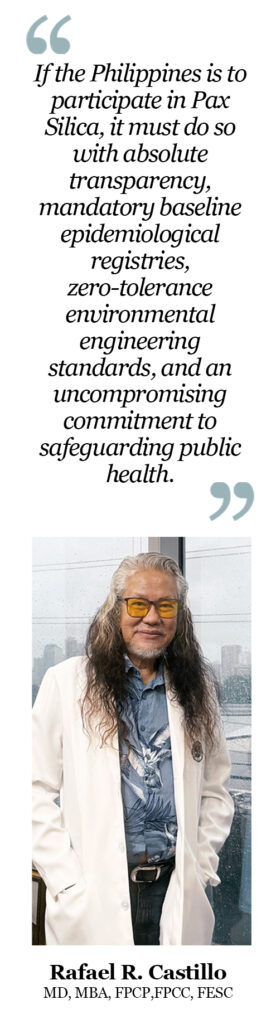
Economic modernization must not come at the expense of our health infrastructure, agricultural security, or worker safety. The Philippines possesses robust environmental laws on paper—such as the Toxic Substances and Hazardous and Nuclear Wastes Control Act (RA 6969) and the Occupational Safety and Health Standards Law (RA 11058)—yet institutional enforcement and specialized toxicological monitoring remain under-resourced. If the Philippines is to participate in Pax Silica, it must do so with absolute transparency, mandatory baseline epidemiological registries, zero-tolerance environmental engineering standards, and an uncompromising commitment to safeguarding public health.










Leave a Reply