

THE HAND SHE HELD
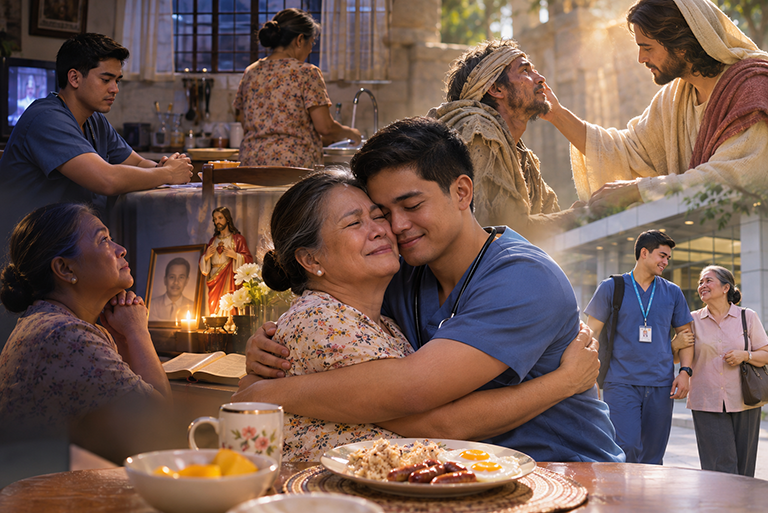
Some of the hardest words a parent will ever hear are spoken quietly at a kitchen table late at night. This Sabbath story, on the eve of the Feast of Christ the King, is about a mother, a son’s difficult confession, and the moment she had to choose between the fear she felt and the love she believed in — and discovered, in an old Gospel story, what a King’s hand is for.
“The Lord did not heal the leper first and touch him afterward. He touched him first.”
By Raffy Castillo
Paolo came home on a Friday night, which was unusual. He was twenty-five, a nurse at a hospital in the city, and he usually visited only on Sundays, after Mass, for lunch.
Aling Rosario was watching the late news when she heard the gate. She was surprised and pleased. She warmed some leftover sinigang and set a plate in front of him.
He didn’t eat.
“Ma,” he said. “May kailangan po akong sabihin.”
The Words at the Kitchen Table
He told her slowly, looking at the table. He had been feeling tired for months. A routine test at work. A second test to confirm. Then a counselor, a doctor, a treatment hub. He had started his medicines two weeks ago.
“HIV po, Ma.”
The word landed in the small kitchen like a dropped plate.
He said more after that — that the doctor said he would be fine, that the medicines work, that people live long lives now, that he could keep working, that the virus would soon be undetectable. He had clearly practiced what to say.
Rosario heard almost none of it.
She was thinking of the news reports. Of the whispers she’d heard over the years in the parish, in the market, among her friends. Of what people would say. Of what her late husband would have said.
She did something she would regret for a long time afterward. She stood up, took his untouched plate to the sink, and began to wash it, with her back to him.
The Silence
Neither of them spoke for a long time. The faucet ran. The television murmured in the other room.
Behind her, she heard him stand up. “Sorry po, Ma,” he said quietly. “Uuwi na lang po ako.”
She heard the gate close.
She stood at the sink until the water ran cold.
The Night She Couldn’t Sleep
She didn’t sleep that night. She lay in the dark, turning everything over. Anger came first, then fear, then a heavy, aching sadness.
Around three in the morning, she got up and sat at the small altar in the corner of the sala, where she kept her husband’s photo, a statue of the Sacred Heart and her old missal with its ribbons faded to gray.
She opened it without thinking. It fell open to a page she must have marked years ago, from the Gospel of Mark:
“And there came a leper to him, beseeching him, and kneeling down to him, and saying unto him, If thou wilt, thou canst make me clean. And Jesus, moved with compassion, put forth his hand, and touched him.”
What the Lord Did First
She read it three times.
She had always thought of that story as a miracle story — a man healed. But in the stillness of three in the morning, a detail stood out that she had never noticed.
In those days, no one touched a leper. They were sent away, made to live outside the village, made to cry “Unclean!” so people would keep their distance. They were untouchable in the most literal sense.
And the Lord touched him.
Not after he was healed. Before.
The touch came first.
She thought of her son at the kitchen table, his eyes on his plate, his voice careful and rehearsed — as if he were the one who had to make it easy for her. She thought of the back she had turned to him.
She closed the missal and wept.
Saturday Morning
At six, she called him. He answered on the first ring; he hadn’t slept either.
“Anak,” she said. “Pumunta ka rito. Ipagluluto kita ng almusal.”
Come home. I’ll cook you breakfast.
He arrived an hour later. She had made garlic rice, longganisa and fried eggs, the breakfast he had loved since he was a boy. When he came through the door, she didn’t say anything at first.
She just reached out and took his hand. She held it for a long time.
“Sorry, anak,” she said finally. “Hindi ako galit sa ‘yo. Natakot lang ako.”
I’m not angry with you. I was just afraid.
“Ako rin po, Ma,” he said. “Natakot din po ako.”
Me too, Ma. I was afraid too.
The Questions She Asked
Over breakfast, she asked questions. Some of them came out clumsy, and some of them came from things she had heard that weren’t true. Paolo answered every one patiently, the way he answered his patients.
No, she couldn’t get it from sharing a plate or a glass. No, it wasn’t a death sentence. Yes, the medicines were free at the treatment hub. Yes, he would be able to keep working. Yes, if he took his medicines every day, the virus would become undetectable, and he could live a long life.
“Ilang taon po kayo ngayon, Ma? Sixty-three?” he teased gently. “Baka mas mahaba pa ang buhay ko sa inyo.”
She swatted his arm, laughing through tears. “Huwag kang bastos.”
The Next Appointment
Before he left, she asked when his next appointment at the treatment hub was.
“Sa Tuesday po.”
“Sasamahan kita,” she said.
I’ll go with you.
He started to say she didn’t need to. Then he stopped and nodded.
What She Wrote Before Sunset
That evening, Rosario sat at the altar again, with her missal and a pen. On the blank page at the back, she wrote:
“Last night I turned my back on my son. This morning I held his hand. Lord, thank You for teaching me the difference.”
And beneath it: “The Lord touched the leper before He healed him. Maybe love always has to come first.”
SABBATH REFLECTION
Tomorrow the Church celebrates the Feast of Christ the King. It’s a strange kind of kingship we honor — a King who wore a crown of thorns, who reigned from a cross, and who spent His ministry touching the people everyone else avoided.
Every age has its “lepers”: people pushed to the edges because of an illness, a mistake, a difference, or simply because others are afraid. In our time, they may include people living with HIV, people with mental illness, people struggling with addiction, or family members whose choices we don’t understand.
The Gospel doesn’t ask us to pretend fear isn’t real. Rosario’s fear was real. But it calls us to do what Jesus did: to reach out before we have all the answers, to touch before we judge, and to let love come first.
This Sabbath, ask yourself: Is there someone I have kept at arm’s length out of fear or shame? Is there a hand I need to hold?
CLOSING PRAYER
Lord Jesus, King of mercy,
You reached out and touched those whom others would not touch.
You looked past fear and shame and saw a beloved child of God.
Forgive me for the times I have turned my back on those who needed my love.
Give me courage when I am afraid,
gentleness when I don’t understand,
and a heart that reaches out before it judges.
Bless all who live with illness and stigma.
Comfort the families who are learning to walk with them.
And let Your reign of love begin in my home, at my table, in my hands.
In Your holy name,
Amen.







Leave a Reply