

Why Millions of Filipinos Are Living with Metabolic Syndrome Without Knowing It
By Rafael R. Castillo, MD
You may not feel sick.
Your blood pressure is only “slightly elevated.” Your waistline has grown just a little. Your blood sugar is “borderline.” Your cholesterol is “not too bad.”
Individually, each seems insignificant.
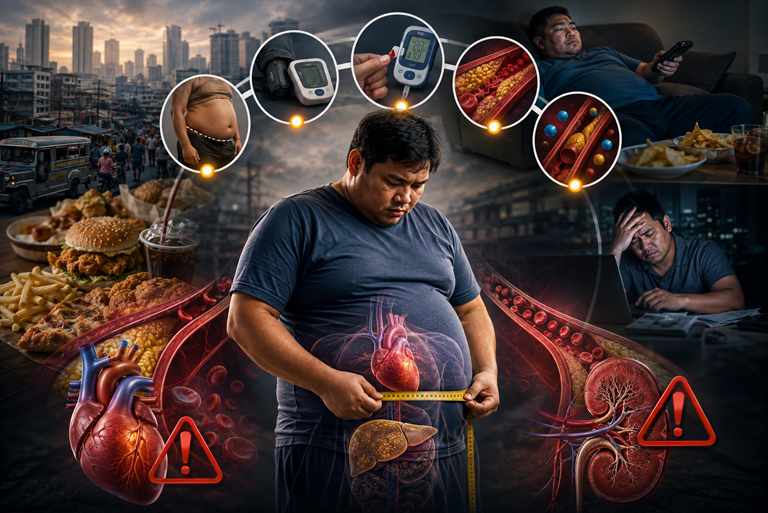
Together, they create one of the most dangerous medical conditions of our time—metabolic syndrome.
Today, nearly one in every three adults worldwide may have this silent disorder. In the Philippines, rapid urbanization, processed diets, physical inactivity, poor sleep, chronic stress, and rising obesity are creating the perfect storm.
The tragedy is that metabolic syndrome is largely preventable—and, in many cases, reversible.
THE SILENT EPIDEMIC WE RARELY TALK ABOUT
Filipinos are becoming healthier in many ways. Life expectancy has increased. Modern medicines have become more available. Diagnostic tests are more sophisticated than ever.
Yet hospital wards continue to fill with patients suffering heart attacks, strokes, kidney failure, diabetes, and heart failure.
These diseases often appear unrelated.
In reality, many arise from the same underlying metabolic dysfunction.
That dysfunction is called metabolic syndrome.
Rather than being a single disease, metabolic syndrome is a constellation of abnormalities that dramatically increase cardiovascular risk.
Think of it as five warning lights on a car dashboard.
One warning light may not stop the engine.
Five flashing simultaneously signal impending disaster.
WHAT EXACTLY IS METABOLIC SYNDROME?
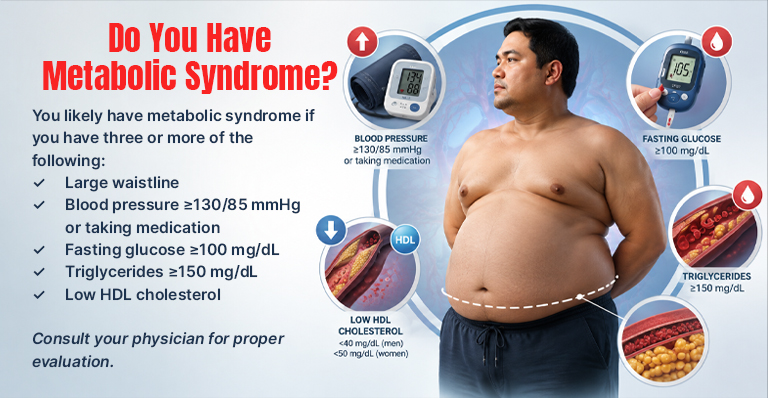
Most international guidelines diagnose metabolic syndrome when at least three of five abnormalities are present:
• Increased waist circumference (central obesity)
• Elevated blood pressure
• Elevated fasting blood glucose
• High triglycerides
• Low HDL (“good”) cholesterol
Although each abnormality can exist independently, together they multiply cardiovascular risk far beyond the sum of their individual effects.
WHY THE WAISTLINE MATTERS
Many Filipinos judge obesity by body weight alone.
That is misleading.
The real danger often lies around the abdomen.
Visceral fat—the fat surrounding internal organs—is metabolically active.
It produces inflammatory chemicals, disrupts hormonal signaling, promotes insulin resistance, and accelerates atherosclerosis.
An individual may appear only mildly overweight while harboring dangerous amounts of visceral fat.
Asian populations, including Filipinos, develop these complications at lower body mass indices than Western populations.
This is why waist circumference has become one of the most useful clinical measurements.
INSULIN RESISTANCE: THE HIDDEN DRIVER
Insulin acts like a key that allows glucose to enter cells.
Over years of excessive calories, inactivity, sleep deprivation, and chronic stress, cells become less responsive.
The pancreas compensates by producing more insulin.
Eventually, this compensation fails.
Blood sugar rises.
Fat accumulates in the liver.
Blood pressure increases.
Triglycerides rise.
HDL falls.
The metabolic syndrome emerges.
WHY FILIPINOS ARE ESPECIALLY VULNERABLE
The Philippine lifestyle has changed dramatically within one generation.
Traditional meals rich in vegetables, fish, legumes, and fresh fruits have increasingly been replaced by ultra-processed foods.
Sugar-sweetened beverages have become commonplace.
Many office workers spend most of the day sitting.
Physical activity declines while calorie intake rises.
Sleep has become shorter.
Stress has become chronic.
The result is a nationwide metabolic imbalance.
Even young adults are developing hypertension, diabetes, and fatty liver disease.
THE DANGERS EXTEND FAR BEYOND DIABETES
Many people believe metabolic syndrome simply leads to diabetes.
Unfortunately, the consequences are much broader.
It significantly increases the risk of:
• Heart attack
• Stroke
• Heart failure
• Chronic kidney disease
• Fatty liver disease
• Obstructive sleep apnea
• Dementia
• Certain cancers
Increasing evidence also links chronic metabolic dysfunction with accelerated biological aging.
“Metabolic syndrome is not one disease. It is the common soil from which many modern diseases grow.”
THE ROLE OF SLEEP
Sleep is one of the most underappreciated components of metabolic health.
Sleeping fewer than six hours per night increases insulin resistance, raises blood pressure, stimulates appetite hormones, and promotes weight gain.
Obstructive sleep apnea further worsens metabolic dysfunction by causing repeated oxygen deprivation during sleep.
Improving sleep quality should become part of routine metabolic care.
EXERCISE IS MEDICINE
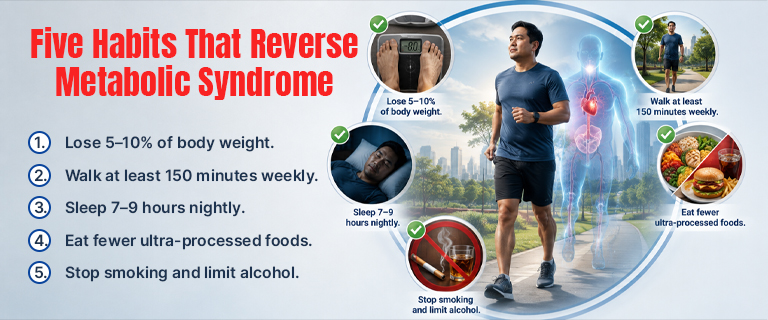
Regular physical activity improves nearly every component of metabolic syndrome.
Exercise:
• improves insulin sensitivity
• lowers blood pressure
• raises HDL cholesterol
• lowers triglycerides
• reduces visceral fat
• improves mood
• enhances sleep
Remarkably, many metabolic improvements occur even before substantial weight loss is achieved.
FOOD IS POWERFUL MEDICINE
There is no miracle diet.
Most experts agree on several principles:
Eat mostly vegetables.
Choose fruits instead of sugary desserts.
Favor whole grains over refined carbohydrates.
Limit sugar-sweetened beverages.
Reduce processed foods.
Include fish, legumes, nuts, and healthy fats.
Watch portion sizes.
Healthy eating patterns—including Mediterranean-style and DASH diets—have consistently demonstrated cardiovascular benefits.
DO MEDICATIONS HELP?
Lifestyle modification remains the cornerstone of treatment.
However, medications are often necessary to control individual risk factors.
These may include:
• antihypertensive drugs
• statins
• diabetes medications
• GLP-1 receptor agonists
• SGLT2 inhibitors
These therapies reduce cardiovascular events but work best when combined with healthy lifestyle changes.
No medication can fully compensate for an unhealthy lifestyle.
PREVENTION SHOULD START IN CHILDHOOD
One alarming trend is the increasing prevalence of childhood obesity.
Children consuming excessive sugary drinks, spending long hours on electronic devices, and engaging in little physical activity may develop metabolic abnormalities years before symptoms appear.
Schools and families therefore play a crucial preventive role.
Healthy habits established early often persist throughout adulthood.
WHAT THE PHILIPPINES CAN DO
Addressing metabolic syndrome requires more than individual responsibility.
Communities, schools, employers, healthcare systems, and government agencies must work together.
Possible national priorities include:
• healthier school meals
• walkable communities
• expanded preventive screening
• nutrition education
• regulation of sugary beverages
• workplace wellness programs
• stronger primary care
The economic benefits would be enormous.
Preventing disease is far less expensive than treating dialysis patients, heart attacks, strokes, and amputations.
CONCLUSION
Metabolic syndrome develops silently.
It rarely causes pain.
It gives few warning signs.
Yet beneath the surface, blood vessels become inflamed, arteries stiffen, organs accumulate fat, and future disease quietly takes root.
Fortunately, this story need not end in tragedy.
Small improvements—healthier meals, regular exercise, better sleep, stress management, and timely medical care—can dramatically reduce risk.
The sooner we recognize metabolic syndrome, the greater our opportunity to reverse its course.
References
- American Heart Association. Life’s Essential 8. 2024.
- International Diabetes Federation. Worldwide Definition of Metabolic Syndrome.
- World Health Organization. Obesity and Overweight. 2024.
- European Society of Cardiology. Cardiovascular Prevention Guidelines. 2021 (current updates where applicable).
- American Association of Clinical Endocrinology. Clinical Practice Guideline for Obesity. 2022.
- Philippine Heart Association. Hypertension Clinical Practice Guidelines.
- Philippine Society of Endocrinology, Diabetes and Metabolism. Diabetes Clinical Practice Guidelines.
- Department of Health Philippines. National Objectives for Health.
- Grundy SM. Metabolic Syndrome Update. Circulation.
- Eckel RH, et al. The Metabolic Syndrome. Lancet.
- GBD Risk Factors Collaborators. Global Burden of Disease Study.
- WHO Western Pacific Region. Noncommunicable Diseases in Asia.
- Asian Pacific Society of Cardiology consensus statements on cardiometabolic risk.










Leave a Reply